KI-Beratung Beta

Gutscheinbedingungen

**Gültig am 20.11.2026 ab einem Mindestbestellwert von 30€ auf Spielzeug, Schreibwaren, Filme, Geschenke & Trends, Musik, tolino eReader & Zubehör, Hörbücher und Hörbuch-Downloads, nicht preisgebundene Bücher und Kalender online auf thalia.at und in der Thalia App. Einzelne Artikel können ausgeschlossen sein. Aufgrund der Buchpreisbindung sind deutschsprachige Bücher und eBooks ausgenommen. Zusätzlich ausgenommen sind Abos & Flatrates, Games, Geschenkkarten/-boxen, Shelfies, Software, Zeitschriften sowie einzelne Artikel von tonies®. Pro Einkauf einmal einlösbar. Click & Collect nur bei Onlinevorabzahlung möglich. Keine Barauszahlung. Nicht kombinierbar mit anderen Aktionen und Gutscheinen. Gutschein wird auf max. 500€ Bestellwert angerechnet. Nicht gültig für Versandkosten und Services. Preisgebundene Artikel sind vom Mindestbestellwert ausgeschlossen.

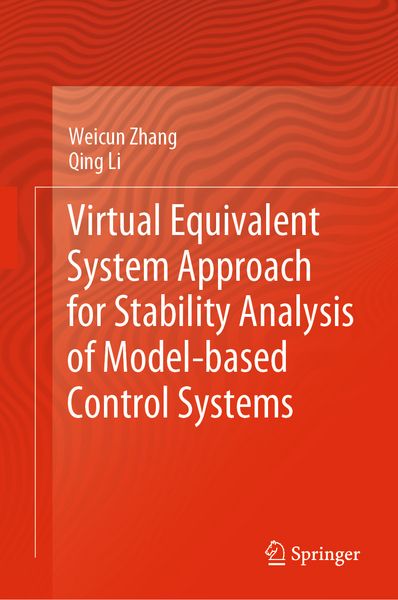
  • Produktbild: Virtual Equivalent System Approach for Stability Analysis of Model-based Control Systems
  • Produktbild: Virtual Equivalent System Approach for Stability Analysis of Model-based Control Systems
- 11%

Virtual Equivalent System Approach for Stability Analysis of Model-based Control Systems

11% sparen

96,99 € UVP 109,99 €

inkl. gesetzl. MwSt., Versandkostenfrei


Beschreibung

This book puts forward the concept of a virtual equivalent system (VES) based on theoretical analysis and simulation results. The new concept will facilitate the development of a unified framework for analyzing the stability and convergence of self-tuning control (STC) systems, and potentially, of all...

Beschreibung

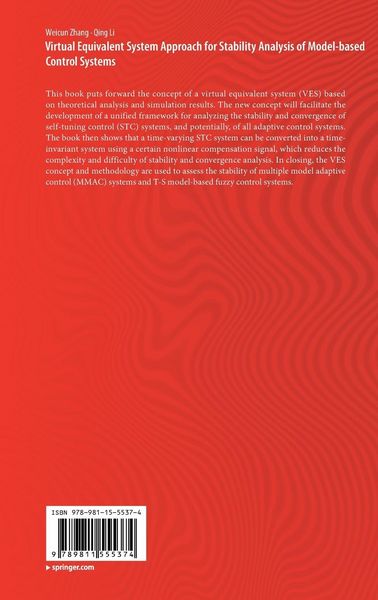
This book puts forward the concept of a virtual equivalent system (VES) based on theoretical analysis and simulation results. The new concept will facilitate the development of a unified framework for analyzing the stability and convergence of self-tuning control (STC) systems, and potentially, of all adaptive control systems. The book then shows that a time-varying STC system can be converted into a time-invariant system using a certain nonlinear compensation signal, which reduces the complexity and difficulty of stability and convergence analysis. In closing, the VES concept and methodology are used to assess the stability of multiple model adaptive control (MMAC) systems and T-S model-based fuzzy control systems.

Produktdetails

Einband

Gebundene Ausgabe

Erscheinungsdatum

06.06.2020

Abbildungen

XIII, 168 p. 100 illus., 15 illus. in color.

Verlag Springer Singapore

Produktdetails

Einband

Gebundene Ausgabe

Erscheinungsdatum

06.06.2020

Abbildungen

XIII, 168 p. 100 illus., 15 illus. in color.

Verlag Springer Singapore
Seitenzahl

168

Maße (L/B/H)

24,1/16/1,6 cm

Gewicht

395 g

Auflage

20001 Auflage 1st edition 2021

Sprache

Englisch

ISBN

978-981-15-5537-4

Herstelleradresse

Springer-Verlag GmbH
Europaplatz 3
69115 Heidelberg
DE

Email: ProductSafety@springernature.com

Noch keine Bewertungen vorhanden

Verfassen Sie die erste Bewertung zu diesem Artikel

Helfen Sie anderen Kundinnen und Kunden durch Ihre Meinung.

Kundinnen und Kunden meinen

Bewertungen (0)

  • Produktbild: Virtual Equivalent System Approach for Stability Analysis of Model-based Control Systems
  • Produktbild: Virtual Equivalent System Approach for Stability Analysis of Model-based Control Systems
  • Motivation and Contents of the Monograph.-Stability and Convergence Analysis of Self-Tuning Control Systems.- Further Results On Stability and Convergence of Self-Tuning Control Systems.- Stable Weighted Multiple Model Adaptive Control: Continuous-Time Plant.- Stable Weighted Multiple Model Adaptive Control: Discrete-Time Stochastic Plant.- Further Results on Stable Weighted Multiple Model Adaptive Control: Discrete-Time Stochastic Plant.- Stability of Continuous-Time T-S Model Based Fuzzy Control Systems.- Appendix A Lemma and proofs for Chapter 2.- Appendix B Lemma and Proofs for Chapter 4.- Appendix C Lemma and proofs for Chapter 6.- Appendix D Lemma and proofs for Chapter 7.