Gutscheinbedingungen

**Gültig bis 06.07.2026 auf fremdsprachige Bücher online auf thalia.at, in der Thalia App ab einem Mindestbestellwert von 30€ und in allen Thalia Buchhandlungen in Österreich. In den Buchhandlungen nur gültig auf lagernde Ware. Einzelne Artikel können ausgeschlossen sein. Ausgenommen sind preisgebundene Artikel & eBooks. Pro Einkauf einmal einlösbar. Nur gültig gegen Vorlage oder im Onlineshop hinterlegter Bonuscard. Infos zur Einlösung in der Buchhandlung sind auf der Bonuscard-Vorteilspreisseite zu finden. Click & Collect nur bei Onlinevorabzahlung möglich. Keine Einlösung bei Scan & Go-Bezahlung. Keine Barauszahlung. Nicht kombinierbar mit anderen Aktionen und Gutscheinen. Gutschein wird auf max. 500€ Bestellwert angerechnet. Nicht gültig für Versandkosten und Services.

  • Produktbild: Sustainable Human Resource Management
  • Produktbild: Sustainable Human Resource Management
- 20%

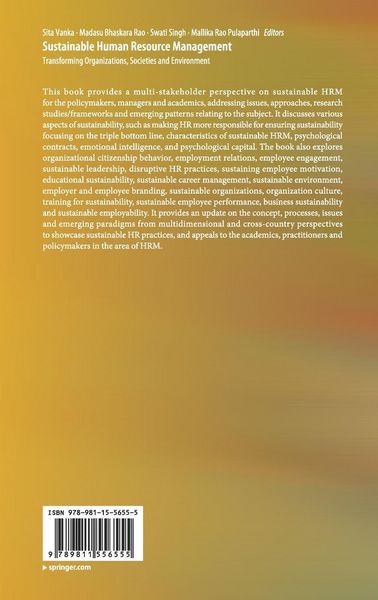
Sustainable Human Resource Management Transforming Organizations, Societies and Environment

20% sparen

175,99 € UVP 219,99 €

inkl. gesetzl. MwSt., Versandkostenfrei


Beschreibung

Produktdetails

Einband

Gebundene Ausgabe

Erscheinungsdatum

14.08.2020

Herausgeber

Sita Vanka + weitere

Verlag

Springer

Seitenzahl

313

Maße (L/B/H)

24,1/16/2,4 cm

Gewicht

658 g

Auflage

1st ed. 2020

Sprache

Englisch

ISBN

978-981-15-5655-5

Beschreibung

Portrait

Dr. Sita Vanka is currently a Professor and former Dean of the School of Management Studies, University of Hyderabad, India. She is a teacher, trainer, researcher and consultant in the area of HRM, Women's studies and entrepreneurship. She serves on the board of two listed companies in Hyderabad. She has guided doctoral research, organized various workshops/conferences and published books /papers in HRM and Sustainable HRM She has received several awards for her research work.  Further, she is a reviewer and has co-edited a special issue of HRMR on Sustainable HRM and a special Issue of IJARHE.

Dr. Bhaskara Rao is currently an Associate Professor at the Department of HRM & OB at ICFAI Business School, part of the ICFAI Foundation for Higher Education, Hyderabad, India. He is the Coordinator of the ICFAI Staff College and SWAYAM Program at the University. Prior to this, he held leadership positions at K.L. University, the ICFAI National College and the corporate world He has authored books and has published in national/ international journals. He has organized several MDPs for Senior executives. Further, he is a Senior Editor of the International Journal of Applied Research in Higher Education, and has co-edited special issue of HRMR on sustainable HRM and a special issue of IJARHE.   

Swati Singh is currently a Senior Research Fellow at the School of Management Studies, University of Hyderabad, India, and is pursuing her Ph.D. on Sustainable Careers for Women Professionals in the IT Sector. She holds a B.A. and an M.B.A. and is a recipient of a JRF from the UGC.  She has reviewed and published papers in reputed journals and won 2 best paper awards.  She is actively engaged in sustainability and sustainable development issues as a partner and volunteer in the Beyond Organic program by Deccan Development Society, Hyderabad.

Mallika Rao is currently pursuing her Ph.D. in HRM from the K.L. University, Vijayawada. She holds an M.B.A. from the same university and a Diploma in Training and Development from the ISTD, Delhi. She has published papers in reputed journals, has authored books and is co-editing a special issue for both the IJARHE and Employee Relations. Her research focuses on Human Resource Management and healthcare management.     


Produktdetails

Einband

Gebundene Ausgabe

Erscheinungsdatum

14.08.2020

Herausgeber

Verlag

Springer

Seitenzahl

313

Maße (L/B/H)

24,1/16/2,4 cm

Gewicht

658 g

Auflage

1st ed. 2020

Sprache

Englisch

ISBN

978-981-15-5655-5

Herstelleradresse

Springer-Verlag KG
Sachsenplatz 4-6
1201 Wien
AT

Email: GPSR Kontakt

Noch keine Bewertungen vorhanden

Verfassen Sie die erste Bewertung zu diesem Artikel

Helfen Sie anderen Kundinnen und Kunden durch Ihre Meinung.

Kundinnen und Kunden meinen

Bewertungen (0)

  • Produktbild: Sustainable Human Resource Management
  • Produktbild: Sustainable Human Resource Management
  • Chapter 1. Sustainable Human Resource Management: Making human resources more responsible.- Chapter 2. Characteristics of Sustainable HRM System and Practices for Implementing Corporate Sustainability.-  Chapter 3. Sustainable HRM for sustainable careers of women professionals- A Conceptual Framework.- Chapter 4. Employee Engagement - A Driving Force for Sustaining Employees.- Chapter 5. Culture, Climate and Sustainability In Organizations.- Chapter 6. Incorporating psychological contract into the sustainable HRM model.- Chapter 7. Emotional Intelligence and Its Importance in Sustainable Development of Human Resources: A Conceptual Model.- Chapter 8. Seasonal Employees' Perceived Sustainability of Destination on Work Motivation in the tourism industry in North East India.- Chapter 9. Examining the role of HR practice and Employee Engagement on Employee's loyalty - The issue of sustainability in Textile industry of Bangladesh.-  Chapter  10. Impact Of Sustainable Leadership On Organizational Transformation - A Qualitative Study.- Chapter  11. Sustainable Human Resource Management in The Hospitality Industry: Evidence From Rajasthan, India.- Chapter 12. Effectiveness of an Emotional Intelligence Course in Enhancing and Sustaining the Emotional Competencies of MBA Students.- Chapter 13. Employer Branding and Employee Bonding - The CSR Way to Sustainable HRM.- Chapter 14. The Green Road to Environmental Performance - A study of Private Banking Sector in Colombo District, Sri Lanka.- Chapter 15. Sustainable HRM Practices - A Drive towards Sustainability-The Case of NLCIL.-  Chapter 16. Organizational Culture dimensions as drivers of Employee Engagement for Business Sustainability: towards a Conceptual Framework.- Chapter 17. Factorsresponsible for the impact of Post-Partum Depression on the productivity of female employees.- Chapter 18. Development of a Model of Sustainable Leadership Practices and Competencies: A Grounded Theory Approach.