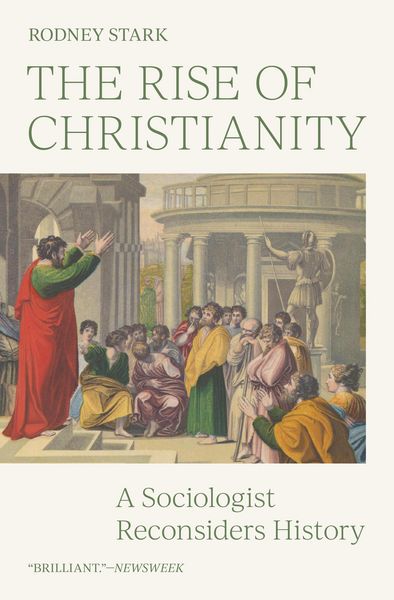
The Rise of Christianity A Sociologist Reconsiders History
-
- Hardcover
- Taschenbuch
- eBook ausgewählt
-
Form:Einzelkauf Download
-
Sprache:Englisch
23,09 €
inkl. gesetzl. MwSt.Beschreibung
Produktdetails
Format
ePUB
Kopierschutz
Nein
Family Sharing
Nein
Text-to-Speech
Ja
Erscheinungsdatum
16.06.2020
Verlag
Bonnier Books UKSeitenzahl
256 (Printausgabe)
Sprache
Englisch
EAN
9780691214290
A landmark reinterpretation of why Christianity became the dominant faith of the West
The idea that Christianity started as a clandestine movement among the poor is a widely accepted notion. Yet it is one of many myths that must be discarded if we are to understand just how a tiny messianic movement on the edge of the Roman Empire became the dominant faith of Western civilization. In a fast-paced, highly readable book that addresses beliefs as well as historical facts, Rodney Stark brings a sociologist's perspective to bear on the puzzle behind the success of early Christianity. He comes equipped not only with the logic and methods of social science but also with insights gathered firsthand into why people convert and how new religious groups recruit members. He digs deep into the historical evidence on many issues-such as the social background of converts, the mission to the Jews, the status of women in the church, the role of martyrdom-to provide a vivid and unconventional account of early Christianity.
The author plots the most plausible curve of Christian growth from the year 40 to 300. By the time of Constantine, Christianity had become a considerable force, with growth patterns very similar to those of modern-day successful religious movements. An unusual number of Christian converts, for example, came from the educated, cosmopolitan classes. Because it offered a new perspective on familiar concepts and was not linked to ethnicity, Christianity had a large following among persons seeking to assimilate into the dominant culture, mainly Hellenized Jews. The oversupply of women in Christian communities-due partly to the respect and protection they received-led to intermarriages with pagans, hence more conversions, and to a high fertility rate. Stark points out, too, the role played by selflessness and faith. Amidst the epidemics, fires, and other disasters that beleaguered Greco-Roman cities, Christian communities were a stronghold of mutual aid, which resulted in a survival rate far greater than that of the pagans. In the meantime, voluntary martyrdom, especially a generation after the death of Christ, reinforced the commitment of the Christian rank and file. What Stark ultimately offers is a multifaceted portrait of early Christianity, one that appeals to practical reasoning, historical curiosity, and personal reflection.
Noch keine Bewertungen vorhanden
Verfassen Sie die erste Bewertung zu diesem Artikel
Helfen Sie anderen Kundinnen und Kunden durch Ihre Meinung.
Kurze Frage zu unserer Seite
Vielen Dank für Ihr Feedback
Wir nutzen Ihr Feedback, um unsere Produktseiten zu verbessern. Bitte haben Sie Verständnis, dass wir Ihnen keine Rückmeldung geben können. Falls Sie Kontakt mit uns aufnehmen möchten, können Sie sich aber gerne an unseren Kund*innenservice wenden.
zum Kundenservice