
The Psychology of Fake News Accepting, Sharing, and Correcting Misinformation
-
- Hardcover
- Taschenbuch ausgewählt
- eBook
-
Sprache:Englisch
48,99 €
inkl. gesetzl. MwSt.,
Beschreibung
Produktdetails
Einband
Taschenbuch
Erscheinungsdatum
14.08.2020
Abbildungen
16 Tabellen
Herausgeber
Greifeneder Rainer + weitereVerlag
Taylor & FrancisSeitenzahl
254
Maße (L/B/H)
23,4/15,6/1,4 cm
Gewicht
392 g
Sprache
Englisch
ISBN
978-0-367-27183-1
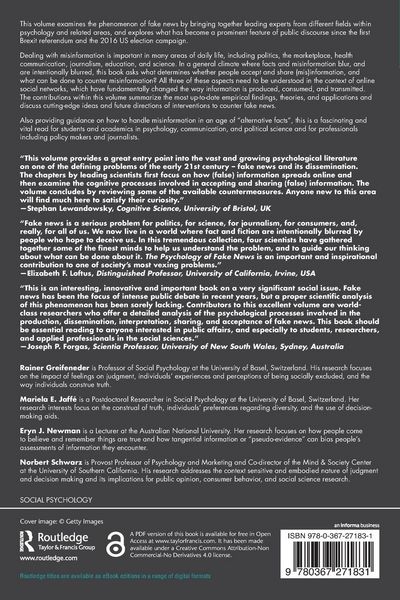
This volume examines the phenomenon of fake news by bringing together leading experts from different fields within psychology and related areas, and explores what has become a prominent feature of public discourse since the first Brexit referendum and the 2016 US election campaign.
Dealing with misinformation is important in many areas of daily life, including politics, the marketplace, health communication, journalism, education, and science. In a general climate where facts and misinformation blur, and are intentionally blurred, this book asks what determines whether people accept and share (mis)information, and what can be done to counter misinformation? All three of these aspects need to be understood in the context of online social networks, which have fundamentally changed the way information is produced, consumed, and transmitted. The contributions within this volume summarize the most up-to-date empirical findings, theories, and applications and discuss cutting-edge ideas and future directions of interventions to counter fake news.
Also providing guidance on how to handle misinformation in an age of "alternative facts", this is a fascinating and vital reading for students and academics in psychology, communication, and political science and for professionals including policy makers and journalists.
Noch keine Bewertungen vorhanden
Verfassen Sie die erste Bewertung zu diesem Artikel
Helfen Sie anderen Kundinnen und Kunden durch Ihre Meinung.
Kurze Frage zu unserer Seite
Vielen Dank für Ihr Feedback
Wir nutzen Ihr Feedback, um unsere Produktseiten zu verbessern. Bitte haben Sie Verständnis, dass wir Ihnen keine Rückmeldung geben können. Falls Sie Kontakt mit uns aufnehmen möchten, können Sie sich aber gerne an unseren Kund*innenservice wenden.
zum Kundenservice