Gutscheinbedingungen

**Gültig bis 06.07.2026 auf fremdsprachige Bücher online auf thalia.at, in der Thalia App ab einem Mindestbestellwert von 30€ und in allen Thalia Buchhandlungen in Österreich. In den Buchhandlungen nur gültig auf lagernde Ware. Einzelne Artikel können ausgeschlossen sein. Ausgenommen sind preisgebundene Artikel & eBooks. Pro Einkauf einmal einlösbar. Nur gültig gegen Vorlage oder im Onlineshop hinterlegter Bonuscard. Infos zur Einlösung in der Buchhandlung sind auf der Bonuscard-Vorteilspreisseite zu finden. Click & Collect nur bei Onlinevorabzahlung möglich. Keine Einlösung bei Scan & Go-Bezahlung. Keine Barauszahlung. Nicht kombinierbar mit anderen Aktionen und Gutscheinen. Gutschein wird auf max. 500€ Bestellwert angerechnet. Nicht gültig für Versandkosten und Services.

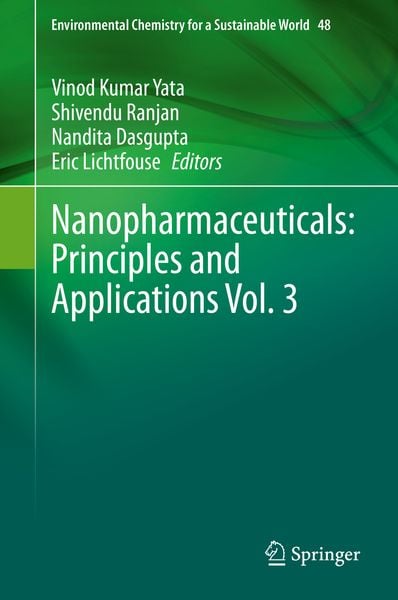
Produktbild: Nanopharmaceuticals: Principles and Applications Vol. 3
Band 48

Nanopharmaceuticals: Principles and Applications Vol. 3

149,99 €

inkl. gesetzl. MwSt., Versandkostenfrei


Beschreibung

Produktdetails

Einband

Gebundene Ausgabe

Erscheinungsdatum

20.08.2020

Herausgeber

Vinod Kumar Yata + weitere

Verlag

Springer

Seitenzahl

340

Maße (L/B/H)

24,1/16/2,4 cm

Gewicht

743 g

Auflage

1st ed. 2020

Sprache

Englisch

ISBN

978-3-030-47119-4

Beschreibung

Portrait

Dr. Vinod Kumar Yata is an interdisciplinary researcher working at National Dairy Research Institute, Karnal, India. He worked as an Assistant professor at the Department of Biotechnology, Dr. B R Ambedkar National Institute of Technology Jalandhar, Punjab, India. He received his Ph.D. in Bio technology from Indian Institute of Technology Guwahati. He specializes in interdisciplinary research which includes Nanotechnology, Microfluidics, Biotechnology, Cancer biology and Bioinformatics. He has developed a microfluidic device for the separation of live and motile spermatozoa from cattle semen samples. He opened up a new avenue to prodrug enzyme therapy by introducing the nanocarriers for the delivery of non-mammalian prodrug activating enzymes. He elucidated the structural features and binding interactions of several bio molecules by in silico methods. He published several research papers in peer reviewed international journals and presented papers in several international conferences.

Dr. Shivendu Ranjan is scientist at the Chaperon Biotech, SIDBI Centre, Indian Institute of Technology, Kanpur, India. He is also serving as a senior research associate, adjunct, at the Faculty of Engineering and Built Environment, University of Johannesburg, South Africa. His research interests include nanotechnology, nanomedicine, science policy and diplomacy.He is associate editor of Environmental Chemistry Letters and editorial board member of Biotechnology and Biotechnological Equipment. He has received 20 awards and honors.

Dr. Nandita Dasgupta has vast working experience in nanoscience and is working as Assistant Professor at Department of Biotechnology, Institute of Engineering and Technology, Lucknow, India. She has worked on Mesenchymal stem cell derived exosomes for the treatment of uveitis. She has successfully engineered micro-vehicles for model drug molecules. Her areas of interest include nanomaterial fabrication and its applications in medicine, food, environment, agriculture and biomedical.She is the associate editor of Environmental Chemistry Letters. She has received several awards and recognitions from different national and international organizations.

Dr. Eric Lichtfouse is an environmental chemist working at the University of Aix-Marseille, France. He has invented carbon-13 dating. He is teaching scientific writing and communication, and has published the book Scientific Writing for Impact Factors. He is founder and Chief Editor of scientific journals and series in environmental chemistry and agriculture. He got the Analytical Chemistry Prize from the French Chemical Society, the Grand Prize of the Universities of Nancy and Metz, and a Journal Citation Award by the Essential Indicators.
Produktdetails

Einband

Gebundene Ausgabe

Erscheinungsdatum

20.08.2020

Herausgeber

Verlag

Springer

Seitenzahl

340

Maße (L/B/H)

24,1/16/2,4 cm

Gewicht

743 g

Auflage

1st ed. 2020

Sprache

Englisch

ISBN

978-3-030-47119-4

Herstelleradresse

Springer-Verlag KG
Sachsenplatz 4-6
1201 Wien
AT

Email: GPSR Kontakt

Noch keine Bewertungen vorhanden

Verfassen Sie die erste Bewertung zu diesem Artikel

Helfen Sie anderen Kundinnen und Kunden durch Ihre Meinung.

Kundinnen und Kunden meinen

Bewertungen (0)

  • Produktbild: Nanopharmaceuticals: Principles and Applications Vol. 3
  • Chapter 1 Inorganic Nanomaterials for Enhanced Therapeutic Safety; Viness Pillay

    Chapter 2 Nanoparticles application for cancer diagnosis; Mohammad Ramezani

    Chapter 3 Insights into nanotools for dental interventions; Zeenat Iqbal

    Chapter 4 Nanopharmaceuticals: Synthesis, Characterization and Challenges; Utpal Bora

    Chapter 5 Electrospun Nanofibers as Carriers in Dermal Drug Delivery; Meryem Sedef

    Chapter 6. Enzyme responsive and enzyme immobilized nanoplatforms for therapeutic delivery: an overview of research innovations and biomedical applications; Sanjukta Patra

    Chapter 7 Systemic Nanotoxicity and its Assessment in Animal Models; Bharti Aneja

    Chapter 8 Dendrimers as drug carriers for cancer therapy; Rajagopal Ramesh

    Chapter 9 Nanoparticle design to improve transport across the intestinal barrier; Javier Octavio Morales

    Chapter 10 Recent Progress in Nano-theranostic medicine; Harishkumar Madhyastha.