Gutscheinbedingungen

**Gültig bis 14.09.2026 auf Spielzeug, Schreibwaren, Filme, Geschenke & Trends, Musik, tolino eReader & Zubehör, Hörbücher, nicht preisgebundene Bücher und Kalender in der Thalia App. Einzelne Artikel können ausgeschlossen sein. Aufgrund der Buchpreisbindung sind deutschsprachige Bücher und eBooks ausgenommen. Zusätzlich ausgenommen sind Abos & Flatrates, Games, Geschenkkarten/-boxen, Shelfies, Software, Zeitschriften sowie einzelne Artikel von tonies®. Pro Einkauf einmal einlösbar. Nur gültig mit im Onlineshop hinterlegter Bonuscard. Click & Collect nur bei Onlinevorabzahlung möglich. Keine Barauszahlung. Nicht kombinierbar mit anderen Aktionen und Gutscheinen. Gutschein wird auf max. 500€ Bestellwert angerechnet. Nicht gültig für Versandkosten und Services.

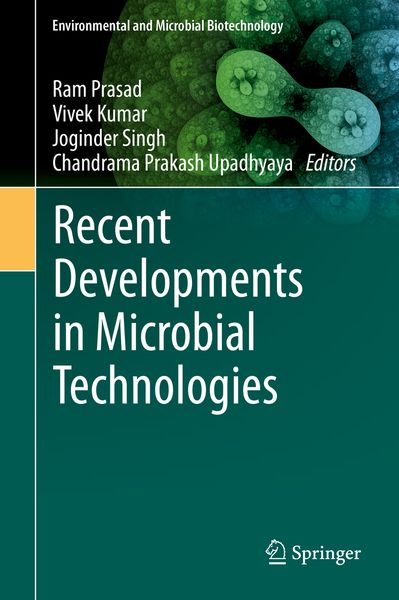
  • Produktbild: Recent Developments in Microbial Technologies
  • Produktbild: Recent Developments in Microbial Technologies
- 12%

Recent Developments in Microbial Technologies

12% sparen

173,99 € UVP 197,99 €

inkl. gesetzl. MwSt., Versandkostenfrei


Beschreibung

Produktdetails

Einband

Gebundene Ausgabe

Erscheinungsdatum

08.12.2020

Abbildungen

XIV, 465 p. 71 illus., 40 illus. in color.

Herausgeber

Ram Prasad + weitere

Verlag

Springer Singapore

Seitenzahl

465

Maße (L/B/H)

24,1/16/3,2 cm

Gewicht

881 g

Auflage

20001 Auflage 1st edition 2021

Sprache

Englisch

ISBN

978-981-15-4438-5

Beschreibung

Portrait

Dr. Ram Prasad is presently working as an Associate Professor at the Department of Botany, Mahatma Gandhi Central University, Motihari, Bihar, India. His research interests include applied microbiology, plant-microbe interactions, sustainable agriculture, and nanobiotechnology. Dr. Prasad has more than 150 publications to his credit, including research papers, review articles & book chapters, has five patents issued or pending, and has edited or authored several books. Previously, Dr. Prasad served as an Assistant Professor at Amity University, Uttar Pradesh, India; Visiting Assistant Professor, Whiting School of Engineering at Johns Hopkins University, USA; and Research Associate Professor at the School of Environmental Science and Engineering, Sun Yat-sen University, China.

Dr. Vivek Kumar is an Associate Professor working at the Himalayan School of Biosciences, Swami Rama Himalayan University, Jolly Grant, Dehradun, India. He has authored more than 100 publications, including research papers, review articles, and book chapters, and also edited several Springer books. His research interests include plant-microbe interactions, environmental microbiology, and bioremediation.

Dr. Joginder Singh is presently working as a Professor at the Department of Microbiology, Lovely Professional University, Punjab, India. He has authored more than 60 research and review articles in peer-reviewed journals; authored/co-authored 20 book chapters; and edited four books: “Arbuscular Mycorrhizal Fungi” and “Microbes: In Action,” both published by AgroBios, India; and “Microbial Bioprospecting for Sustainable Development” and “Fungi and their Role in Sustainable Development: Current Perspectives,” with Springer International Publishing.

Dr. Chandrama Prakash Upadhyaya is an Assistant Professor at the Department of Biotechnology, Dr. Harisingh Gour Central University, India. He previously served as an Assistant Professor of Biotechnology at Konkuk University, Seoul, South Korea for three years. He has been awarded several national and international fellowships, e.g. an Indo-Swiss Fellowship at the University of Basel, Switzerland, and an INSA Visiting Scientist Fellowship in India. His research interests include plant genetic engineering, plant stress physiology & molecular biology, plant-nanoparticle interactions, and epigenetic research.


Produktdetails

Einband

Gebundene Ausgabe

Erscheinungsdatum

08.12.2020

Abbildungen

XIV, 465 p. 71 illus., 40 illus. in color.

Herausgeber

Verlag

Springer Singapore

Seitenzahl

465

Maße (L/B/H)

24,1/16/3,2 cm

Gewicht

881 g

Auflage

20001 Auflage 1st edition 2021

Sprache

Englisch

ISBN

978-981-15-4438-5

Herstelleradresse

Springer-Verlag KG
Sachsenplatz 4-6
1201 Wien
AT

Email: ProductSafety@springernature.com

Noch keine Bewertungen vorhanden

Verfassen Sie die erste Bewertung zu diesem Artikel

Helfen Sie anderen Kundinnen und Kunden durch Ihre Meinung.

Kundinnen und Kunden meinen

Bewertungen (0)

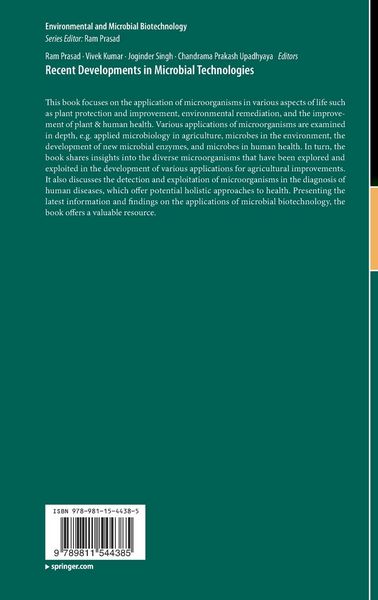
  • Produktbild: Recent Developments in Microbial Technologies
  • Produktbild: Recent Developments in Microbial Technologies
  • Chapter 1. Recent Trends in Plant and Microbe based Biopesticide for Sustainable Crop Production and Environmental Security.- Chapter 2. Microbial Biofertilizers and Biopesticides: Nature’s assets fostering sustainable agriculture.- Chapter 3. Microbial factories for biofuel production: Current trends and future prospects.- Chapter 4. Industrial Methanogenesis: Bio-Methane Production from Organic Wastes for energy supplementation.- Chapter 5. Recent Trends and Advancements in Biosensor Research for Food Safety.- Chapter 6. Bacteriocin: A Potential Biopreservative in Foods.- Chapter 7. Utilization of agro waste for Pectinase production for its industrial applications.- Chapter 8. Gallic Acid (GA): A Multifaceted Biomolecule Transmuting the Biotechnology Era.- Chapter 9. Role of Metagenomics in Plant Disease Management.- Chapter 10. Endophytes as Guardians of Plants against Diseases.- Chapter 11. Mass Production and Quality of Biological Control Agents for pest management.- Chapter 12. Iron chlorosis in peach: Current trend and eco-friendly management outlook.- Chapter 13. Role of microbes in plastic degradation.- Chapter 14. Bioplastics: Fundamentals to application.- Chapter 15. Microbial electrochemical dye degradation: present state of art.- Chapter 16. Psychrophiles as the Source for Potential Industrial Psychrozymes.- Chapter 17. Transcriptional Regulators in Bacillus Anthracis: A Potent Biothreat Agent.- Chapter 18. Medicinal fungi: A natural source of pharmacologically important metabolites.- Chapter 19. Biochemical Aspects of Syngas Fermentation.- Chapter 20.Marine Actinobacteria: New horizons in bioremediation.