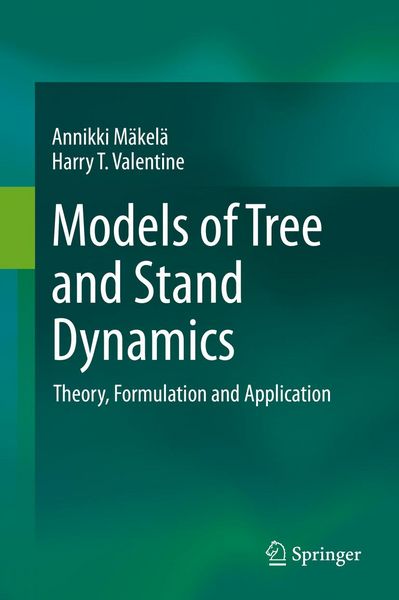
Models of Tree and Stand Dynamics Theory, Formulation and Application
-
- Hardcover
- Taschenbuch
- eBook ausgewählt
-
Form:Einzelkauf Download
-
Sprache:Englisch
87,99 €
inkl. gesetzl. MwSt.Beschreibung
Produktdetails
Format
Kopierschutz
Nein
Family Sharing
Nein
Text-to-Speech
Nein
Erscheinungsdatum
17.03.2020
Verlag
SpringerSeitenzahl
310 (Printausgabe)
Dateigröße
5885 KB
Sprache
Englisch
EAN
9783030357610
The book is designed to be a textbook for university students (MSc-PhD level) and a reference for researchers and practitioners. It is an introduction to dynamic modelling of forest growth based on ecological theory but aiming for practical applications for forest management under environmental change. It is largely based on the work and research findings of the authors, but it also covers a wide range of literature relevant to process-based forest modelling in general. The models presented in the book also serve as tools for research and can be elaborated further as new research findings emerge.
The material in the book is arranged such that the student starts from basic concepts and formulations, then moves towards more advanced theories and methods, finally learning about parameter estimation, model testing, and practical application. Exercises with solutions and hands-on R-code are provided to help the student digest the concepts and become proficient with the methods. The book should be useful for both forest ecologists who want to become modellers, and for applied mathematicians who want to learn about forest ecology.
The basic concepts and theory are formulated in the first four chapters, including a review of traditional descriptive forest models, basic concepts of carbon balance modelling applied to trees, and theories and models of tree and forest structure. Chapter 5 provides a synthesis in the form of a core model which is further elaborated and applied in the subsequent chapters. The more advanced theories and methods in Chapters 6 and 7 comprise aspects of competition through tree interactions, and eco-evolutionary modelling, including optimisation and game theory, a topical and fast developing area of ecological modelling under climate change. Chapters 8 and 9 are devoted to parameter estimation and model calibration, showing how empirical and process-based methods and related data sources can be bridged to provide reliable predictions. Chapter 10 demonstrates some practical applications and possible future development paths of the approach.
The approach in this book is unique in that the models presented are based on ecological theory and research findings, yet sufficiently simple in structure to lend themselves readily to practical application, such as regional estimates of harvest potential, or satellite-based monitoring of growth. The applicability is also related to the objective of bridging empirical and process-based approaches through data assimilation methods that combine research-based ecological measurements with standard forestry data. Importantly, the ecological basis means that it is possible to build on the existing models to advance the approach as new research findings become available.
Noch keine Bewertungen vorhanden
Verfassen Sie die erste Bewertung zu diesem Artikel
Helfen Sie anderen Kundinnen und Kunden durch Ihre Meinung.
Kurze Frage zu unserer Seite
Vielen Dank für Ihr Feedback
Wir nutzen Ihr Feedback, um unsere Produktseiten zu verbessern. Bitte haben Sie Verständnis, dass wir Ihnen keine Rückmeldung geben können. Falls Sie Kontakt mit uns aufnehmen möchten, können Sie sich aber gerne an unseren Kund*innenservice wenden.
zum Kundenservice