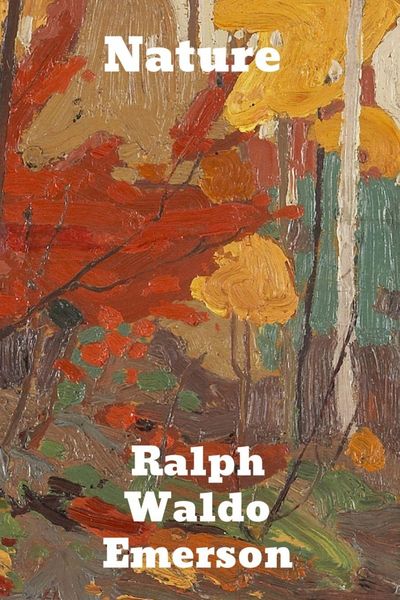
Nature
-
- Hardcover
- Taschenbuch ausgewählt
- eBook
-
Sprache:Englisch
- Deutsch 12,00 €
- Englisch 13,99 € ausgewählt
13,99 €
inkl. gesetzl. MwSt.,
- Kostenlose Lieferung ab 30 € Einkaufswert
- Versandkostenfrei für Bonuscard-Kund*innen
Beschreibung
Produktdetails
Einband
Taschenbuch
Erscheinungsdatum
23.02.2020
Verlag
Binker NorthSeitenzahl
54
Maße (L/B/H)
22,9/15,2/0,4 cm
Gewicht
95 g
Sprache
Englisch
ISBN
978-1-77441-401-9
Nature, by Ralph Waldo Emerson, is a superb nature essay and a philosophical interpretation of nature and how it influences man physically and spiritually. Emerson's writing is redolent with the wonder of the true romantic, but never sinks to the level of maudlin fluff.In the essay Emerson put forth the foundation of transcendentalism, a belief system that espouses a non-traditional appreciation of nature. Transcendentalism suggests that the divine, or God, suffuses nature, and suggests that reality can be understood by studying nature. Emerson's visit to the Muséum National d'Histoire Naturelle in Paris inspired a set of lectures he later delivered in Boston which were then published.Within the essay, Emerson divides nature into four usages: Commodity, Beauty, Language and Discipline. These distinctions define the ways by which humans use nature for their basic needs, their desire for delight, their communication with one another and their understanding of the world.Emerson followed the success of "Nature" with a speech, "The American Scholar", which together with his previous lectures laid the foundation for transcendentalism and his literary career. Ralph Waldo Emerson (May 25, 1803 – April 27, 1882)[5] was an American essayist, lecturer, philosopher, and poet who led the transcendentalist movement of the mid-19th century. He was seen as a champion of individualism and a prescient critic of the countervailing pressures of society, and he disseminated his thoughts through dozens of published essays and more than 1,500 public lectures across the United States.Emerson gradually moved away from the religious and social beliefs of his contemporaries, formulating and expressing the philosophy of transcendentalism in his 1836 essay "Nature". Following this work, he gave a speech entitled "The American Scholar" in 1837, which Oliver Wendell Holmes Sr. considered to be America's "intellectual Declaration of Independence."
Noch keine Bewertungen vorhanden
Verfassen Sie die erste Bewertung zu diesem Artikel
Helfen Sie anderen Kundinnen und Kunden durch Ihre Meinung.
Kurze Frage zu unserer Seite
Vielen Dank für Ihr Feedback
Wir nutzen Ihr Feedback, um unsere Produktseiten zu verbessern. Bitte haben Sie Verständnis, dass wir Ihnen keine Rückmeldung geben können. Falls Sie Kontakt mit uns aufnehmen möchten, können Sie sich aber gerne an unseren Kund*innenservice wenden.
zum Kundenservice