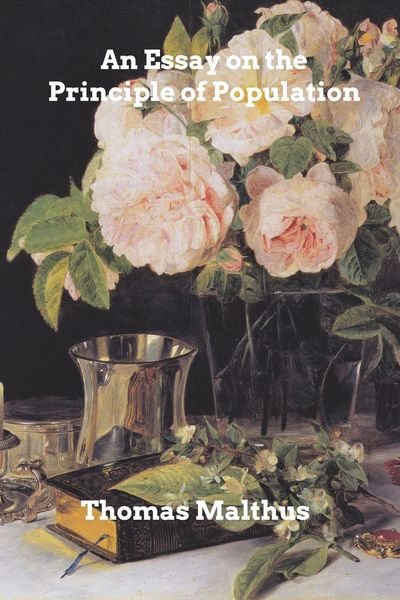
An Essay on the Principle of Population
-
- Hardcover
- Taschenbuch ausgewählt
- eBook
-
Sprache:Englisch
- Englisch 21,99 € ausgewählt
- Französisch 19,99 €
-
Verlag:Blurb
- Globe Pequot Publishing Group Inc 23,99 €
- Lector House 15,99 €
- Cambridge Academic 58,99 €
- Alpha Editions 23,99 €
- Tredition 13,30 €
- Cambridge University Press 49,99 €
- Oxford University Press 12,99 €
- Book Jungle 23,99 €
- Creative Media Partners, LLC 34,99 €
- FV éditions 19,99 €
- Norton 33,99 €
- Cosimo Classics 31,99 €
- Blurb 21,99 € ausgewählt
- Double 9 Books 16,99 €
21,99 €
inkl. gesetzl. MwSt.,
- Kostenlose Lieferung ab 30 € Einkaufswert
- Versandkostenfrei für Bonuscard-Kund*innen
Beschreibung
Produktdetails
Einband
Taschenbuch
Erscheinungsdatum
13.08.2019
Verlag
BlurbSeitenzahl
160
Maße (L/B/H)
22,9/15,2/0,9 cm
Gewicht
242 g
Sprache
Englisch
ISBN
978-0-464-19411-8
The book An Essay on the Principle of Population was first published anonymously in 1798,[1] but the author was soon identified as Thomas Robert Malthus. The book predicted a grim future, as population would increase geometrically, doubling every 25 years,[2] but food production would only grow arithmetically, which would result in famine and starvation, unless births were controlled. While it was not the first book on population, it was revised for over 28 years and has been acknowledged as the most influential work of its era. Malthus's book fuelled debate about the size of the population in the Kingdom of Great Britain and contributed to the passing of the Census Act 1800. This Act enabled the holding of a national census in England, Wales and Scotland, starting in 1801 and continuing every ten years to the present. The book's 6th edition (1826) was independently cited as a key influence by both Charles Darwin and Alfred Russel Wallace in developing the theory of natural selection. A key portion of the book was dedicated to what is now known as Malthus' Iron Law of Population. This name itself is retrospective, based on the iron law of wages, which is the reformulation of Malthus' position by Ferdinand Lassalle, who in turn derived the name from Goethe's "great, eternal iron laws" in Das Göttliche.[3] This theory suggested that growing population rates would contribute to a rising supply of labour that would inevitably lower wages. In essence, Malthus feared that continued population growth would lend itself to poverty and famine.
Noch keine Bewertungen vorhanden
Verfassen Sie die erste Bewertung zu diesem Artikel
Helfen Sie anderen Kundinnen und Kunden durch Ihre Meinung.
Kurze Frage zu unserer Seite
Vielen Dank für Ihr Feedback
Wir nutzen Ihr Feedback, um unsere Produktseiten zu verbessern. Bitte haben Sie Verständnis, dass wir Ihnen keine Rückmeldung geben können. Falls Sie Kontakt mit uns aufnehmen möchten, können Sie sich aber gerne an unseren Kund*innenservice wenden.
zum Kundenservice