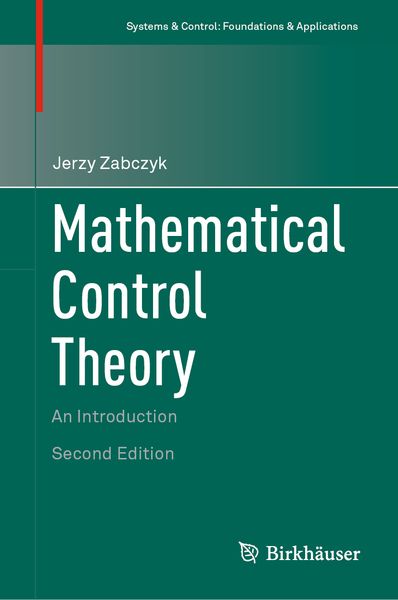
Mathematical Control Theory An Introduction
69,99 €
UVP
82,49 €
inkl. gesetzl. MwSt.,
Beschreibung
Produktdetails
Einband
Gebundene Ausgabe
Erscheinungsdatum
21.06.2020
Abbildungen
XXVI, 336 p. 5 illus., 1 illus. in color.
Verlag
SpringerSeitenzahl
336
Maße (L/B/H)
24,1/16/2,4 cm
Gewicht
725 g
Auflage
Second Edition 2020
Sprache
Englisch
ISBN
978-3-030-44776-2
This textbook presents, in a mathematically precise manner, a unified introduction to deterministic control theory. With the exception of a few more advanced concepts required for the final part of the book, the presentation requires only a knowledge of basic facts from linear algebra, differential equations, and calculus.
In addition to classical concepts and ideas, the author covers the stabilization of nonlinear systems using topological methods, realization theory for nonlinear systems, impulsive control and positive systems, the control of rigid bodies, the stabilization of infinite dimensional systems, and the solution of minimum energy problems.
This second edition includes new chapters that introduce a variety of topics, such as controllability with vanishing energy, boundary control systems, and delayed systems. With additional proofs, theorems, results, and a substantially larger index, this new edition will be an invaluable resource for students and researchers of control theory.
Mathematical Control Theory: An Introduction
will be ideal for a beginning graduate course in mathematical control theory, or for self-study by professionals needing a complete picture of the mathematical theory that underlies the applications of control theory.
From reviews of the first edition:
At last! We did need an introductory textbook on control which can be read, understood, and enjoyed by anyone.
Gian-Carlo Rota, The Bulletin of Mathematics Books
It covers a remarkable number of topics...The exposition is excellent, and the book is a joy to read. A novel one-semester course covering both linear and nonlinear systems could be given...The book is an excellent one for introducing a mathematician to control theory.
Bulletin of the AMS
Indeed, for mathematicians who look for the basic ideas or a general picture about the main branches of control theory, I believe this book can provide anexcellent bridge to this area.
IEEE Control Systems Magazine
Noch keine Bewertungen vorhanden
Verfassen Sie die erste Bewertung zu diesem Artikel
Helfen Sie anderen Kundinnen und Kunden durch Ihre Meinung.
Kurze Frage zu unserer Seite
Vielen Dank für Ihr Feedback
Wir nutzen Ihr Feedback, um unsere Produktseiten zu verbessern. Bitte haben Sie Verständnis, dass wir Ihnen keine Rückmeldung geben können. Falls Sie Kontakt mit uns aufnehmen möchten, können Sie sich aber gerne an unseren Kund*innenservice wenden.
zum Kundenservice