KI-Beratung Beta

Gutscheinbedingungen

**Gültig bis 05.10.2026 ab einem Mindestbestellwert von 30€ auf Spielzeug, Schreibwaren, Filme, Geschenke & Trends, Musik, tolino eReader & Zubehör, Hörbücher und Hörbuch-Downloads, nicht preisgebundene Bücher und Kalender online auf thalia.at und in der Thalia App. Einzelne Artikel können ausgeschlossen sein. Aufgrund der Buchpreisbindung sind deutschsprachige Bücher und eBooks ausgenommen. Zusätzlich ausgenommen sind Abos & Flatrates, Games, Geschenkkarten/-boxen, Shelfies, Software, Zeitschriften sowie einzelne Artikel von tonies®. Pro Einkauf einmal einlösbar. Nur gültig mit im Onlineshop hinterlegter Bonuscard. Click & Collect nur bei Onlinevorabzahlung möglich. Keine Barauszahlung. Nicht kombinierbar mit anderen Aktionen und Gutscheinen. Gutschein wird auf max. 500€ Bestellwert angerechnet. Nicht gültig für Versandkosten und Services. Preisgebundene Artikel sind vom Mindestbestellwert ausgeschlossen.

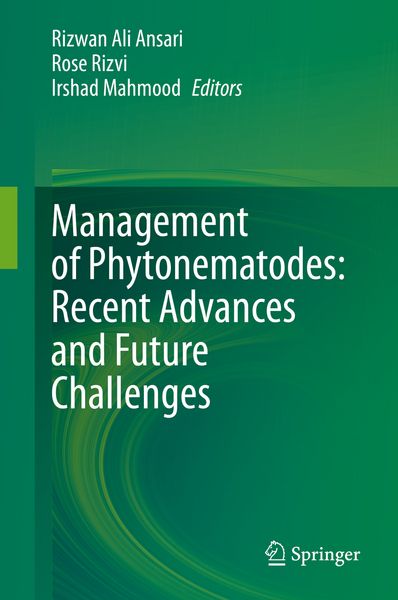
  • Produktbild: Management of Phytonematodes: Recent Advances and Future Challenges
  • Produktbild: Management of Phytonematodes: Recent Advances and Future Challenges
- 12%

Management of Phytonematodes: Recent Advances and Future Challenges

12% sparen

239,99 € UVP 274,99 €

inkl. gesetzl. MwSt., Versandkostenfrei


Beschreibung

Produktdetails

Einband

Gebundene Ausgabe

Erscheinungsdatum

30.06.2020

Abbildungen

X, 399 p. 13 illus.

Herausgeber

Rizwan Ali Ansari + weitere

Verlag

Springer Singapore

Seitenzahl

399

Maße (L/B/H)

24,1/16/2,8 cm

Gewicht

781 g

Auflage

1. Auflage

Sprache

Englisch

ISBN

978-981-15-4086-8

Beschreibung

Portrait


Dr. Rizwan Ali Ansari
is currently working as an Assistant Professor at Aligarh Muslim University, Aligarh, India. He obtained his Ph.D. degree from the same university and has focused his research on understanding the mechanisms involved in the development of disease complexes, and on using organic additives and biological agents for the management of nematode-fungus complexes. He has received a number of prestigious awards from various scientific societies, e.g. the Society of Plant Protection Sciences (SPSS) and Nematological Society of India (NSI), for his outstanding contributions in the field of Plant Pathology/Nematology. He has published several book chapters, research and review articles on the utility of organic additives, mycorrhizal fungi and plant-growth-promoting bacteria in the sustainable management of plant pathogens. Dr. Ansari also edited the two-volume book “Plant Health Under Biotic Stress,” which has enjoyed international success.

Dr. Rose Rizvi
 is currently working as an Assistant Professor at the Department of Botany, Aligarh Muslim University, Aligarh, India.  She has published numerous articles in respected journals and received various awards, e.g. the UGC-BSR Research Fellow Award (UGC); Norman Ernest Borlaug Research Award for Plant Pathology (Photon Foundation); Junior Scientist Award (NESA); Scientist of the Year Award (2018, NESA); and Young Scientist of the Year Award (2018, IFEE).

Dr. Irshad Mahmood
 is a Professor of Plant Pathology and Nematology who has focused his research on the application of organic additives and potent microorganisms for the sustainable management of phytoparasitic nematodes and plant pathogenic fungi. He has taught undergraduate and graduate level students for the past 30 years, and has engaged in overseas research visits to e.g. the US, France and the UK. He has published more than 150 original research papers, review articles and book chapters, and has successfully completed training courses at various ICAR-sponsored research institutes in India, and at North Carolina State University, Raleigh, US. 

Produktdetails

Einband

Gebundene Ausgabe

Erscheinungsdatum

30.06.2020

Abbildungen

X, 399 p. 13 illus.

Herausgeber

Verlag

Springer Singapore

Seitenzahl

399

Maße (L/B/H)

24,1/16/2,8 cm

Gewicht

781 g

Auflage

1. Auflage

Sprache

Englisch

ISBN

978-981-15-4086-8

Herstelleradresse

Springer-Verlag KG
Sachsenplatz 4-6
1201 Wien
AT

Email: ProductSafety@springernature.com

Noch keine Bewertungen vorhanden

Verfassen Sie die erste Bewertung zu diesem Artikel

Helfen Sie anderen Kundinnen und Kunden durch Ihre Meinung.

Kundinnen und Kunden meinen

Bewertungen (0)

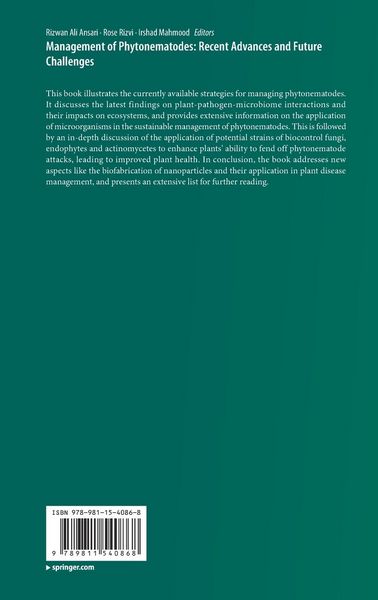
  • Produktbild: Management of Phytonematodes: Recent Advances and Future Challenges
  • Produktbild: Management of Phytonematodes: Recent Advances and Future Challenges
  • Chapter 1. Nanobiotechnology driven management of Phytonematodes.- Chapter 2. Bioprospecting compost for long-term control of plant parasitic nematodes.- Chapter 3. Plant Growth Promoting Rhizobacteria (PGPR) based sustainable management of phytoparasitic nematodes: Current understandings and future challenges.- Chapter 4. Organic additives and their role in the phytoparasitic nematodes management.- Chapter 5. Metagenomics insights into interactions between plant nematodes and endophytic microbiome.- Chapter 6. Nanoparticles Synthesis and their application in the management of phytonematodes: An Overview.- Chapter 7. Integrated management of phytopathogenic nematodes infesting mushroom.- Chapter 8. Plant-parasitic nematodes and their biocontrol agents: Current status and future vistas.- Chapter 9. Importance of biopesticides in the sustainable management of plant parasitic nematodes.- Chapter 10. Efficacy of microbial biocontrol agents in integration with other managing methods againstphytoparasitic nematodes.- Chapter 11. Role of Trichoderma spp. in the management of plant parasitic nematodes.- Chapter 12. Role of organic additives in the sustainable management of phytoparasitic nematodes.- Chapter 13. Plant-parasitic nematode control: Current progress and challenges.- Chapter 14. Utilization of beneficial microorganisms in sustainable control of phytonematodes.- Chapter 15. Current management strategies for phytoparasitic nematodes.- Chapter 16. Sustainable mmanagement of plant-parasitic nematodes: An overview from conventional practices to modern techniques.