• Produktbild: Women, Philosophy and Science
  • Produktbild: Women, Philosophy and Science
Band 4

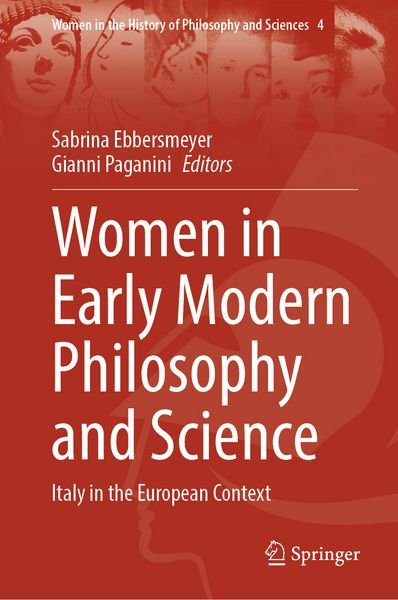
Women, Philosophy and Science Italy and Early Modern Europe

119,99 €

inkl. gesetzl. MwSt., Versandkostenfrei


Beschreibung

Produktdetails

Einband

Gebundene Ausgabe

Erscheinungsdatum

09.07.2020

Abbildungen

XVI, 218 p. 1 illus.

Herausgeber

Sabrina Ebbersmeyer + weitere

Verlag

Springer

Seitenzahl

218

Maße (L/B/H)

24,1/16/1,9 cm

Gewicht

522 g

Sprache

Englisch

ISBN

978-3-030-44547-8

Beschreibung

Rezension

“A critical stance on the methodologies deployed in the different chapters and the ways in which they interrelate would not only have illuminated the conceptual foundations of the collection, but might also have pleaded for the volume’s coherence as a whole. … this volume provides rich historical and cultural context pertaining to a variety of women’s output.” (Iulia Z Mihai, Early Science and Medicine, Vol. 26, 2021)

Portrait


Sabrina Ebbersmeyer is an Associate Professor of History of Philosophy at the University of Copenhagen, Denmark. Working primarily on Renaissance and early modern philosophy, her research focuses on debates in moral psychology and philosophy of mind on humanism and gender in the historiography of philosophy. She has published work on numerous Renaissance and early modern philosophers, including Isotta Nogarola, Bernardino Telesio, Elisabeth of Bohemia and Gottfried Wilhelm Leibniz. She is author of Homo agens (Berlin, New York: de Gruyter 2010), has edited the volume Emotional Minds (Berlin, New York: de Gruyter 2012) and translated the correspondence between Elisabeth of Bohemia and René Descartes into German (München: Fink 2015).   Gianni Paganini (Università del Piemonte Orientale), fellow of the Research Center of the Accademia dei Lincei (Rome), edited the first atheist clandestine manuscript: Theophrastus redivivus (1659), 2 vols, Florence, LaNuova Italia, 1981–1982. He is also the author of Skepsis. Le Débat des modernes sur le scepticisme, Paris, Vrin, 2008, published by the Académie Française. In 2010, he won a prize for his work in philosophy, awarded by the Accademia dei Lincei (Rome). His current research focuses on 17th century philosophy (Hobbes, clandestine philosophy, history of early modern skepticism) and the Enlightenment (the connections between Hume and Diderot). He has edited works by Voltaire (Zadig), Hume (Dialog Concerning Natural Religion) and Hobbes (De motu, loco et tempore). 


Produktdetails

Einband

Gebundene Ausgabe

Erscheinungsdatum

09.07.2020

Abbildungen

XVI, 218 p. 1 illus.

Herausgeber

Verlag

Springer

Seitenzahl

218

Maße (L/B/H)

24,1/16/1,9 cm

Gewicht

522 g

Sprache

Englisch

ISBN

978-3-030-44547-8

Herstelleradresse

Springer-Verlag KG
Sachsenplatz 4-6
1201 Wien
AT

Email: ProductSafety@springernature.com

Noch keine Bewertungen vorhanden

Verfassen Sie die erste Bewertung zu diesem Artikel

Helfen Sie anderen Kundinnen und Kunden durch Ihre Meinung.

Kundinnen und Kunden meinen

Bewertungen (0)

  • Produktbild: Women, Philosophy and Science
  • Produktbild: Women, Philosophy and Science
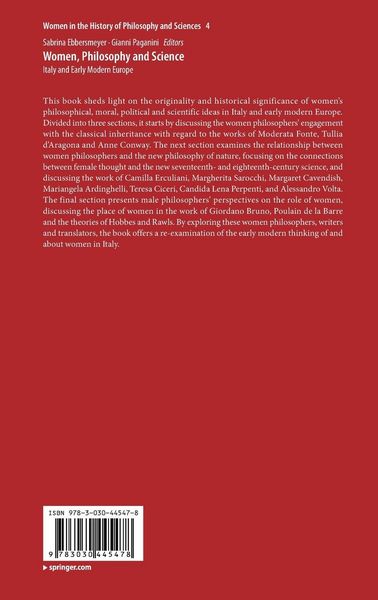
  • Part 1: Women philosophers and the classical inheritance.- Introduction.- Chapter 1. Moderata Fonte and Michel de Montaigne in the Renaissance debate on friendship and marriage (Annalisa Ceron).- Chapter 2. Plato and the Platonism of Anne Conway (Sarah Hutton).- Part 2: Women philosophers and the new philosophy of nature.- Chapter 3. Letters on natural philosophy and new science: Camilla Erculiani (Padua 1584) and Margherita Sarocchi (Rome 1612) (Sandra Plastina).- Chapter 4. Margaret Cavendish and Robert Boyle on the purpose, method and writing of natural philosophy (Emma Wilkins).- Chapter 5. Margaret Cavendish: science and women’s power through The Blazing World (Carlotta Cossutta).- Chapter 6. A woman between Buffon and Sauvage: Mariangela Ardinghelli, the Italian translator of Hales’ books (Corinna Guerra).- Chapter 7. Female science, experimentation, and ‘common utility’. Teresa Ciceri, Candida Lena Perpenti, and Alessandro Volta’s research (Alessandra Mita Ferraro).- Part 3: Menphilosophers on the role of women.- Chapter 8. Amorous attraction and the role of women in the work of Giordano Bruno (Simonetta Bassi).- Chapter 9. Women from objects to subjects of science in Poulain de La Barre (Marie-Frédérique Pellegrin).- Chapter 10. From natural equality to sexual subordination in the theories of Hobbes and Rawls (S. A. Lloyd).- Index.