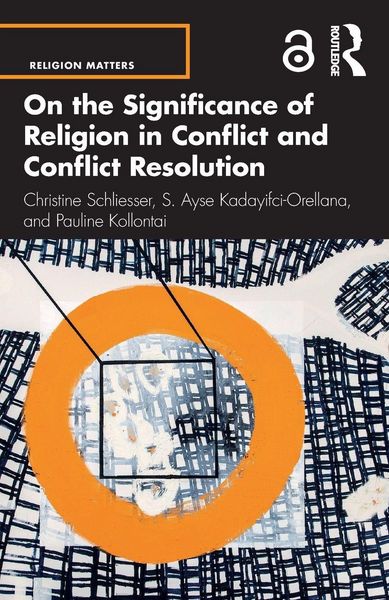
• Produktbild: On the Significance of Religion in Conflict and Conflict Resolution
  • Produktbild: On the Significance of Religion in Conflict and Conflict Resolution

On the Significance of Religion in Conflict and Conflict Resolution

Aus der Reihe Religion Matters

28,99 €

inkl. gesetzl. MwSt., zzgl. Versandkosten


  • Kostenlose Lieferung ab 30 € Einkaufswert
  • Versandkostenfrei für Bonuscard-Kund*innen

Beschreibung

Produktdetails

Einband

Taschenbuch

Erscheinungsdatum

02.07.2020

Verlag

Taylor & Francis

Seitenzahl

168

Maße (L/B/H)

19,8/12,9/1 cm

Gewicht

186 g

Sprache

Englisch

ISBN

978-0-367-43392-5

Beschreibung

Rezension

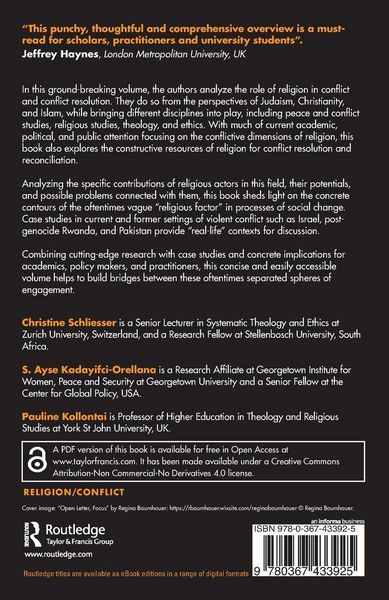
"This initial book in an exciting new series looks at one of the key global issues with which religion is intimately involved: the sustainable development goals. This punchy, thoughtful and comprehensive overview of the relevant issues is a must-read for scholars, practitioners and university students. It will help set the focus of debates on this issue. I warmly recommend it."

Jeffrey Haynes, London Metropolitan University, UK

"The Religion Matters series is a timely and accessible compendium contextualizing the role of religion within the critical issues of our time. The first volume, On the Significance of Religion in Conflict and Conflict Resolution, demonstrates through careful analysis and illustrative case studies around the three Abrahamic traditions the real yet complex impact of religion in the global sphere, showing clearly the need for collaboration and understanding across sectors and religious traditions in conflict resolution. Building upon the rich academic expertise and lived experiences of the authors, and situating itself within the broader religion and peacebuilding scholarship of recent decades, this volume raises to the forefront the "how" and "why" religion does indeed matter."

Melissa Nozell, United States Institute of Peace, USA

"Does religion matter" is a crucial question for billions of people around the world. Although in recent years, many governments and international organizations have begun considering the role of religion in policy, nevertheless these efforts remain in their initial phase. This edited volume creatively tackles this central issue in international politics. Combining several real and challenging cases, the Editors successfully dispel the myth that religion alone causes violent conflicts and is responsible for their solutions. The book also illustrates how the three Abrahamic traditions can be deployed effectively to positively contribute to conflict resolution and peacebuilding in Israeli Palestinian, Pakistan, and Rwanda settings. The edited volume adds an important voice to the field of interreligious peacebuilding. It also respond to the need for further engagement between policy makers and peacebuilding communities and practitioners."

Mohammed Abu-Nimer, American University School, USA

"This volume is an important contribution to efforts to bring religion back into the mainstream of conflict resolution and peacebuilding. Analyzing religion's role in conflict and peace by applying a simple framework to several rich case studies, the authors convincingly demonstrate that religion matters for anyone working in the field of conflict resolution today."

Owen Frazer, Center for Security Studies, Zurich, Switzerland

Produktdetails

Einband

Taschenbuch

Erscheinungsdatum

02.07.2020

Verlag

Taylor & Francis

Seitenzahl

168

Maße (L/B/H)

19,8/12,9/1 cm

Gewicht

186 g

Sprache

Englisch

ISBN

978-0-367-43392-5

Herstelleradresse

Libri GmbH
Europaallee 1
36244 Bad Hersfeld
DE

Email: gpsr@libri.de

Noch keine Bewertungen vorhanden

Verfassen Sie die erste Bewertung zu diesem Artikel

Helfen Sie anderen Kundinnen und Kunden durch Ihre Meinung.

Kundinnen und Kunden meinen

Bewertungen (0)

Die Leseprobe wird geladen.
  • Produktbild: On the Significance of Religion in Conflict and Conflict Resolution
  • Produktbild: On the Significance of Religion in Conflict and Conflict Resolution
  • Acknowledgements  Foreword   List of Abbreviations  Notes on the authors  Part 1: Summary  1. Summary and Implications for Academics, Policy Makers, and Practitioners  Part 2: Why Religion Matters  2. Why Religion Matters: An Introduction  Part 3: Religion Matters in Conflict  3. Orientation: Did Religion Do It?  4. Jewish Perspective: Religion in Israel's Land Rights Conflicts  5. Christian Perspective: Religion in Pre-Genocide and Genocide Rwanda  6. Islamic Perspective: Religion in Pakistan's Internal Conflicts  Part 4: Religion Matters in Conflict Resolution  7. Orientation: What Do They Have that Others Don't?  8. Jewish Perspective: Religion in Israel's Quest for Conflict Resolution and Reconciliation in Its Land Rights Conflicts  9. Christian Perspective: Religion in Post-Genocide Rwanda's Quest for Conflict Resolution and Reconciliation  10. Islamic Perspective: Religion in Muslim Women's PeaceBuilding Initiatives in Pakistan  Part 5: Now What?  11. Now What? Implications for Academics, Policy Makers, and Practitioners  Index