KI-Beratung Beta

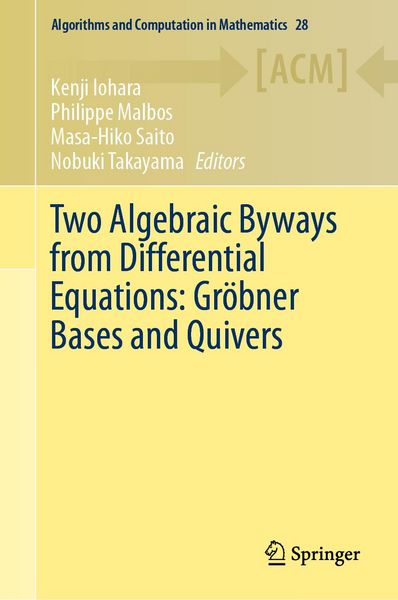
Produktbild: Two Algebraic Byways from Differential Equations: Gröbner Bases and Quivers
Band 28

Two Algebraic Byways from Differential Equations: Gröbner Bases and Quivers

109,99 €

inkl. gesetzl. MwSt.

Beschreibung

This edited volume presents a fascinating collection of lecture notes focusing on differential equations from two viewpoints: formal calculus (through the theory of Gröbner bases) and geometry (via quiver theory). Gröbner bases serve as effective models for computation in algebras of various types. Although...

Beschreibung

This edited volume presents a fascinating collection of lecture notes focusing on differential equations from two viewpoints: formal calculus (through the theory of Gröbner bases) and geometry (via quiver theory). Gröbner bases serve as effective models for computation in algebras of various types. Although the theory of Gröbner bases was developed in the second half of the 20th century, many works on computational methods in algebra were published well before the introduction of the modern algebraic language. Since then, new algorithms have been developed and the theory itself has greatly expanded. In comparison, diagrammatic methods in representation theory are relatively new, with the quiver varieties only being introduced - with big impact - in the 1990s.

Divided into two parts, the book first discusses the theory of Gröbner bases in their commutative and noncommutative contexts, with a focus on algorithmic aspects and applications of Gröbner bases to analysison systems of partial differential equations, effective analysis on rings of differential operators, and homological algebra. It then introduces representations of quivers, quiver varieties and their applications to the moduli spaces of meromorphic connections on the complex projective line.

While no particular reader background is assumed, the book is intended for graduate students in mathematics, engineering and related fields, as well as researchers and scholars.

Produktdetails

Format

PDF

Kopierschutz

Nein

Family Sharing

Nein

Text-to-Speech

Nein

Produktdetails

Format

PDF

Format

eBooks im PDF-Format haben eine festgelegte Seitengröße und eignen sich daher nur bedingt zum Lesen auf einem tolino eReader oder Smartphone. Für den vollen Lesegenuss empfehlen wir Ihnen bei PDF-eBooks die Verwendung eines Tablets oder Computers.

Kopierschutz

Nein

Kopierschutz

Dieses eBook können Sie uneingeschränkt auf allen Geräten der tolino Familie, allen sonstigen eReadern und am PC lesen. Das eBook ist nicht kopiergeschützt und kann ein personalisiertes Wasserzeichen enthalten. Weitere Hinweise zum Lesen von eBooks mit einem personalisierten Wasserzeichen finden Sie unter Hilfe/Downloads.

Family Sharing

Nein

Family Sharing

Mit Family Sharing können Sie eBooks innerhalb Ihrer Familie (max. sechs Mitglieder im gleichen Haushalt) teilen. Sie entscheiden selbst, welches Buch Sie mit welchem Familienmitglied teilen möchten. Auch das parallele Lesen durch verschiedene Familienmitglieder ist durch Family Sharing möglich. Um eBooks zu teilen oder geteilt zu bekommen, muss jedes Familienmitglied ein Konto bei Thalia oder einem anderen tolino-Buchhändler haben. Weitere Informationen finden Sie unter Hilfe/Family-Sharing.

Text-to-Speech

Nein

Text-to-Speech

Bedeutet Ihnen Stimme mehr als Text? Mit der Funktion Text-to-Speech können Sie sich im tolino webReader und in der aktuellen Thalia – Lesen & Hören App das eBook vorlesen lassen. Weitere Informationen finden Sie unter Hilfe/Text-to-Speech.

Erscheinungsdatum

20.02.2020

Herausgeber
Verlag Springer
Seitenzahl

371 (Printausgabe)

Dateigröße

5311 KB

Sprache

Englisch

EAN

9783030264543

Barrierefreiheit
  • keine Information zur Barrierefreiheit bekannt

Noch keine Bewertungen vorhanden

Verfassen Sie die erste Bewertung zu diesem Artikel

Helfen Sie anderen Kundinnen und Kunden durch Ihre Meinung.

Kundinnen und Kunden meinen

Bewertungen (0)

Weitere Artikel finden Sie in

  • Produktbild: Two Algebraic Byways from Differential Equations: Gröbner Bases and Quivers