The Manifesto for Teaching Online
42,99 €
inkl. gesetzl. MwSt.,
Beschreibung
Produktdetails
Einband
Taschenbuch
Erscheinungsdatum
15.09.2020
Abbildungen
11 B&W ILLUS.
Verlag
MIT PressSeitenzahl
274
Maße (L/B/H)
20,3/13,7/1,6 cm
Gewicht
359 g
Sprache
Englisch
ISBN
978-0-262-53983-8
An update to a provocative manifesto intended to serve as a platform for debate and as a resource and inspiration for those teaching in online environments.
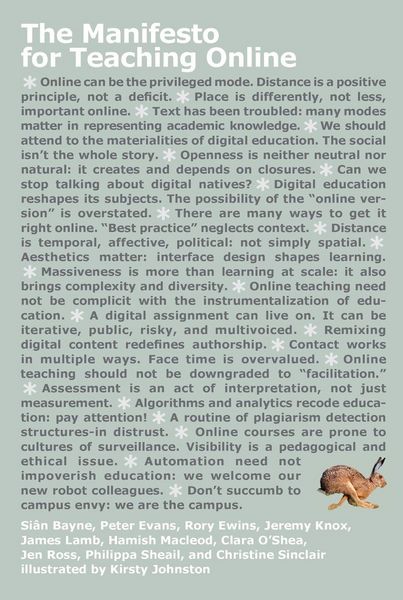
In 2011, a group of scholars associated with the Centre for Research in Digital Education at the University of Edinburgh released “The Manifesto for Teaching Online,” a series of provocative statements intended to articulate their pedagogical philosophy. In the original manifesto and a 2016 update, the authors counter both the “impoverished” vision of education being advanced by corporate and governmental edtech and higher education’s traditional view of online students and teachers as second-class citizens. The two versions of the manifesto were much discussed, shared, and debated. In this book, Siân Bayne, Peter Evans, Rory Ewins, Jeremy Knox, James Lamb, Hamish Macleod, Clara O'Shea, Jen Ross, Philippa Sheail and Christine Sinclair have expanded the text of the 2016 manifesto, revealing the sources and larger arguments behind the abbreviated provocations.
The book groups the twenty-one statements (“Openness is neither neutral nor natural: it creates and depends on closures”; “Don’t succumb to campus envy: we are the campus”) into five thematic sections examining place and identity, politics and instrumentality, the primacy of text and the ethics of remixing, the way algorithms and analytics “recode” educational intent, and how surveillance culture can be resisted. Much like the original manifestos, this book is intended as a platform for debate, as a resource and inspiration for those teaching in online environments, and as a challenge to the techno-instrumentalism of current edtech approaches. In a teaching environment shaped by COVID-19, individuals and institutions will need to do some bold thinking in relation to resilience, access, teaching quality, and inclusion.
Noch keine Bewertungen vorhanden
Verfassen Sie die erste Bewertung zu diesem Artikel
Helfen Sie anderen Kundinnen und Kunden durch Ihre Meinung.
Kurze Frage zu unserer Seite
Vielen Dank für Ihr Feedback
Wir nutzen Ihr Feedback, um unsere Produktseiten zu verbessern. Bitte haben Sie Verständnis, dass wir Ihnen keine Rückmeldung geben können. Falls Sie Kontakt mit uns aufnehmen möchten, können Sie sich aber gerne an unseren Kund*innenservice wenden.
zum Kundenservice