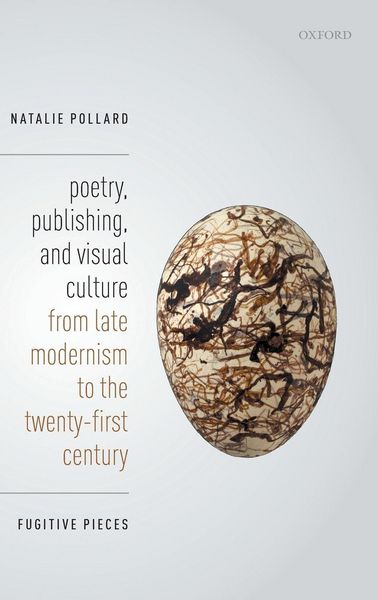
Poetry, Publishing, and Visual Culture from Late Modernism to the Twenty-First Century Fugitive Pieces
165,99 €
inkl. gesetzl. MwSt.,
Beschreibung
Produktdetails
Einband
Gebundene Ausgabe
Erscheinungsdatum
01.07.2020
Abbildungen
18 Illustrations
Verlag
Oxford AcademicSeitenzahl
332
Maße (L/B/H)
24/16,1/2,2 cm
Gewicht
663 g
Sprache
Englisch
ISBN
978-0-19-885260-5
This is a book about contemporary literary and artistic entanglements: word and image, media and materiality, inscription and illustration. It proposes a vulnerable, fugitive mode of reading poetry, which defies disciplinary categorisations, embracing the open-endedness and provisionality of forms. This manifests itself interactively in the six case studies, which have been chosen for their distinctness and diversity across the long twentieth century: the book begins with the early twentieth-century work of writer and artist Djuna Barnes, exploring her re-animation of sculptural and dramatic sources. It then turns to the late modernist artist and poet David Jones considering his use of the graphic and plastic arts in The Anathemata, and next, to the underappreciated mid-century poet F.T. Prince, whose work uncannily re-activates Michelangelo's poetry and sculpture. The second half of the book explores the collaborations of the canonical poet Ted Hughes with the publisher and artist Leonard Baskin during the 1970s; the innovative late twentieth-century poetry of Denise Riley who uses page space and embodied sound as a form of address; and, finally, the contemporary poet Paul Muldoon who has collaborated with photographers and artists, as well as ventriloquising nonhuman phenomena. The resulting unique study offers contemporary writers and readers a new understanding of literary, artistic, and nonhuman practices and shows the cultural importance of engaging with their messy co-dependencies. The book challenges critical methodologies that make a sharp division between the textual work and the extra-literary, and raises urgent questions about the status and autonomy of art and its social role.
Noch keine Bewertungen vorhanden
Verfassen Sie die erste Bewertung zu diesem Artikel
Helfen Sie anderen Kundinnen und Kunden durch Ihre Meinung.
Kurze Frage zu unserer Seite
Vielen Dank für Ihr Feedback
Wir nutzen Ihr Feedback, um unsere Produktseiten zu verbessern. Bitte haben Sie Verständnis, dass wir Ihnen keine Rückmeldung geben können. Falls Sie Kontakt mit uns aufnehmen möchten, können Sie sich aber gerne an unseren Kund*innenservice wenden.
zum Kundenservice