
KI-Beratung Beta

Gutscheinbedingungen

**Gültig bis 30.11.2026 auf Spielzeug, Schreibwaren, Filme, Geschenke & Trends, Musik, tolino eReader & Zubehör, Hörbücher und Hörbuch-Downloads, nicht preisgebundene Bücher und Kalender online auf thalia.at und in der Thalia App. Einzelne Artikel können ausgeschlossen sein. Aufgrund der Buchpreisbindung sind deutschsprachige Bücher und eBooks ausgenommen. Zusätzlich ausgenommen sind Abos & Flatrates, Games, Geschenkkarten/-boxen, Shelfies, Software, Zeitschriften sowie einzelne Artikel von tonies®. Pro Einkauf einmal einlösbar. Nur gültig mit im Onlineshop hinterlegter Bonuscard. Click & Collect nur bei Onlinevorabzahlung möglich. Keine Barauszahlung. Nicht kombinierbar mit anderen Aktionen und Gutscheinen. Gutschein wird auf max. 500€ Bestellwert angerechnet. Nicht gültig für Versandkosten und Services.

  • Produktbild: The Digitalisation of (Inter)Subjectivity
  • Produktbild: The Digitalisation of (Inter)Subjectivity

The Digitalisation of (Inter)Subjectivity A Psy-critique of the Digital Death Drive

69,99 €

inkl. gesetzl. MwSt., Versandkostenfrei


Beschreibung

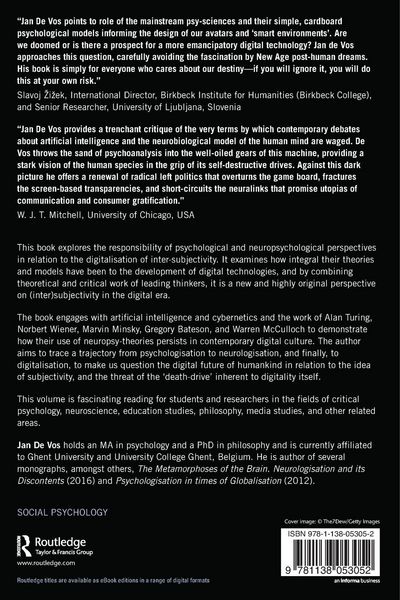
This book explores the responsibility of psychological and neuropsychological perspectives in relation to the digitalisation of inter-subjectivity. It examines how integral their theories and models have been to the development of digital technologies, and by combining theoretical and critical work of...

Beschreibung

This book explores the responsibility of psychological and neuropsychological perspectives in relation to the digitalisation of inter-subjectivity. It examines how integral their theories and models have been to the development of digital technologies, and by combining theoretical and critical work of leading thinkers, it is a new and highly original perspective on (inter)subjectivity in the digital era.

The book engages with artificial intelligence and cybernetics and the work of Alan Turing, Norbert Wiener, Marvin Minsky, Gregory Bateson, and Warren McCulloch to demonstrate how their use of neuropsy-theories persists in contemporary digital culture. The author aims to trace a trajectory from psychologisation to neurologisation, and finally, to digitalisation, to make us question the digital future of humankind in relation to the idea of subjectivity, and the threat of the 'death-drive' inherent to digitality itself.

This volume is fascinating reading for students and researchers in the fields of critical psychology, neuroscience, education studies, philosophy, media studies, and other related areas.

Rezension

"One should resist the temptation to proclaim the prospect of a wired brain an illusion, something that we are still far from and that cannot really be actualized: such a view is itself an escape from the threat, from the fact that something new and unheard-of is effectively emerging. Even if it will be realized in a much more modest way than today's grandiose visions of Singularity, everything will change with it. But how will things change? It is here that Jan De Vos points to the role of the mainstream psy-sciences and their simple, cardboard psychological models informing the design of our avatars and 'smart environments'. Are we doomed or is there a prospect for a more emancipatory digital technology? Jan de Vos approaches this question, carefully avoiding the fascination by New Age post-human dreams. His book is simply for everyone who cares about their destiny-if you will ignore it, you will do this at your own risk." -Slavoj Zzk is International Director at Birkbeck Institute for Humanities, Birkbeck College, University of London, and Senior Researcher at the Department of Philosophy, Faculty of Arts, University of Ljubljana, Slovenia

"Jan De Vos's The Digitalisation Of (Inter)Subjectivity provides a trenchant critique of the very terms by which contemporary debates about artificial intelligence and the neurobiological model of the human mind are waged. De Vos shows convincingly that reductive forms of ego psychology ('psychologization') provide the basis for merging machines and human beings in a smooth calculus of late capitalist subjectivity. De Vos throws the sand of psychoanalysis into the well-oiled gears of this machine, providing a stark vision of the human species in the grip of its self-destructive drives. Against this dark picture he offers a renewal of radical left politics that overturns the game board, fractures the screen-based transparencies, and short-circuits the neuralinks that promise utopias of communication and consumer gratification." -W. J. T. Mitchell, editor of Critical Inquiry and author of Iconology, Picture Theory, What Do Pictures Want?, and Image Science, teaches at the University of Chicago, USA

Produktdetails

Einband

Taschenbuch

Erscheinungsdatum

18.12.2020

Verlag Taylor & Francis
Seitenzahl

236

Produktdetails

Einband

Taschenbuch

Erscheinungsdatum

18.12.2020

Verlag Taylor & Francis
Seitenzahl

236

Maße (L/B/H)

23,4/15,6/1,3 cm

Gewicht

365 g

Sprache

Englisch

ISBN

978-1-138-05305-2

Herstelleradresse

Libri GmbH
Europaallee 1
36244 Bad Hersfeld
DE

Email: gpsr@libri.de

Noch keine Bewertungen vorhanden

Verfassen Sie die erste Bewertung zu diesem Artikel

Helfen Sie anderen Kundinnen und Kunden durch Ihre Meinung.

Kundinnen und Kunden meinen

Bewertungen (0)

Weitere Artikel finden Sie in

Die Leseprobe wird geladen.
  • Produktbild: The Digitalisation of (Inter)Subjectivity
  • Produktbild: The Digitalisation of (Inter)Subjectivity
  • Acknowledgements

    PART 1: INTRODUCTION

    Chapter 1: The digital death drive

    PART 2: LEARNING MACHINES: DIGITALISATION AND ITS PSY-ANTECEDENTS

    Chapter 2: Alan Turing, Artificial Intelligence, and its Psy-Fantasies

    Chapter 3: Cybernetics and the War of the Psychologies

    Chapter 4: Towards a psy-critique of the digitalisation of intersubjectivity: two case-studies

    PART 3: EDUCATING THE PEOPLE: DIGITAL DEADLOCKS

    Chapter 5: Digitalising education and parenting: the end of interpellation?

    Chapter 6: The Digital (no)Future of Education

    Chapter 7: Digital mass effects

    PART 4: CONCLUSIONS

    Chapter 8: What digitality should not think. A guide to imagine the end of the world

    Index