KI-Beratung Beta

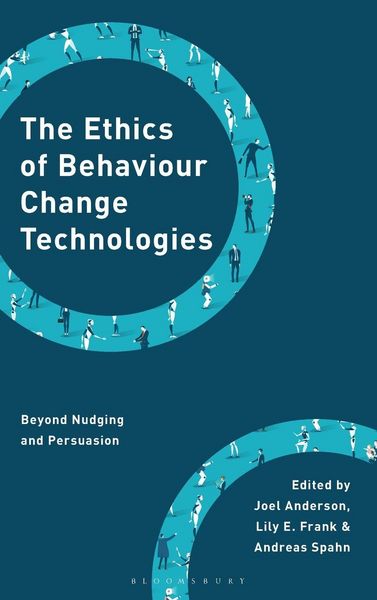
Produktbild: The Ethics of Behaviour Change Technologies

The Ethics of Behaviour Change Technologies Beyond Nudging and Persuasion

153,99 €

inkl. gesetzl. MwSt., Versandkostenfrei


Beschreibung

Produktdetails

Einband

Gebundene Ausgabe

Erscheinungsdatum

02.10.2025

Abbildungen

3 bw illus

Herausgeber

Anderson Joel + weitere

Verlag

Rowman & Littlefield

Seitenzahl

288

Maße (L/B/H)

23,5/15,7/2 cm

Gewicht

571 g

Sprache

Englisch

ISBN

978-1-78661-326-4

Beschreibung

Portrait

Joel Anderson is Professor of Moral Psychology and Social Philosophy at the Ethics Institute in the Department of Philosophy and Religious Studies of Utrecht University, the Netherlands. In his work, he develops a relational and intersubjectivist conception of autonomy, a recognitional account of critical social theory, an "extended" approach to self-regulation and disability studies, and a social ethics of technology. He is currently working on a book on "Autonomy Gaps" and editing a collection about how technology is "Disrupting the Human." He is also a principal investigator in the research consortium Ethics of Socially Disruptive Technologies (ESDiT.nl).

Lily E. Frank is Assistant Professor of Philosophy and Ethics at Eindhoven University of Technology, the Netherlands. Her research encompasses biomedical ethics, biotechnology, moral psychology, and ethics of technology. Currently, she investigates topics such as moral expertise, the moralization of health conditions, and the interplay between technology and moral progress. She also explores reproductive ethics, including issues like abortion and the development of artificial uteruses. Frank serves as a Senior Researcher at the 4TU Center for Ethics and Technology and is a board member of the TU/e Center for Humans and Technology.

Andreas Spahn is Associate Professor in the Philosophy and Ethics research group at the Eindhoven University of Technology, the Netherlands. He has worked and published on ethics of behaviour change technologies and persuasive technologies, ethics of energy systems, and environmental ethics, as well as on the role of ethics in engineering education. Spahn is a member of the management team and senior researchers in the 4TU Center for Ethics and Technology, as well as in the ESDiT research program on Ethics of Socially Disruptive Technologies.

Produktdetails

Einband

Gebundene Ausgabe

Erscheinungsdatum

02.10.2025

Abbildungen

3 bw illus

Herausgeber

Verlag

Rowman & Littlefield

Seitenzahl

288

Maße (L/B/H)

23,5/15,7/2 cm

Gewicht

571 g

Sprache

Englisch

ISBN

978-1-78661-326-4

Herstelleradresse

Libri GmbH
Europaallee 1
36244 Bad Hersfeld
DE

Email: gpsr@libri.de

Noch keine Bewertungen vorhanden

Verfassen Sie die erste Bewertung zu diesem Artikel

Helfen Sie anderen Kundinnen und Kunden durch Ihre Meinung.

Kundinnen und Kunden meinen

Bewertungen (0)

Die Leseprobe wird geladen.
  • Produktbild: The Ethics of Behaviour Change Technologies
  • Introduction: The Ethical Landscape of Behaviour Change Technology
    Joel Anderson (Utrecht University, the Netherlands), Lily E. Frank (Eindhoven University of Technology, the Netherlands), Andreas Spahn (Eindhoven University of Technology, the Netherlands) and Arianna Sica (Eindhoven University of Technology, the Netherlands)
    Part I. Foundations
    1. Psychology of Behaviour Change
    Wokje Abrahamse (Victoria University of Wellington, New Zealand) and Nadja Contzen (Eawag: Swiss Federal Institute of Aquatic Science and Technology, Switzerland, and University of Groningen, the Netherlands)
    Chapter 2. Technologies of Behaviour Change
    Harri Oinas-Kukkonen (University of Oulu, Finland) and Eunice E.Y.F. Agyei (University of Oulu, Finland)
    Chapter 3. Guiding Hands or Invisible Chains? On the Ethics and Philosophy of Behaviour Change Technologies
    Andreas Spahn (Eindhoven University of Technology, the Netherlands) and Lily E. Frank (Eindhoven University of Technology, the Netherlands)
    Part II. Values and Principles
    Chapter 4. Control, Personal Autonomy, and Behaviour Change Technologies
    Sven Nyholm (Ludwig Maximilian University of Munich, Germany)
    Chapter 5. Transparency and Trust in Behaviour Change Technologies
    Philip J. Nickel (Eindhoven University of Technology, the Netherlands)
    Chapter 6. Privacy, Consent, and Behaviour Change Technologies
    Titus Stahl (University of Groningen, the Netherlands)
    Chapter 7. Social Justice, Autonomous Agency, and Interpersonal Recognition
    Joel Anderson (Utrecht University, the Netherlands)
    Part III. Cases and Applications
    Chapter 8. Limiting Driver Autonomy for Safety and Sustainability
    Jilles Smids (Erasmus University Rotterdam, the Netherlands)
    Chapter 9. 'Good Patients Manage Their Health': A Critical Conceptual Analysis of the Patient as Health Manager Using Smart Technology
    Tania Moerenhout (University of Otago, New Zealand) and Katleen Gabriels (Maastricht University, the Netherlands)
    Chapter 10. The Ethics of Using Boosts to Change Behaviour
    Till Grüne-Yanoff (Royal Institute of Technology, Sweden)
    Chapter 11. The Cumulative Impact of Behaviour Change Interventions
    Will Tiemeijer (Erasmus University Rotterdam, the Netherlands)
    Chapter 12. Pandemic Behaviour Change Technology, Autonomy, and Confucian Philosophy: The Case of Jiankangma (China's Digital Health Code)
    Tom Xiaowei Wang (Renmin University of China, China) and Pak-Hang Wong (Hong Kong Baptist University, Hong Kong)
    Chapter 13. Behaviour Change, Technology, and the Regulation of the Poor: A Case Study of the 'Water Wars' in South Africa
    Brendon R. Barnes (University of Johannesburg, South Africa)
    Index
    About the Contributors