KI-Beratung Beta

Produktbild: Fashionopolis

Fashionopolis Why What We Wear Matters

1

19,99 €

inkl. gesetzl. MwSt., zzgl. Versandkosten


  • Kostenlose Lieferung ab 30 € Einkaufswert
  • Versandkostenfrei für Bonuscard-Kund*innen

Beschreibung

*NYTBR Paperback Row Selection * The Independent's Best Fashion Book on Sustainability * Ralph Nader's Top Ten of the Year* An investigation into the damage wrought by the colossal clothing industry and the grassroots, high-tech, international movement fighting to reform it What should I wear? It’s one...

Beschreibung

*NYTBR Paperback Row Selection * The Independent's Best Fashion Book on Sustainability * Ralph Nader's Top Ten of the Year*
An investigation into the damage wrought by the colossal clothing industry and the grassroots, high-tech, international movement fighting to reform it
What should I wear? It’s one of the fundamental questions we ask ourselves every day. More than ever, we are told it should be something new. Today, the clothing industry churns out 80 billion garments a year and employs every sixth person on Earth. Historically, the apparel trade has exploited labor, the environment, and intellectual property—and in the last three decades, with the simultaneous unfurling of fast fashion, globalization, and the tech revolution, those abuses have multiplied exponentially, primarily out of view. We are in dire need of an entirely new human-scale model. Bestselling journalist Dana Thomas has traveled the globe to discover the visionary designers and companies who are propelling the industry toward that more positive future by reclaiming traditional craft and launching cutting-edge sustainable technologies to produce better fashion.
 
In Fashionopolis, Thomas sees renewal in a host of developments, including printing 3-D clothes, clean denim processing, smart manufacturing, hyperlocalism, fabric recycling—even lab-grown materials. From small-town makers and Silicon Valley whizzes to such household names as Stella McCartney, Levi’s, and Rent the Runway, Thomas highlights the companies big and small that are leading the crusade.
 
We all have been casual about our clothes. It's time to get dressed with intention. Fashionopolis is the first comprehensive look at how to start.

Produktdetails

Einband

Taschenbuch

Erscheinungsdatum

08.09.2020

Abbildungen

B&W PHOTOS THROUGHOUT

Verlag Random House N.Y.

Produktdetails

Einband

Taschenbuch

Erscheinungsdatum

08.09.2020

Abbildungen

B&W PHOTOS THROUGHOUT

Verlag Random House N.Y.
Seitenzahl

320

Maße (L/B/H)

21/13,8/2,2 cm

Gewicht

294 g

Sprache

Englisch

ISBN

978-0-7352-2403-2

Herstelleradresse

Libri GmbH
Europaallee 1
36244 Bad Hersfeld
DE

Email: gpsr@libri.de

Kundinnen und Kunden meinen

Informationen zu Bewertungen

Zur Abgabe einer Bewertung ist eine Anmeldung im Konto notwendig. Die Authentizität der Bewertungen wird von uns nicht überprüft. Wir behalten uns vor, Bewertungstexte, die unseren Richtlinien widersprechen, entsprechend zu kürzen oder zu löschen.

Die Bewertungen sind nach Format, Anzahl Sterne und Datum sortiert.

  • Bewertung

    aus Watt

    5/5

    18.04.2023

    Buch (Taschenbuch)

    “Fashionopolis” by Dana Thomas – a worthwhile and highly interesting book on fast fashion

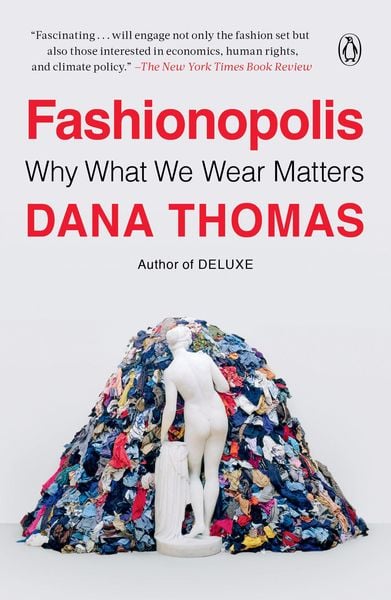
    The author created a disillusioning yet inspiring piece of work on the topic of fast fashion. By presenting shocking and worth-knowing facts on the textile industry, Dana Thomas manages to captivate the readers easily. Supported by studies and interviews with various people, Thomas created a highly informative but at the same time smoothly written book. The eye-catching cover and illustration are impressively showing the (negative) impacts of the fast fashion industry at one sight – on our environment and humans living in it or as employees. Nowadays, we often have the impression to know “a lot”. To quote Thomas: “We imagine ourselves as more learned, more egalitarian, more humane than our predecessors. More woke. That by procuring $5 tees and $20 jeans by the sackful, we aren’t causing grievous harm. We might even be creating good jobs on the other side of the world for those in need. Having visited many offshore factories and spoken with dozens of workers, I can assure you this is not reality” (p. 11). Still, we learn that there are reasons to “remain hopeful” – even if there might not be a global movement yet. As consumers, we play a major role in the game that Thomas calls “Fashionopolis”. This book should function as a wake-up call to not be casual about our clothes anymore but to care about the “troubles that come with a global, opaque supply chain” (p. 12). Moreover, we learn about Fashion tycoons and the story behind stores such as Zara and so on. Thomas goes on to explain to us how, for example, sweatshops in Los Angeles look like, what the NAFTA agreement triggered, or how resource-intensive the fashion industry is. Additionally, we learn about alternatives to fast fashion, or what is being done to “push back” on the current model. Thomas aptly writes: “The revolution is not only going to be born from the makers. We all have to step up. Buy less. Wash our clothes differently. Repair or upcycle them more. Consider the impact of the material they are made of. Consider the supply chain that produces them. Consider the tenets of the company that created and distributed them. We need to fashion a personal style that does more good for the world than ill” (p. 290). Overall, I highly recommend reading “Fashionopolis”: presenting not only many worthwhile and to me unknown facts and history, but it also inspires me to change one’s behavior while presenting some interesting alternatives.

Kundinnen und Kunden meinen

5

1

4

0

3

0

2

0

1

0

Bewertungen (1)

Die Leseprobe wird geladen.
  • Produktbild: Fashionopolis