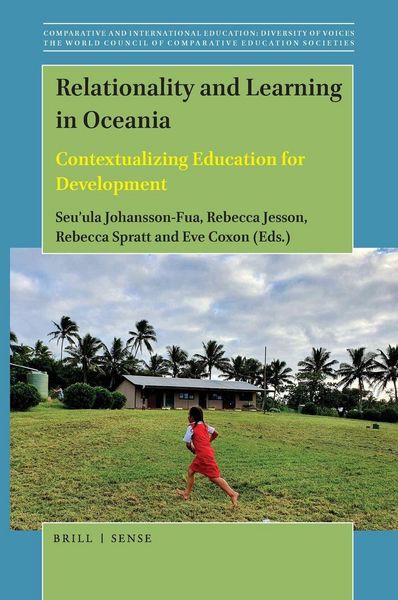
Relationality and Learning in Oceania Contextualizing Education for Development
-
- Englisch ausgewählt
65,99 €
inkl. gesetzl. MwSt.,
Beschreibung
Produktdetails
Einband
Taschenbuch
Erscheinungsdatum
20.02.2020
Herausgeber
Seu'ula Johansson-Fua + weitereVerlag
BrillSeitenzahl
172
Maße (L/B/H)
23,4/15,2/1,3 cm
Gewicht
318 g
Sprache
Englisch
ISBN
978-90-04-42529-3
This multi-authored volume draws on the collective experiences of a team of researcher-practitioners, from three Oceanic universities, in an aid-funded intervention program for enhancing literacy learning in Pacific Islands primary education schools. The interventions explored here--in Solomon Islands and Tonga--were implemented via a four-year collaboration which adopted a design-based research approach to bringing about sustainable improvements in teacher and student learning, and in the delivery and evaluation of educational aid. This approach demanded that learning from the context of practice should be determining of both content and process; that all involved in the interventions should see themselves as learners. Essential to the trusting and respectful relationships required for this approach was the program's acknowledgement of relationality as central to indigenous Oceanic societies, and of education as a relational activity.
Relationality and Learning in Oceania: Contextualizing Education for Development addresses debates current in both comparative education and international aid. Argued strongly is that relational research-practice approaches (south-south, south-north) which center the importance of context and culture, and the significance of indigenous epistemologies, are required to strengthen education within the post-colonial relational space of Oceania, and to inform the various agencies and actors involved in 'education for development' in Oceania and globally. Maintained is that the development of education structures and processes within the contexts explored through the chapters comprising this volume, continues to be a negotiation between the complexity of historically developed local 'traditions' and understandings and the 'global' imperatives shaped by dominant development discourses.
Noch keine Bewertungen vorhanden
Verfassen Sie die erste Bewertung zu diesem Artikel
Helfen Sie anderen Kundinnen und Kunden durch Ihre Meinung.
Kurze Frage zu unserer Seite
Vielen Dank für Ihr Feedback
Wir nutzen Ihr Feedback, um unsere Produktseiten zu verbessern. Bitte haben Sie Verständnis, dass wir Ihnen keine Rückmeldung geben können. Falls Sie Kontakt mit uns aufnehmen möchten, können Sie sich aber gerne an unseren Kund*innenservice wenden.
zum Kundenservice