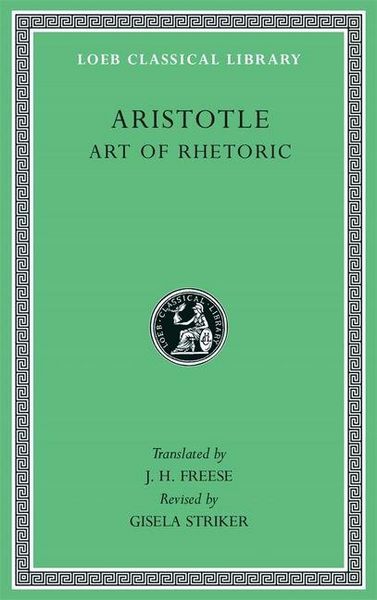
Art of Rhetoric
-
- Hardcover ausgewählt
- Taschenbuch
- eBook
-
Sprache:Englisch
-
Verlag:University Presses
35,99 €
inkl. gesetzl. MwSt.,
Beschreibung
Produktdetails
Einband
Gebundene Ausgabe
Erscheinungsdatum
09.06.2020
Verlag
University PressesSeitenzahl
528
Maße (L/B/H)
18,3/11,4/0,2 cm
Gewicht
374 g
Übersetzt von
J. H. Freese
Sprache
Englisch
ISBN
978-0-674-99732-5
Persuasion analyzed.
Aristotle (384-322 BC), the great Greek thinker, researcher, and educator, ranks among the most important and influential figures in the history of philosophy, theology, and science. He joined Plato's Academy in Athens in 367 and remained there for twenty years. After spending three years at the Asian court of a former pupil, Hermeias, where he married Pythias, one of Hermeias' relations, and living for a time at Mytilene, he was appointed by Philip of Macedon in 343/2 to become tutor of his teenaged son, Alexander. After Philip's death in 336, Aristotle became head of his own school, the Lyceum at Athens, whose followers were known as the Peripatetics. Because of anti-Macedonian feeling in Athens after Alexander's death in 323, Aristotle withdrew to Chalcis in Euboea, where he died in 322.
Aristotle wrote voluminously on a broad range of subjects analytical, practical, and theoretical, but nearly all the works that he prepared for publication are lost; extant are lecture-materials, notes, and memoranda, some spurious. Rhetoric, a manual for public speakers, was probably composed while Aristotle was still at the Academy and Isocrates was still alive. Instead of the sophistic and Isocratean method of imitating model speeches, Aristotle devised a systematic method based in dialectic, on which he had recently written the first manual. The goal of rhetoric is to find the available means of persuasion for any given case using argument, the character of the speaker, and the emotions of the audience. Rhetoric, he says, is "a kind of offshoot from dialectic and the study of character, which is justly called the science of politics."
This edition of Aristotle's Rhetoric, which replaces the original Loeb edition by J. H. Freese, supplies a Greek text based on that of Rudolf Kassel, a fresh translation, and ample annotation fully current with modern scholarship.
Noch keine Bewertungen vorhanden
Verfassen Sie die erste Bewertung zu diesem Artikel
Helfen Sie anderen Kundinnen und Kunden durch Ihre Meinung.
Kurze Frage zu unserer Seite
Vielen Dank für Ihr Feedback
Wir nutzen Ihr Feedback, um unsere Produktseiten zu verbessern. Bitte haben Sie Verständnis, dass wir Ihnen keine Rückmeldung geben können. Falls Sie Kontakt mit uns aufnehmen möchten, können Sie sich aber gerne an unseren Kund*innenservice wenden.
zum Kundenservice