Beschreibung
Produktdetails
Einband
Gebundene Ausgabe
Erscheinungsdatum
01.08.2022
Herausgeber
Kaiyou Wang + weitereVerlag
John Wiley & Sons IncSeitenzahl
336
Maße (L/B/H)
24,8/17/2,4 cm
Gewicht
726 g
Auflage
1. Auflage
Sprache
Englisch
ISBN
978-1-119-69897-5
Discover the latest advances in spintronic materials, devices, and applications
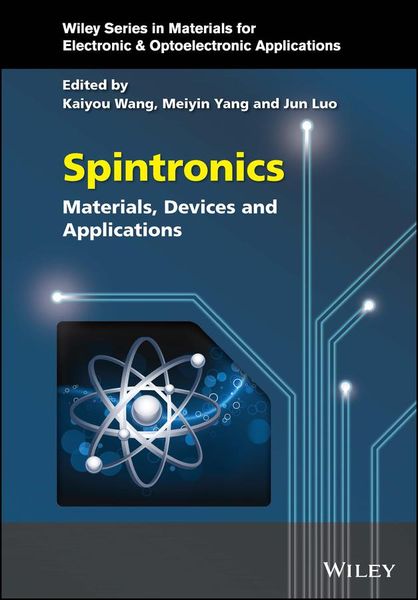
In Spintronics: Materials, Devices and Applications, a team of distinguished researchers delivers a holistic introduction to spintronic effects within cutting-edge materials and applications. Containing the perfect balance of academic research and practical application, the book discusses the potential--and the key limitations and challenges--of spintronic devices.
The latest title in the Wiley Series in Materials for Electronic and Optoelectronic Applications, Spintronics: Materials, Devices and Applications explores giant magneto-resistance (GMR) and tunneling magnetic resistance (TMR) materials, spin-transfer torque and spin-orbit torque materials, spin oscillators, and spin materials for use in artificial neural networks. Applications in multi-ferroelectric and antiferromagnetic materials are presented as well.
This book also includes:
* A thorough introduction to recent research developments in the fields of spintronic materials, devices, and applications
* Comprehensive explorations of skymions, magnetic semiconductors, and antiferromagnetic materials
* Practical discussions of spin-transfer torque materials and devices for magnetic random-access memory
* In-depth examinations of giant magneto-resistance materials and devices for magnetic sensors
Perfect for advanced students and researchers in materials science, physics, electronics, and computer science, Spintronics: Materials, Devices and Applications will also earn a place in the libraries of professionals working in the manufacture of optics, photonics, and nanometrology equipment.
In Spintronics: Materials, Devices and Applications, a team of distinguished researchers delivers a holistic introduction to spintronic effects within cutting-edge materials and applications. Containing the perfect balance of academic research and practical application, the book discusses the potential--and the key limitations and challenges--of spintronic devices.
The latest title in the Wiley Series in Materials for Electronic and Optoelectronic Applications, Spintronics: Materials, Devices and Applications explores giant magneto-resistance (GMR) and tunneling magnetic resistance (TMR) materials, spin-transfer torque and spin-orbit torque materials, spin oscillators, and spin materials for use in artificial neural networks. Applications in multi-ferroelectric and antiferromagnetic materials are presented as well.
This book also includes:
* A thorough introduction to recent research developments in the fields of spintronic materials, devices, and applications
* Comprehensive explorations of skymions, magnetic semiconductors, and antiferromagnetic materials
* Practical discussions of spin-transfer torque materials and devices for magnetic random-access memory
* In-depth examinations of giant magneto-resistance materials and devices for magnetic sensors
Perfect for advanced students and researchers in materials science, physics, electronics, and computer science, Spintronics: Materials, Devices and Applications will also earn a place in the libraries of professionals working in the manufacture of optics, photonics, and nanometrology equipment.
Noch keine Bewertungen vorhanden
Verfassen Sie die erste Bewertung zu diesem Artikel
Helfen Sie anderen Kundinnen und Kunden durch Ihre Meinung.
Kurze Frage zu unserer Seite
Vielen Dank für Ihr Feedback
Wir nutzen Ihr Feedback, um unsere Produktseiten zu verbessern. Bitte haben Sie Verständnis, dass wir Ihnen keine Rückmeldung geben können. Falls Sie Kontakt mit uns aufnehmen möchten, können Sie sich aber gerne an unseren Kund*innenservice wenden.
zum Kundenservice