Gutscheinbedingungen

**Gültig bis 17.08.2026 auf Schreibwaren & Office-Artikel online auf thalia.at, in der Thalia App und in teilnehmenden Thalia Buchhandlungen in Österreich mit Schulsortiment. In den Buchhandlungen nur gültig auf lagernde Ware. Einzelne Artikel können ausgeschlossen sein. Ausgenommen sind preisgebundene Artikel. Pro Einkauf einmal einlösbar. Nur gültig gegen Vorlage oder im Onlineshop hinterlegter Bonuscard. Infos zur Einlösung in der Buchhandlung sind auf der Bonuscard-Vorteilspreisseite zu finden. Click & Collect nur bei Onlinevorabzahlung möglich. Keine Einlösung bei Scan & Go-Bezahlung. Keine Barauszahlung. Nicht kombinierbar mit anderen Aktionen und Gutscheinen. Gutschein wird auf max. 500€ Bestellwert angerechnet. Nicht gültig für Geschenkkarten, Versandkosten und Services.

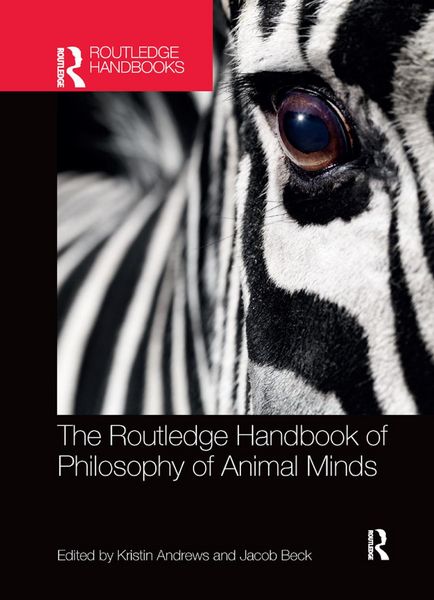
Produktbild: The Routledge Handbook of Philosophy of Animal Minds

The Routledge Handbook of Philosophy of Animal Minds

72,99 €

inkl. gesetzl. MwSt., Versandkostenfrei


Beschreibung

Produktdetails

Einband

Taschenbuch

Erscheinungsdatum

12.12.2019

Herausgeber

Kristin Andrews + weitere

Verlag

Taylor & Francis

Seitenzahl

540

Maße (L/B/H)

24,7/17,7/3,5 cm

Gewicht

930 g

Sprache

Englisch

ISBN

978-0-367-87129-1

Beschreibung

Rezension

"This collection offers readers a rich feast of ideas, information and argument about the minds of some of the other beings with whom we share our planet. The chapters draw on recent scientific breakthroughs that inform discussions of such questions as the possibility of consciousness in ants, on the evidence for pain in fish, and on the capacities for empathy of rats and chimpanzees. It is hard to imagine any reader who will not find something in these pages that will excite his or her own mind." - Peter Singer, Princeton University, USA; author of Animal Liberation

"This is exciting stuff! A new field of philosophy has come of age and this broad ranging volume has assembled an all-star collection of authors. For anyone interested in animals and their mental life, it will be the go-to volume for the next decade." - Stephen Stich, Rutgers University, USA

"What is it like to be a non-human being? In penetrating, sometimes entertaining chapters, numerous authors summarize the many approaches to the many parts of the answer to that question. This is a thorough overview of the immense span of human thinking about the capacity of non-human beings to experience life. It is a great resource for students, teachers, researchers, and writers interested in the topic." - Carl Safina, Stony Brook University, USA; author of Beyond Words: What Animals Think and Feel

Produktdetails

Einband

Taschenbuch

Erscheinungsdatum

12.12.2019

Herausgeber

Verlag

Taylor & Francis

Seitenzahl

540

Maße (L/B/H)

24,7/17,7/3,5 cm

Gewicht

930 g

Sprache

Englisch

ISBN

978-0-367-87129-1

Herstelleradresse

Libri GmbH
Europaallee 1
36244 Bad Hersfeld
DE

Email: gpsr@libri.de

Noch keine Bewertungen vorhanden

Verfassen Sie die erste Bewertung zu diesem Artikel

Helfen Sie anderen Kundinnen und Kunden durch Ihre Meinung.

Kundinnen und Kunden meinen

Bewertungen (0)

Die Leseprobe wird geladen.
  • Produktbild: The Routledge Handbook of Philosophy of Animal Minds
  • Introduction, Kristin Andrews and Jacob Beck

    Part 1: Mental Representation

    1. Arthropod Intentionality? Andrew Knoll and Georges Rey

    2. Visual imagery in the thought of monkeys and apes Christopher Gauker

    3. Maps in the Head? Michael Rescorla

    4. Do Nonhuman Animals Have a Language of Thought? Jacob Beck

    5. Animal minds in time: the question of episodic memory Christoph Hoerl and Teresa McCormack

    6. Novel Colours in Animal Perception Mohan Matthen

    7. Color manipulation and comparative color: they're not all compatible Derek Brown

    Part 2: Reasoning and Metacognition

    8. Animal rationality and belief Hans-Johann Glock

    9. Instrumental Reasoning in Nonhuman Animals Elisabeth Camp and Eli Shupe

    10. A Different Kind of Mind? Matthew Boyle

    11. Can Non-Linguistic Animals Think about Thinking? José Luis Bermúdez

    12. On Psychological Explanations and Self-Concepts (in some animals) Eric Saidel

    13. Non-human metacognition Joelle Proust

    Part 3: Consciousness

    14. So That's What It's Like! Sean Allen-Hermanson

    15. Do Fish Have Feelings? Michael Tye

    16. The Unpleasantness of Pain for Nonhuman Animals Adam Shriver

    17. Attention, Working Memory, and Animal Consciousness Jesse Prinz

    18. Animal Consciousness and Higher-Order Thoughts. Rocco Gennaro

    19. Minds and Bodies in Animal Evolution Michael Trestman

    20. The Evolution of Consciousness in Phylogenetic Context Peter Godfrey-Smith

    Part 4: Mindreading

    21. Animal Mindreading: The Problem and How It Can Be Solved Robert Lurz

    22. What apes know about seeing Marta Halina

    23. Using Causal Models to Think About Mindreading Hayley Clatterbuck

    24. Do Chimpanzees Reason About Belief Kristin Andrews

    25. Tracking and Representing Others' Mental States Stephen Butterfill

    26. From False Beliefs to True Interactions: Are Chimpanzees Socially Enactive? Sarah Vincent and Shaun Gallagher

    Part 5: Communication

    27. Pragmatic Interpretation and Signaler-Receiver Asymmetries in Animal Communication Dorit Bar-On and Richard Moore

    28. Communicative Intentions, Expressive Communication, and Origins of Meaning Dorit Bar-On

    29. How much mentality is needed for meaning? Mitchell S. Green

    30. The Content of Animal Signals Ulrich Stegmann

    31. Intentionality and Flexibility in Animal Communication Christine Sievers, Markus Wild, and Thibaud Gruber

    Part 6: Social Cognition and Culture

    32. What is animal culture? Grant Ramsey

    33. Varieties of Culture Grant Goodrich

    34. Animal Traditions: What they are, and why they matter Rachael Brown

    35. Primates are touched by your concern: touch, emotion, and social cognition in chimpanzees Maria Botero

    36. Do chimpanzees conform to social norms? Laura Schlingloff and Richard Moore

    37. Kinds of collective behavior and the possibility of group minds Bryce Huebner

    Part 7: Association, Simplicity, & Modeling

    38. Associative Learning Colin Allen

    39. Understanding Associative and Cognitive Explanations in Comparative Psychology Cameron Buckner

    40. A New View of Association and Associative Models Michael Dacey

    41. Simplicity and Cognitive Models: Avoiding Old Mistakes in New Experimental Contexts Irina Mikhalevich

    42. Against Morgan's Canon Simon Fitzpatrick

    43. A Bridge Too Far? Inference and Extrapolation from Animal Models in Neuroscience David M. Kaplan

    Part 8: Ethics

    44. Animals and Ethics, Agents and Patients Dale Jamieson

    45. Moral Subjects Mark Rowlands

    46. Decisional authority and animal research subjects Andrew Fenton

    47. Empathy in Mind Lori Gruen

    48. Using, Owning, and Exploiting Animals Alasdair Cochrane

    49. Animal Mind and Animal Ethics Bernard Rollin.

    Index