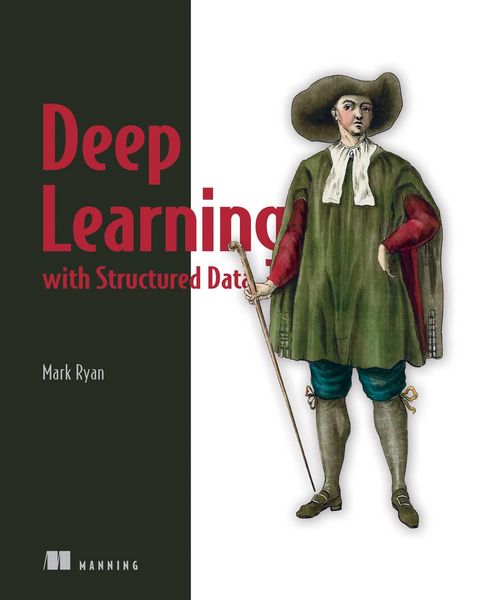
Deep Learning with Structured Data
-
- Taschenbuch ausgewählt
- eBook
-
Sprache:Englisch
69,99 €
inkl. gesetzl. MwSt.,
Beschreibung
Produktdetails
Einband
Taschenbuch
Erscheinungsdatum
29.12.2020
Verlag
Pearson AcademicSeitenzahl
264
Maße (L/B/H)
23,1/18,5/1,8 cm
Gewicht
440 g
Auflage
1. Auflage
Sprache
Englisch
ISBN
978-1-61729-672-7
Deep Learning with Structured Data teaches you powerful data analysis techniques for tabular data and relational databases.
Summary
Deep learning offers the potential to identify complex patterns and relationships hidden in data of all sorts. Deep Learning with Structured Data shows you how to apply powerful deep learning analysis techniques to the kind of structured, tabular data you'll find in the relational databases that real-world businesses depend on. Filled with practical, relevant applications, this book teaches you how deep learning can augment your existing machine learning and business intelligence systems.
About the technology
Here’s a dirty secret: Half of the time in most data science projects is spent cleaning and preparing data. But there’s a better way: Deep learning techniques optimized for tabular data and relational databases deliver insights and analysis without requiring intense feature engineering. Learn the skills to unlock deep learning performance with much less data filtering, validating, and scrubbing.
About the book
Deep Learning with Structured Data teaches you powerful data analysis techniques for tabular data and relational databases. Get started using a dataset based on the Toronto transit system. As you work through the book, you’ll learn how easy it is to set up tabular data for deep learning, while solving crucial production concerns like deployment and performance monitoring.
What's inside
When and where to use deep learning
The architecture of a Keras deep learning model
Training, deploying, and maintaining models
Measuring performance
About the reader
For readers with intermediate Python and machine learning skills.
About the author
Mark Ryan is a Data Science Manager at Intact Insurance. He holds a Master's degree in Computer Science from the University of Toronto.
Table of Contents
1 Why deep learning with structured data?
2 Introduction to the example problem and Pandas dataframes
3 Preparing the data, part 1: Exploring and cleansing the data
4 Preparing the data, part 2: Transforming the data
5 Preparing and building the model
6 Training the model and running experiments
7 More experiments with the trained model
8 Deploying the model
9 Recommended next steps
Noch keine Bewertungen vorhanden
Verfassen Sie die erste Bewertung zu diesem Artikel
Helfen Sie anderen Kundinnen und Kunden durch Ihre Meinung.
Kurze Frage zu unserer Seite
Vielen Dank für Ihr Feedback
Wir nutzen Ihr Feedback, um unsere Produktseiten zu verbessern. Bitte haben Sie Verständnis, dass wir Ihnen keine Rückmeldung geben können. Falls Sie Kontakt mit uns aufnehmen möchten, können Sie sich aber gerne an unseren Kund*innenservice wenden.
zum Kundenservice