Gutscheinbedingungen

**Gültig bis 06.07.2026 auf fremdsprachige Bücher online auf thalia.at, in der Thalia App ab einem Mindestbestellwert von 30€ und in allen Thalia Buchhandlungen in Österreich. In den Buchhandlungen nur gültig auf lagernde Ware. Einzelne Artikel können ausgeschlossen sein. Ausgenommen sind preisgebundene Artikel & eBooks. Pro Einkauf einmal einlösbar. Nur gültig gegen Vorlage oder im Onlineshop hinterlegter Bonuscard. Infos zur Einlösung in der Buchhandlung sind auf der Bonuscard-Vorteilspreisseite zu finden. Click & Collect nur bei Onlinevorabzahlung möglich. Keine Einlösung bei Scan & Go-Bezahlung. Keine Barauszahlung. Nicht kombinierbar mit anderen Aktionen und Gutscheinen. Gutschein wird auf max. 500€ Bestellwert angerechnet. Nicht gültig für Versandkosten und Services.

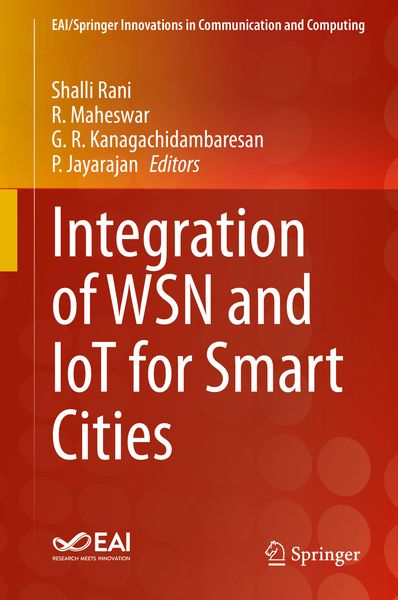
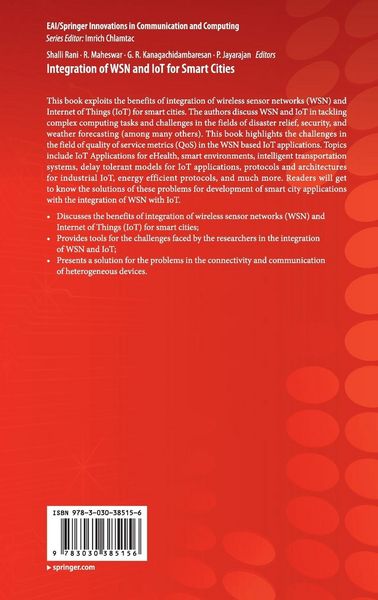
  • Produktbild: Integration of WSN and IoT for Smart Cities
  • Produktbild: Integration of WSN and IoT for Smart Cities

Integration of WSN and IoT for Smart Cities

99,99 €

inkl. gesetzl. MwSt., Versandkostenfrei


Beschreibung

Produktdetails

Einband

Gebundene Ausgabe

Erscheinungsdatum

19.03.2020

Herausgeber

Shalli Rani + weitere

Verlag

Springer

Seitenzahl

199

Maße (L/B/H)

24,1/16/1,8 cm

Gewicht

494 g

Auflage

1st ed. 2020

Sprache

Englisch

ISBN

978-3-030-38515-6

Beschreibung

Portrait

Dr. Shalli Rani is Associate Professor in CSE with Chitkara University, Rajpura, Punjab, India. She has 15 years teaching experience. She received MCA degree from Maharishi Dyanand University, Rohtak in 2004 and the M.Tech. degree in Computer Science from Janardan Rai Nagar Vidyapeeth University, Udaipur in 2007 and Ph.D. degree in Computer Applications from Punjab Technical University, Jalandhar in 2017. Her main area of interest and research is Wireless Sensor Networks, Underwater Sensor networks and Internet of Things. She has published/accepted/presented more than 25 papers in international journals /conferences. She has worked on Big Data, Underwater Acoustic Sensors and IoT to show the importance of WSN in IoT applications. She received a young scientist award in Feb. 2014 from Punjab Science Congress, in the same field.

Dr. R. Maheswar has completed his B.E (ECE) from Madras University in the year 1999, M.E (Applied Electronics) from Bharathiyar University inthe year 2002 and Ph.D in the field of Wireless Sensor Network from Anna University in the year 2012. He has about 18 years of teaching experience at various levels and presently working as Dean – Research (Assistant) and Associate Professor in the School of EEE, VIT Bhopal University, Bhopal. He has published 52 papers at International Journals and International Conferences and published patents. His research interest includes Wireless Sensor Network, IoT, Queueing theory and Performance Evaluation. He has been serving as editorial review board member for peer reviewed journals, guest editor for Wireless Networks Journal, Springer and edited books supported by EAI/Springer Innovations in Communications and Computing book series.

Dr. G. R. Kanagachidambaresan received his B.E degree in Electrical and Electronics Engineering from Anna University in 2010 and M.E Pervasive Computing Technologies in Anna University in 2012. He has completed his Ph.D. in Anna University Chennai in 2017. He is currently an Associate Professor, Department of CSE, Veltech Rangarajan Dr. Sagunthala R&D Institute of Science and Technology. His main research interest includes Body Sensor Network and Fault tolerant Wireless Sensor Network. He has published several reputed articles and undertaken several consultancy activities for leading MNC companies. He has also guest edited several special issue articles and serving as editorial review board members for peer reviewed journals.

Dr. P. Jayarajan has completed his B.E (EEE) from Madurai Kamaraj University in the year 2004, M.E (Applied Electronics) from Anna University in the year 2008 and Ph.D. in the field of Wireless Sensor Network under Anna University in the year 2018. He has about 12 years of teaching experience and presently working as an Assistant Professor in the Electronics and Communication Engineering Department, Sri Krishna College of Technology, Coimbatore. He has published 15 papers at International Journals and Conferences. His research interest includes Wireless Sensor Network and Queueing theory.

Produktdetails

Einband

Gebundene Ausgabe

Erscheinungsdatum

19.03.2020

Herausgeber

Verlag

Springer

Seitenzahl

199

Maße (L/B/H)

24,1/16/1,8 cm

Gewicht

494 g

Auflage

1st ed. 2020

Sprache

Englisch

ISBN

978-3-030-38515-6

Herstelleradresse

Springer-Verlag KG
Sachsenplatz 4-6
1201 Wien
AT

Email: GPSR Kontakt

Noch keine Bewertungen vorhanden

Verfassen Sie die erste Bewertung zu diesem Artikel

Helfen Sie anderen Kundinnen und Kunden durch Ihre Meinung.

Kundinnen und Kunden meinen

Bewertungen (0)

  • Produktbild: Integration of WSN and IoT for Smart Cities
  • Produktbild: Integration of WSN and IoT for Smart Cities
  • Introduction.- Part I: WSN integrated IoT applications.- IoT Applications for eHealth, smart cities.- Hybrid networks for smart environment.- Smart Metering.- Intelligent Transportation Systems.- Vehicular communication networks.- Part II: Wireless Communication protocols for smart environment.- Localization problems.- Protocols for WSN.- Cross layer design issues.- Prototypes for new applications for WSNs and IoT.- Delay tolerant models for IoT applications.- QoS enhancements.- Protocols and architectures for Industrial IoT.- Health care solution and data analytics in hospital environment.- Role of AI and bio inspired computing in decision making.- Deep learning concepts aiding smart city applications.- Part III: Energy optimization and security.- Energy efficient protocols.- Power optimization algorithms.- Challenges in data gathering and processing.- Security, privacy and trust in the IoT context.- Handling network failure during critical duration.- Trust models and digital signature concepts for resource starving embedded systems.- Reliability analysis and fault tolerant architecture for IoT and Edge Computing.- Conclusion.