KI-Beratung Beta

Gutscheinbedingungen

**Gültig am 25.11.2026 auf fremdsprachige Bücher online auf thalia.at und in der Thalia App. Einzelne Artikel können ausgeschlossen sein. Ausgenommen sind preisgebundene Artikel & eBooks. Pro Einkauf einmal einlösbar. Click & Collect nur bei Onlinevorabzahlung möglich. Keine Barauszahlung. Nicht kombinierbar mit anderen Aktionen und Gutscheinen. Gutschein wird auf max. 500€ Bestellwert angerechnet. Nicht gültig für Geschenkkarten, Versandkosten und Services.

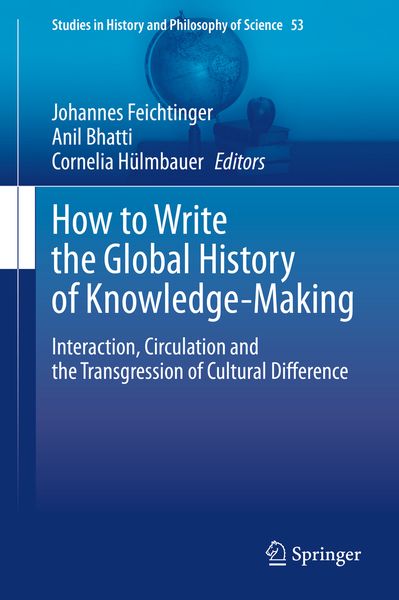
Produktbild: How to Write the Global History of Knowledge-Making
Band 53 - 10%

How to Write the Global History of Knowledge-Making Interaction, Circulation and the Transgression of Cultural Difference

10% sparen

137,99 € UVP 153,99 €

inkl. gesetzl. MwSt., Versandkostenfrei


Beschreibung

This multidisciplinary collection of essays provides a critical and comprehensive understanding of how knowledge has been made, moved and used, by whom and for what purpose. To explain how new knowledge emerges, this volume offers a two-fold conceptual move: challenging both the premise of insurmountable...

Beschreibung

This multidisciplinary collection of essays provides a critical and comprehensive understanding of how knowledge has been made, moved and used, by whom and for what purpose. To explain how new knowledge emerges, this volume offers a two-fold conceptual move: challenging both the premise of insurmountable differences between confined, autarkic cultures and the linear, nation-centered approach to the spread of immutable stocks of knowledge. Rather, the conceptual focus of the book is on the circulation, amalgamation and reconfiguration of locally shaped bodies of knowledge on a broader, global scale. The authors emphasize that  the histories of interaction have been made less transparent through the study of cultural representations thus distorting the view of how knowledge is actually produced.

Leading scholars from a range of fields, including history, philosophy, social anthropology and comparative culture research, have contributed chapters which cover the period from the early modern age to the present day and investigate settings in Africa, Asia, and Europe. Their particular focus is on areas that have largely been neglected until now. In this work, readers from many disciplines will find new approaches to writing the global history of knowledge-making, especially historians, scholars of the history and philosophy of science, and those in culture studies.

Portrait


Johannes Feichtinger
 is a Senior Research Associate at the Austrian Academy of Sciences, and teaches history at the University of Vienna. He specializes in the history and philosophy of science, history of knowledge and culture studies. His publications include two monographs: 
Wissenschaft als reflexives Projekt. Von Bolzano über Freud zu Kelsen. Österreichische Wissenschaftsgeschichte 1848–1938 
(2010), and 
Wissenschaft zwischen den Kulturen.
Österreichische Hochschullehrer in der Emigration 1933–1945
(2001), numerous co-edited volumes, among them
Habsburg Postcolonial
(2003),
Deploying Orientalism in Culture and History. From Germany to Central and Eastern Europe
(2013), and
Understanding Multiculturalism. The Habsburg Central European Experience
 (2014).


Anil Bhatti
 is Professor Emeritus at the JNU New Delhi. He specializes in the theory of literature and culture theory, modern German and comparative literature and comparative culture studies between Europe (Germany, Austria, Switzerland) and India/Asia, orientalism and postcolonial studies. His main publications include coedited volumes on 
Kulturelle Identität. Deutsch-indische Kulturkontakte in Literatur, Religion und Politik
 (1997), 
Reisen, Entdeckungen, Utopien
 (1998), 
Jewish Exile in India
 (1999), and the recently published 
Similarity. A Paradigm for Culture Theory
(2018, in German 2015). He has published a large number of articles focusing on 
Language, Homogeneities, Heterogeneities and Similarity, 
and he holds numerous international fellowships, awards and honors,
 
including the Research Award of the Alexander von Humboldt Foundation.


Cornelia Hülmbauer
was a Junior Research Associate at the Austrian Academy of Sciences from 2013 to 2018. She obtained a PhD from the University of Vienna with a dissertation on English as a Lingua Franca in European multilingualism. Specializing in lingua-cultural diversity and translingual practices, philosophy of language and culture studies, she worked as a researcher for the European FP6 project 
DYLAN – Language Dynamics and Management of Diversity
 as well as for the international network project 
Toolkit for Transnational Communication
. She was co-editor of the volume 
Mehrsprachigkeit aus der Perspektive zweier EU-Projekte: DYLAN meets LINEE
 (2010) and has published various articles in international journals.

Produktdetails

Einband

Gebundene Ausgabe

Erscheinungsdatum

03.03.2020

Abbildungen

VI, 226 p. 1 illus.

Herausgeber Johannes Feichtinger + weitere

Produktdetails

Einband

Gebundene Ausgabe

Erscheinungsdatum

03.03.2020

Abbildungen

VI, 226 p. 1 illus.

Herausgeber
Verlag Springer
Seitenzahl

226

Maße (L/B/H)

24,1/16/1,9 cm

Gewicht

466 g

Auflage

20001 Auflage 1st edition 2020

Sprache

Englisch

ISBN

978-3-030-37921-6

Herstelleradresse

Springer-Verlag GmbH
Europaplatz 3
69115 Heidelberg
DE

Email: ProductSafety@springernature.com

Noch keine Bewertungen vorhanden

Verfassen Sie die erste Bewertung zu diesem Artikel

Helfen Sie anderen Kundinnen und Kunden durch Ihre Meinung.

Kundinnen und Kunden meinen

Bewertungen (0)

  • Produktbild: How to Write the Global History of Knowledge-Making

  • 1. "Introduction: Interaction, Circulation and the Transgression of Cultural Differences in the History of Knowledge-Making" (Johannes Feichtinger).- Part 1. Knowledge Production beyond the Logic of Cultural Difference.- 2. The Role of Exiles in the History of Knowledge: Two Cases (Peter Burke).- 3. "Interactive Knowledge-Making: How and Why Nineteenth-Century Austrian Scientific Travelers in Asia and Africa Overcame Cultural Differences" (Johannes Feichtinger).- Part 2. Mobilizations of Knowledge Reconsidered.- 4. "How Romance Studies Shaped the Ukrainian Language and How the Ukrainian-Romanian Conflict Helped to Create Ladinian: A (Very) Entangled History of A-Political Science" (Jan Surman).- 5. "A Spiritual Unity of Europe and the Yugoslav Politics of Knowledge in the Interwar Period: A Philosophical Enhancement of the ‘Slavic Spirit’" (Dragan Prole).- Part 3. Shifting Positions of and for Knowledge Production.- 6. "A History of Circulation vs. an ‘Episodic’ History of Mathematics in South Asia: Titrating the Historiography and Social Theory of Science and Mathematics" (Dhruv Raina).- 7. "Shaping Newtonianism: The Intersection of Knowledge Claims in Eighteenth-Century Greek Intellectual Life" (Manolis Patiniotis).- Part 4. Writing a Shared History of Knowledge Production.- 8. "Queer Diasporic Practice of a Muslim Traveler: Syed Mujtaba Ali’s Chacha Kahini" (Kris Manjapra).- 9. "Shared Village Stories: How (Not) to Disentangle Literary Historiography from ‘Modernization’" (Marcus Twellmann).- 10. "Can Black Folk Dream—in Theory? Psychoanalysis and Coloniality—Anamnesis of a Failed Encounter" (Ulrike Kistner).- 11. "Positivist Worldmakers: John Stuart Mill’s and Auguste Comte’s Rival Universalisms at the Zenith of Empire" (Franz L. Fillafer).