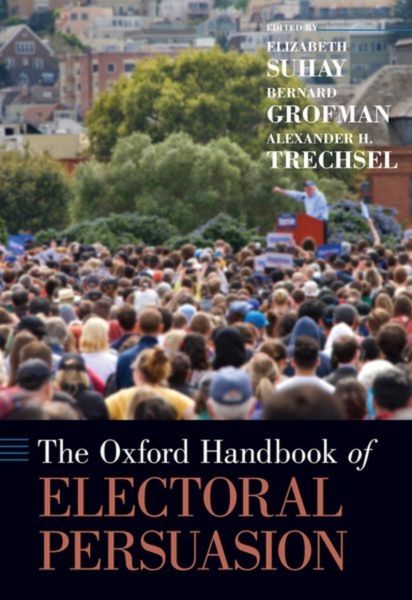
Produktbild: The Oxford Handbook of Electoral Persuasion

The Oxford Handbook of Electoral Persuasion

344,99 €

inkl. gesetzl. MwSt., Versandkostenfrei


Beschreibung

Produktdetails

Einband

Gebundene Ausgabe

Erscheinungsdatum

06.05.2020

Herausgeber

Elizabeth Suhay + weitere

Verlag

Oxford Academic

Seitenzahl

1128

Maße (L/B/H)

25,3/18/6,7 cm

Gewicht

2021 g

Sprache

Englisch

ISBN

978-0-19-086080-6

Beschreibung

Produktdetails

Einband

Gebundene Ausgabe

Erscheinungsdatum

06.05.2020

Herausgeber

Verlag

Oxford Academic

Seitenzahl

1128

Maße (L/B/H)

25,3/18/6,7 cm

Gewicht

2021 g

Sprache

Englisch

ISBN

978-0-19-086080-6

Herstelleradresse

Libri GmbH
Europaallee 1
36244 Bad Hersfeld
DE

Email: gpsr@libri.de

Noch keine Bewertungen vorhanden

Verfassen Sie die erste Bewertung zu diesem Artikel

Helfen Sie anderen Kundinnen und Kunden durch Ihre Meinung.

Kundinnen und Kunden meinen

Bewertungen (0)

Die Leseprobe wird geladen.
  • Produktbild: The Oxford Handbook of Electoral Persuasion

    • 1. A Framework for the Study of Electoral Persuasion


    • Elizabeth Suhay, Bernard Grofman, and Alexander H. Trechsel


    • Part I. General Models of Political Persuasion


    • 2. Classic Models of Persuasion


    • Richard R. Lau


    • 3. When, How, and Why Persuasion Fails: A Motivated Reasoning Account


    • Ryan G. Cotter, Milton Lodge, and Robert Vidigal


    • 4. The Boundary Conditions of Motivated Reasoning


    • Ryan G. Cotter, Milton Lodge, and Robert Vidigal


    • 5. Reasoned Persuasion


    • Bernard Grofman


    • 6. Persuasion and Issue Voting


    • Bernard Grofman


    • 7. Party Cues


    • John G. Bullock


    • 8. How the News Media Persuades: Framing Effects and Beyond


    • Thomas J. Leeper and Rune Slothuus


    • 9. The Emotional Aspects of Political Persuasion


    • Bethany Albertson, Lindsay Dun, and Shana Kushner Gadarian


    • 10. Do Election Campaigns Matter? A Comparative Perspective and Overview


    • J. Alexander Branham and Christopher Wlezien


    • Part II. Persuasion by Parties, Candidates, and Outside Groups


    • 11. The Utility and Content of Traditional Ads


    • Michael Franz


    • 12. The Persuasion Effects of Political Endorsements


    • Cheryl Boudreau


    • 13. Mobilization Strategies and Get Out the Vote


    • Melissa R. Michelson


    • 14. Appealing to Diverse Electorates in the United States


    • David M. Searle and Marisa Abrajano


    • 15. Race and Racism in U.S. Campaigns


    • Christopher Sebastian Parker, Christopher C. Towler, Loren Collingwood, and Kassra AR Oskooii


    • 16. Gendered Aspects of Political Persuasion in Campaigns


    • Kelly Dittmar


    • 17. Persuasion and Non-Party Groups in the Digital Age


    • Deana A. Rohlinger


    • 18. Interest Groups and Elections


    • Jeffrey M. Berry


    • 19. How Electoral Spending Relates to Political Persuasion


    • David B. Magleby


    • 20. Low-Resource Candidates and Fundraising Appeals


    • Richard Johnson


    • Part III. Media Influence


    • 21. Campaigns and Elections in a Changing Media Landscape


    • Michael X. Delli Carpini and Bruce A. Williams


    • 22. Sowing Distrust of the News Media as an Electoral Strategy


    • Jonathan M. Ladd and Alexander R. Podkul


    • 23. Beyond Infotainment: Political-Entertainment Media and Electoral Persuasion


    • Geoffrey Baym and R. Lance Holbert


    • 24. Horse-Race and Game-Framed Journalism's Effects on Turnout, Vote Choice, and Attitudes toward Politics


    • Benjamin Toff


    • 25. Misinformation, Fake News, and Dueling Fact Perceptions in Public Opinion and Elections


    • David C. Barker and Morgan Marietta


    • 26. Conspiracy Theories


    • Joseph E. Uscinski


    • 27. Polarization and Media Usage: Disentangling Causality


    • Justin de Benedictis-Kessner, Matthew A. Baum, and Adam J. Berinsky


    • 28. National and Cross-National Perspectives on Political Media Bias


    • Yphtach Lelkes


    • 29. The Incentives and Effects of Independent and Government-Controlled Media in the Developing World


    • Horacio Larreguy and John Marshall


    • Part IV. Interpersonal Influence


    • 30. Persuasion in Interpersonal Networks


    • Anand Edward Sokhey and Carey Stapleton


    • 31. Social Network Effects in Developing Countries


    • Cesi Cruz, Horacio Larreguy, and John Marshall


    • 32. Voter Mobilization in Intimate Networks


    • Florian Foos and Eline A. de Rooij


    • 33. Citizen Deliberation Online


    • Patrícia Rossini and Jennifer Stromer-Galley


    • 34. Networks and Media Influence


    • David A. Siegel


    • 35. Bandwagon Effects, Information Cascades, and the Power in Numbers


    • Susanne Lohmann


    • 36. Lobbying Networks


    • Jennifer Nicoll Victor


    • Part V. Electoral Persuasion across Contexts


    • 37. Electoral Persuasion in the New Democracies: Challenges and Opportunities


    • Rosario Aguilar and Jeffrey Conroy-Krutz


    • 38. A Menu of Clientelist Methods to Buy and Coerce Voters: The Dark Side of Electoral Persuasion


    • Gilles Serra


    • 39. How and Why the Populist Radical Right Persuades Citizens


    • Elisabeth Ivarsflaten, Scott Blinder, and Lise Bjånesÿy


    • 40. The Strategic Adaptation of the Populist Radical Right in Western Europe: Shifting the Party Message


    • Elie Michel


    • 41. Party Nominations and Electoral Persuasion


    • J. Andrew Sinclair


    • 42. Persuasion and Ballot Propositions


    • Shaun Bowler and Stephen P. Nicholson


    • 43. Online versus Offline Strategies in Comparative Perspective


    • Tiago Silva


    • 44. Voting Advice Applications: The Power of Self-Persuasion


    • Alexander H. Trechsel and Diego Garzia


    • 45. How Voters Distort Their Perceptions and Why This Matters


    • Andrea De Angelis


    • Part VI. Empirical Methodologies for Understanding Electoral Persuasion


    • 46. Accounting for Complex Survey Designs: Strategies for Post-stratification and Weighting of Internet Surveys


    • Erin Hartman and Ines Levin


    • 47. Debating How to Measure Media Exposure in Surveys


    • Seth K. Goldman and Stephen M. Warren


    • 48. Studying Electoral Persuasion Using Online Experiments


    • Thomas J. Leeper


    • 49. Citizens, Elites, and Social Media: Methodological Challenges and Opportunities in the Study of Persuasion and Mobilization


    • Philip Habel and Yannis Theocharis