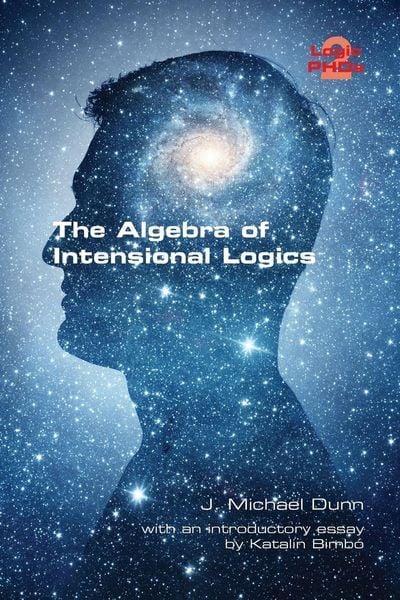
The Algebra of Intensional Logics
-
- Englisch ausgewählt
24,99 €
inkl. gesetzl. MwSt.,
- Kostenlose Lieferung ab 30 € Einkaufswert
- Versandkostenfrei für Bonuscard-Kund*innen
Beschreibung
Produktdetails
Einband
Taschenbuch
Erscheinungsdatum
30.10.2019
Verlag
College PublicationsSeitenzahl
144
Maße (L/B/H)
23,4/15,6/0,8 cm
Gewicht
231 g
Sprache
Englisch
ISBN
978-1-84890-318-0
J. Michael Dunn's PhD dissertation occupies a unique place in the development of the algebraic approach to logic. In The Algebra of Intensional Logics, Dunn introduced De Morgan monoids, a class of algebras in which the algebra of R (the logic of relevant implication) is free. This is an example where a logic's algebra is neither a Boolean algebra with further operations, nor a residuated distributive lattice. De Morgan monoids served as a paradigm example for the algebraization of other relevance logics, including E, the logic of entailment and R-Mingle (RM), the extension of R with the mingle axiom. De Morgan monoids extend De Morgan lattices, which algebraize the logic of first-degree entailments that is a common fragment of R and E. Dunn studied the role of the four-element De Morgan algebra D in the representation of De Morgan lattices, and from this he derived a completeness theorem for first-degree entailments. He also showed that every De Morgan lattice can be embedded into a 2-product of Boolean algebras, and proved related results about De Morgan lattices in which negation has no fixed point. Dunn also developed an informal interpretation for first-degree entailments utilizing the notion of aboutness, which was motivated by the representation of De Morgan lattices by sets. Dunn made preeminent contributions to several areas of relevance logic in his career spanning more than half a century. In proof theory, he developed sequent calculuses for positive relevance logics and a tableaux system for first-degree entailments; in semantics, he developed a binary relational semantics for the logic RM. The use of algebras remained a central theme in Dunn's work from the proof of the admissibility of the rule called γ to his theory of generalized Galois logics (or ``gaggles''), in which the residuals of arbitrary operations are considered. The representation of gaggles---utilizing relational structures---gave a new framework for relational semantics for relevance and for so-called substructural logics, and led to an information-based interpretation of them.
Noch keine Bewertungen vorhanden
Verfassen Sie die erste Bewertung zu diesem Artikel
Helfen Sie anderen Kundinnen und Kunden durch Ihre Meinung.
Kurze Frage zu unserer Seite
Vielen Dank für Ihr Feedback
Wir nutzen Ihr Feedback, um unsere Produktseiten zu verbessern. Bitte haben Sie Verständnis, dass wir Ihnen keine Rückmeldung geben können. Falls Sie Kontakt mit uns aufnehmen möchten, können Sie sich aber gerne an unseren Kund*innenservice wenden.
zum Kundenservice