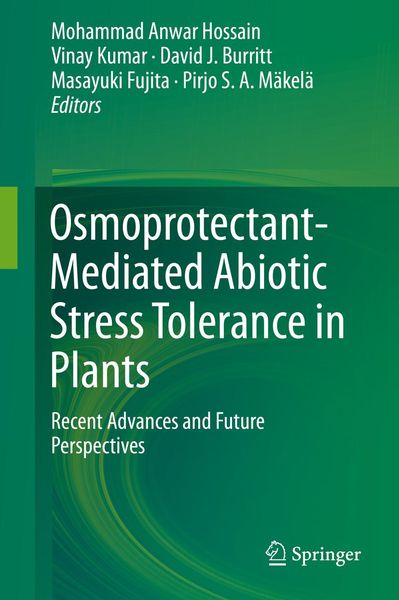
Osmoprotectant-Mediated Abiotic Stress Tolerance in Plants Recent Advances and Future Perspectives
-
- Hardcover
- Taschenbuch
- eBook ausgewählt
-
Form:Einzelkauf Download
-
Sprache:Englisch
153,99 €
inkl. gesetzl. MwSt.Beschreibung
Produktdetails
Format
Kopierschutz
Nein
Family Sharing
Nein
Text-to-Speech
Nein
Erscheinungsdatum
01.11.2019
Herausgeber
Mohammad Anwar Hossain + weitereVerlag
SpringerSeitenzahl
342 (Printausgabe)
Dateigröße
7929 KB
Sprache
Englisch
EAN
9783030274238
In nature, plants are constantly challenged by various abiotic and biotic stresses that can restrict their growth, development and yields. In the course of their evolution, plants have evolved a variety of sophisticated and efficient mechanisms to sense, respond to, and adapt to changes in the surrounding environment. A common defensive mechanism activated by plants in response to abiotic stress is the production and accumulation of compatible solutes (also called osmolytes). This include amino acids (mainly proline), amines (such as glycinebetaine and polyamines), and sugars (such as trehalose and sugar alcohols), all of which are readily soluble in water and non-toxic at high concentrations. The metabolic pathways involved in the biosynthesis and catabolism of compatible solutes, and the mechanisms that regulate their cellular concentrations and compartmentalization are well characterized in many important plant species. Numerous studies have provided evidence that enhancedaccumulation of compatible solutes in plants correlates with increased resistance to abiotic stresses. New insights into the mechanisms associated with osmolyte accumulation in transgenic plants and the responses of plants to exogenous application of osmolyte, will further enhance our understanding of the mechanisms by which compatible solutes help to protect plants from damage due to abiotic stress and the potential roles compatible solutes could play in improving plants growth and development under optimal conditions for growth. Although there has been significant progress made in understanding the multiple roles of compatible solute in abiotic stress tolerance, many aspects associated with compatible solute-mediated abiotic stress responses and stress tolerance still require more research. As well as providing basic up-to-date information on the biosynthesis, compartmentalization and transport of compatible solute in plants, this book will also give insights into the direct or indirect involvement of these key compatible solutes in many important metabolic processes and physiological functions, including their antioxidant and signaling functions, and roles in modulating plant growth, development and abiotic stress tolerance.
In this book, Osmoprotectant-mediated abiotic stress tolerance in plants: recent advances and future perspectives, we present a collection of 16 chapters written by leading experts engaged with compatible solute-induced abiotic stress tolerance in plants. The main objective of this volume is to promote the important roles of these compatible solutes in plant biology, by providing an integrated and comprehensive mix of basic and advanced information for students, scholars and scientists interested in, or already engaged in, research involving osmoprotectant. Finally, this book will be a valuable resource for future environmental stress-related research, and can be considered as a textbook for graduate students and as a reference book for front-line researchers working on the relationships between osmoprotectant and abiotic stress responses and tolerance in plants.
Noch keine Bewertungen vorhanden
Verfassen Sie die erste Bewertung zu diesem Artikel
Helfen Sie anderen Kundinnen und Kunden durch Ihre Meinung.
Kurze Frage zu unserer Seite
Vielen Dank für Ihr Feedback
Wir nutzen Ihr Feedback, um unsere Produktseiten zu verbessern. Bitte haben Sie Verständnis, dass wir Ihnen keine Rückmeldung geben können. Falls Sie Kontakt mit uns aufnehmen möchten, können Sie sich aber gerne an unseren Kund*innenservice wenden.
zum Kundenservice