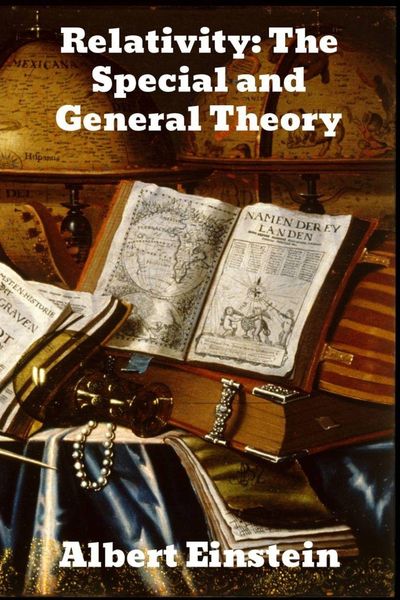
Relativity The Special and General Theory
-
- Hardcover
- Taschenbuch ausgewählt
- eBook
- Hörbuch
-
Sprache:Englisch
-
Verlag:Binker North
- Taylor & Francis 4,99 €
- Lector House 15,99 €
- Hawk Press 14,99 €
- Penguin US 15,99 €
- Penguin Random House India Pvt. Ltd 9,99 €
- Sasa Publishing (OPC) Private Limited 18,99 €
- Www.bnpublishing.net 14,99 €
- Ukiyoto Publishing 13,99 €
- True Sign Publishing House 17,99 €
- Ockham Publishing 14,99 €
- Delhi Open Books 13,99 €
- Crown Publishing Group (ny) 14,99 €
- Martino Fine Books 12,99 €
- Alpha Edition 17,99 €
- Globe Pequot Publishing 15,99 €
- Ancient Wisdom Publications 13,99 €
- Binker North 17,99 € ausgewählt
- Pharos Books Private Limited 17,99 €
17,99 €
inkl. gesetzl. MwSt.,
- Kostenlose Lieferung ab 30 € Einkaufswert
- Versandkostenfrei für Bonuscard-Kund*innen
Beschreibung
Produktdetails
Einband
Taschenbuch
Erscheinungsdatum
01.07.1916
Verlag
Binker NorthSeitenzahl
106
Maße (L/B/H)
22,9/15,2/0,6 cm
Gewicht
167 g
Sprache
Englisch
ISBN
978-1-989708-97-2
Relativity: The Special and the General Theory began as a short paper and was eventually published as a book written by Albert Einstein with the aim of giving: . . . an exact insight into the theory of relativity to those readers who, from a general scientific and philosophical point of view, are interested in the theory, but who are not conversant with the mathematical apparatus of theoretical physics. — from the Preface It was first published in German in 1916 and later translated into English in 1920.[1][2][3] It is divided into 3 parts, the first dealing with special relativity, the second dealing with general relativity and the third dealing with considerations on the universe as a whole. There have been many versions published since the original in 1916, the latest in December, 2011. The work has been labeled[by whom?] unique in that it gives readers an insight into the thought processes of one of the greatest minds of the 20th century. Albert Einstein (14 March 1879 – 18 April 1955) was a German-born theoretical physicist who developed the theory of relativity, one of the two pillars of modern physics (alongside quantum mechanics). His work is also known for its influence on the philosophy of science. He is best known to the general public for his mass–energy equivalence formula which has been dubbed "the world's most famous equation". He received the 1921 Nobel Prize in Physics "for his services to theoretical physics, and especially for his discovery of the law of the photoelectric effect", a pivotal step in the development of quantum theory. Near the beginning of his career, Einstein thought that Newtonian mechanics was no longer enough to reconcile the laws of classical mechanics with the laws of the electromagnetic field. This led him to develop his special theory of relativity during his time at the Swiss Patent Office in Bern (1902–1909). He subsequently realized that the principle of relativity could be extended to gravitational fields, and published a paper on general relativity in 1916 introducing his theory of gravitation. He continued to deal with problems of statistical mechanics and quantum theory, which led to his explanations of particle theory and the motion of molecules. He also investigated the thermal properties of light and the quantum theory of radiation, the basis of laser, which laid the foundation of the photon theory of light. In 1917, he applied the general theory of relativity to model the structure of the universe. Einstein moved to Switzerland in 1895 and renounced his German citizenship in 1896. After being stateless for more than five years, he acquired Swiss citizenship in 1901, which he kept for the rest of his life. Except for one year in Prague, he lived in Switzerland between 1895 and 1914.
Noch keine Bewertungen vorhanden
Verfassen Sie die erste Bewertung zu diesem Artikel
Helfen Sie anderen Kundinnen und Kunden durch Ihre Meinung.
Kurze Frage zu unserer Seite
Vielen Dank für Ihr Feedback
Wir nutzen Ihr Feedback, um unsere Produktseiten zu verbessern. Bitte haben Sie Verständnis, dass wir Ihnen keine Rückmeldung geben können. Falls Sie Kontakt mit uns aufnehmen möchten, können Sie sich aber gerne an unseren Kund*innenservice wenden.
zum Kundenservice