• Produktbild: Understanding Recruitment to Organized Crime and Terrorism
  • Produktbild: Understanding Recruitment to Organized Crime and Terrorism

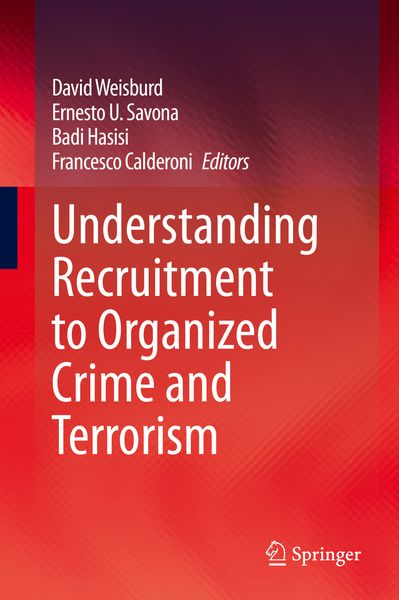
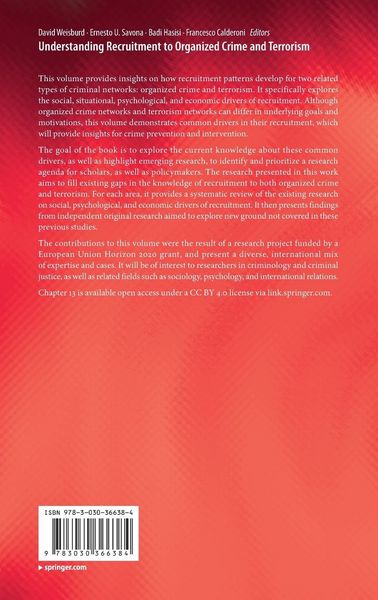
Understanding Recruitment to Organized Crime and Terrorism

129,99 €

inkl. gesetzl. MwSt., Versandkostenfrei


Beschreibung

Produktdetails

Einband

Gebundene Ausgabe

Erscheinungsdatum

12.06.2020

Herausgeber

David Weisburd + weitere

Verlag

Springer

Seitenzahl

348

Maße (L/B/H)

24,1/16/2,5 cm

Gewicht

696 g

Auflage

1st ed. 2020

Sprache

Englisch

ISBN

978-3-030-36638-4

Beschreibung

Portrait

David Weisburd is a Distinguished Professor at George Mason University and Director of the Center for Evidence-Based Crime Policy. He is also the Walter E. Meyer Professor of Law and Criminal Justice at the Hebrew University Faculty of Law in Jerusalem. He serves as Chief Science Advisor at the Police Foundation in Washington DC and is Chair of its Research Advisory Committee. He has received many awards for his contributions to criminology and crime prevention.  These include: the Stockholm Prize in Criminology (2010); the Klachky Family Prize for the Advancement of the Frontiers of Science (2011); the Jerry Lee Award for Lifetime Achievement in Experimental Criminology (Division of Experimental Criminology, ASC, 2014), the Robert Boruch Award for distinctive contributions to research that influences public policy of the Campbell Collaboration (2014); the Sutherland Award for "outstanding contributions to the discipline of criminology" (ASC, 2014); the Israel Prize (generallyregarded as the State of Israel's highest civilian honor) (2015); the Mentoring Award for “excellence in mentorship in the discipline of Criminology and Criminal Justice” (ASC, 2016); and the August Vollmer Award for contributions to the prevention of crime (ASC, 2017).

Ernesto U. Savona is Director of TRANSCRIME, Joint Research Centre of the Università Cattolica del Sacro Cuore and the Università degli Studi di Trento and since 2003 professor of Criminology at the Università Cattolica del Sacro Cuore in Milan. From 1986 to 2002 he was professor of Criminology at the Faculty of Law at the Università degli Studi di Trento. In 2003 he was appointed Editor in Chief of the European Journal on Criminal Policy and Research, an international refereed Journal published by Springer. He is also Editor in chief of the series Research in Brief in International and Comparative Criminology published by Springer. He has been consultant to the United Nations, Council of Europe, the European Union and various national governments. He was also nominated President of the European Society of Criminology for the years 2003/2004. In June 2011 he was appointed Chair for the term 2011-2012 of the Global Agenda Council on Organized Crime del World Economic Forum.

Badi Hasisi serves as an associate professor and Chair of the Institute of Criminology, Faculty of Law, The Hebrew University. His work focuses on the interaction between community and the criminal justice agencies, with specific emphasis on the particular problems faced by minority groups with the criminal justice system. He also specializes in homeland security ad terrorism. In the last three years he received about 900,000 € from the European Commission to study terrorism. He also specializes in evaluating innovations in the criminal justice system. Prof. Hasisi also specializes in the legal history of Mandate Palestine. His recent study focuses on analyzing the reaction of the British court system during the Mandate in Palestine to family honour crimes, especially among the Arab community. He received the 2018 best article prize of the Israeli Organization of Law and History and the Fattal Prize for Excellence in Legal Research & Criminology. Prof. Hasisi also serves as the Executive Editor of the Journal of Quantitative Criminology.

Francesco Calderoni is Associate Professor at the Faculty of Social and Political Sciences at Università Cattolica del Sacro Cuore and researcher at Transcrime Joint Research Centre of the Università Cattolica del Sacro Cuore, the University of Bologna and the University of Perugia. He is coordinator of the International Ph.D. in Criminology and of the master curriculum in Policies for Security at the M.Sc. in Public Policies at Università Cattolica in Milan. He is Associate Editor at Global Crime. He was awarded the Ambrosoli Prize 2010 by the Milan City Council for the best Ph.D. thesis and the Canada-Italy innovation award 2014 by the Canadian Embassy in Italy for the application of network analysis methods to criminal organizations.

Produktdetails

Einband

Gebundene Ausgabe

Erscheinungsdatum

12.06.2020

Herausgeber

Verlag

Springer

Seitenzahl

348

Maße (L/B/H)

24,1/16/2,5 cm

Gewicht

696 g

Auflage

1st ed. 2020

Sprache

Englisch

ISBN

978-3-030-36638-4

Herstelleradresse

Springer-Verlag GmbH
Tiergartenstr. 17
69121 Heidelberg
DE

Email: ProductSafety@springernature.com

Kundinnen und Kunden meinen

0 Bewertungen

Informationen zu Bewertungen

Zur Abgabe einer Bewertung ist eine Anmeldung im Konto notwendig. Die Authentizität der Bewertungen wird von uns nicht überprüft. Wir behalten uns vor, Bewertungstexte, die unseren Richtlinien widersprechen, entsprechend zu kürzen oder zu löschen.

Die Bewertungen sind nach Format, Anzahl Sterne und Datum sortiert.

Verfassen Sie die erste Bewertung zu diesem Artikel

Helfen Sie anderen Kund*innen durch Ihre Meinung

Kundinnen und Kunden meinen

0 Bewertungen filtern

  • Produktbild: Understanding Recruitment to Organized Crime and Terrorism
  • Produktbild: Understanding Recruitment to Organized Crime and Terrorism
  • Introduction: The Context of Recruitment to Organized Crime and Terrorism.- Part 1: Recruitment to Organized Crime Networks.- Systematic Review of the Social, Psychological, and Economic Drivers of Organized Crime Recruitment.- Criminal Careers of Organized Crime Offenders.- Recruitment into Mafias: Criminal Careers of Mafia Members and Mafia Bosses.- Emotional and Cognitive Determinants of Organized Crime Involvement.- Socioeconomic Inequality and Organized Crime Involvement.- Part 2: Recruitment to Terrorist Networks.- Systematic Review of the Social, Psychological, and Economic Drivers of Radicalization and Terrorism Recruitment.- Imprisonment and Criminal Offending of Security Offenders.- Counter-terrorism Legitimacy and Recruitment into Terrorism.- Emotional and Cognitive Determinants of Terrorism Involvement.- Protective Factors against Extremism and Recruitment for Terrorism.- How Real and Perceived Socioeconomic Inequalities Affect Involvement in Terrorism.- Conclusions.