KI-Beratung Beta

Gutscheinbedingungen

**Gültig bis 18.11.2026 auf englischsprachige Klassiker (klassiker-32728) online auf thalia.at und in der Thalia App. Einzelne Artikel können ausgeschlossen sein. Ausgenommen sind preisgebundene Artikel & eBooks. Pro Einkauf einmal einlösbar. Click & Collect nur bei Onlinevorabzahlung möglich. Keine Barauszahlung. Nicht kombinierbar mit anderen Aktionen und Gutscheinen. Gutschein wird auf max. 500€ Bestellwert angerechnet. Nicht gültig für Geschenkkarten, Versandkosten und Services.

  • Produktbild: Smart Healthcare for Disease Diagnosis and Prevention
  • Produktbild: Smart Healthcare for Disease Diagnosis and Prevention

Smart Healthcare for Disease Diagnosis and Prevention

153,99 €

inkl. gesetzl. MwSt., Versandkostenfrei


Beschreibung

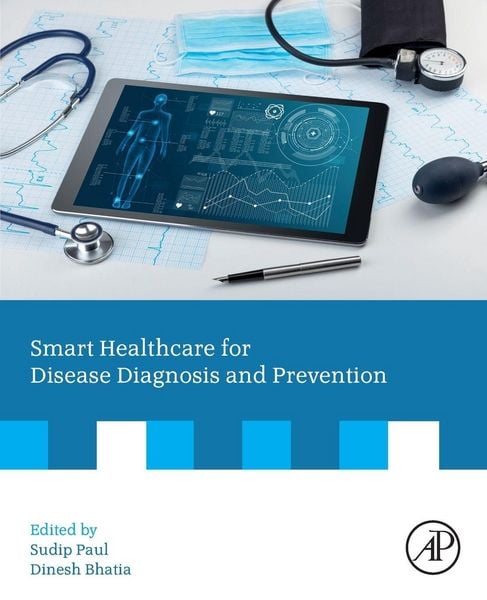
Smart Healthcare for Disease Diagnosis and Prevention focuses on the advancement in healthcare technology to improve human health at all levels using smart technologies. It covers all necessary topics from basic concepts (such as signal and image processing) to advanced knowledge on topics such as tissue...

Beschreibung

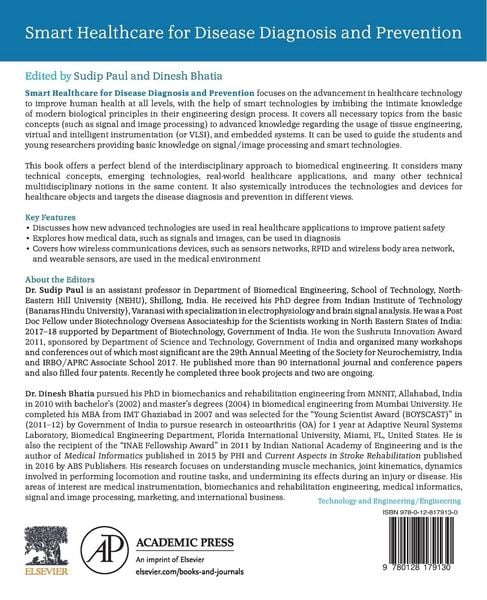
Smart Healthcare for Disease Diagnosis and Prevention focuses on the advancement in healthcare technology to improve human health at all levels using smart technologies. It covers all necessary topics from basic concepts (such as signal and image processing) to advanced knowledge on topics such as tissue engineering, virtual and intelligent instrumentation (or VLSI) and Embedded Systems. This book can be used to guide students and young researchers, providing basic knowledge on signal/image processing and smart technologies. Users will find a perfect blend of the interdisciplinary approach to biomedical engineering.

The book considers many technical concepts, emerging technologies, real-world healthcare applications, and many other technical, multidisciplinary notions in the same content. Finally, it systemically introduces the technologies and devices for healthcare objects and targets disease diagnosis and prevention in different views.

Portrait

Dr. Sudip Paul presently holds the position of Associate Professor in the Department of Biomedical Engineering at the National Institute of Technology, Raipur, India. He conducted his post-doctoral research at the School of Computer Science and Software Engineering, The University of Western Australia, Perth, under the Biotechnology Overseas Associateship scheme for scientists from the North-Eastern States of India (2017-18), supported by the Department of Biotechnology, Government of India. He obtained his Ph.D. from the Indian Institute of Technology (Banaras Hindu University), Varanasi, specializing in Electrophysiology and brain signal analysis. He organized numerous workshops and conferences, notably the 40th Indian Academy of Neuroscience Annual Meeting in 2022, the IEEE Conference on Computational Performance Evaluation in 2020 and 2021, the IRBO/APRC Associate School in 2017, the IBRO Global Engagement in 2021, the IBRO Meeting in 2021, and the 29th Annual Meeting of the Society for Neurochemistry, India in 2015. Dr. Sudip has published about 60 publications in international and national journals, as well as over 50 conference papers across several international and national platforms. He possesses 7 granted patents and 6 granted copyrights. He has finalized 20 book projects as an editor or author with Springer Nature, Elsevier, IGI Global, and others. Dr. Sudip is a Senior Member of IEEE and belongs to various societies and professional organizations, including IAN, IEEE-EMBS, APSN, ISN, and IBRO. He was honored with numerous accolades, notably the World Federation of Neurology (WFN) traveling fellowship, the Young Investigator Award, the IBRO Travel Award, and the ISN Travel Award. Dr. Sudip also imparted his expertise to other international publications as a member of the editorial board and as a reviewer. He has showcased his research achievements in several nations, including the USA, Greece, France, South Africa, and Australia.

Dinesh Bhatia pursued his PhD in Biomechanics and Rehabilitation Engineering from MNNIT, Allahabad, Uttar Pradesh, India with Bachelor's and Master's degrees in Biomedical Engineering from Mumbai University, Mumbai, Maharashtra, India. He is MBA from IMT Ghaziabad, Uttar Pradesh, India. He was selected for the "Young Scientist Award (BOYSCAST)” in (2011-12) by the Government of India to pursue research in osteoarthritis (OA) at Adaptive Neural Systems Laboratory, Florida International University, Miami, Florida, USA. He was selected as one of the twelve young biomedical scientists by the Indian Council of Medical Research (ICMR), Govt. of India in 2015 to pursue research in the field of sensory prosthetics at the University of Glasgow, Scotland, UK. He has authored/published 300+ articles, 12 books, and 30 book chapters. His interest areas are smart healthcare technologies, assistive technologies, and environmental sustainability.
Produktdetails

Einband

Taschenbuch

Erscheinungsdatum

31.01.2020

Herausgeber Sudip Paul + weitere
Verlag Elsevier Science & Technology

Produktdetails

Einband

Taschenbuch

Erscheinungsdatum

31.01.2020

Herausgeber
Verlag Elsevier Science & Technology
Seitenzahl

270

Maße (L/B/H)

23,5/19,1/1,4 cm

Gewicht

471 g

Sprache

Englisch

ISBN

978-0-12-817913-0

EU-Ansprechpartner

Elsevier B.V.
Radarweg 29
1043 NX Amsterdam
NL
productsafety@elsevier.com

Herstelleradresse

Elsevier Science & Technology
London Wall 125
EC2Y 5AS London
GB
tradeorders@elsevier.com

Noch keine Bewertungen vorhanden

Verfassen Sie die erste Bewertung zu diesem Artikel

Helfen Sie anderen Kundinnen und Kunden durch Ihre Meinung.

Kundinnen und Kunden meinen

Bewertungen (0)

Die Leseprobe wird geladen.
  • Produktbild: Smart Healthcare for Disease Diagnosis and Prevention
  • Produktbild: Smart Healthcare for Disease Diagnosis and Prevention
  • 1. A very short story for a new future
    2. Design and development of command prompt assist device for locked in syndrome patients
    3. Stem cell factor induces mast cell degranulation and proliferation independent of CD81 receptor
    4. Triply periodic minimal surface porous implants to reconstruct bone defects
    5. Preparation and characterization of gold nanoparticles conjugated insulin
    6. Application of machine learning for early diagnosis of Parkinson's disease
    7. Power spectrum analysis of heart rate variability during internally and externally operative attention
    8. Investigation of heart rate variability with the help of Welch periodogram in Indian young adults based on body physique
    9. An insight into Parkinson's disease: researches and its complexities
    10. Investigation into the occupational ride comfort due to exposure of whole body vibration
    11. Fuzzy entropy based seizure detection algorithms for EEG data analysis
    12. Low-cost ultrasonic-based shoe for visually impaired people
    13. Design of array multiplier circuit using reversible logic approach with optimized performance parameters
    14. Smart diagnosis of cardiac arrhythmias using optimal feature rank score algorithm for solar based energy storage ECG acquisition system
    15. Therapeutic approach in cerebral palsy treatment and management: Outcomes and benefits
    16. Magnetic nanoparticles mediated cancer hyperthermia
    17. Bone cancer detection using machine learning techniques
    18. Introduction to physiology
    19. Basic overview of human physiology
    20. Smart healthcare with sensors and wireless body area networking
    21. Muscular load compensation patterns in patients with knee osteo-arthritis