
• Produktbild: Semiconductor Nanophotonics
  • Produktbild: Semiconductor Nanophotonics
Band 194

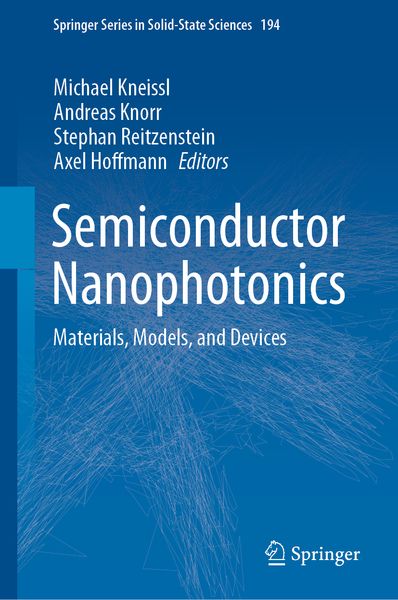
Semiconductor Nanophotonics Materials, Models, and Devices

169,99 €

inkl. gesetzl. MwSt., Versandkostenfrei


Beschreibung

Produktdetails

Einband

Gebundene Ausgabe

Erscheinungsdatum

11.03.2020

Herausgeber

Michael Kneissl + weitere

Verlag

Springer

Seitenzahl

556

Maße (L/B/H)

24,1/16/3,7 cm

Gewicht

1027 g

Auflage

1st ed. 2020

Sprache

Englisch

ISBN

978-3-030-35655-2

Beschreibung

Portrait

Michael Kneissl is the Executive Director of the Institute of Solid State Physics and chair of Experimental Nanophysics and Photonics at the Technical University of Berlin (TU Berlin), Germany. He holds a dual appointment at the Ferdinand-Braun-Institute (FBH) in Berlin, where he heads the Joint Lab GaN Optoelectronics and is also spokesperson of the Collaborative Research Center “Semiconductor Nanophotonics” (CRC 787). His interests include group III-nitride semiconductor materials, metal organic vapor phase epitaxy of wide bandgap semiconductors and nanostructures as well as novel optoelectronic devices, including UV LEDs and laser diodes. He has co-authored over 300 publications, five book chapters, and holds more than 60 patents in the area of group II-nitride device technologies. He recently co-edited a book on "III-Nitride Ultraviolet Emitters - Technology & Applications" which was published in 2016 within the Springer Series on Material Science. In 2016 Michael Kneisslwas named Fellow of the Institute of Electrical and Electronics Engineers (IEEE) for his contributions to the development of wide bandgap semiconductor laser diodes and ultraviolet LEDs.

Andreas Knorr works in the field of nonlinear optics and quantum electronics of nanostructured solids. His research is focused on the interaction of light and matter, self-consistent solutions of Maxwell- and material equations and many body effects in open quantum systems. Since 2000 Andreas Knorr holds a professorship at the TU Berlin. His scientific career, which started at the Friedrich-Schiller-University Jena led him to the Universities of New Mexico, Arizona (College of Optical Sciences), Marburg, Göttingen, Auckland, Kingston and to Sandia National Labs Albuquerque and NTT Tokio. He was a Divisional Editor of Physical Review Letters from 2013-2018.

Stephan Reitzenstein is Director of the Center of Nanophotonics of the Institute of Solid State Physics at  theTU Berlin and holds the chair of Optoelectronics and Quantum Devices. His research interests focus on the development and study of nanophotonic devices and structures based on III/V semiconductor materials. Present activities include the realization of cavity-enhanced microlasers with ultra-low threshold powers, quantum-light sources for applications in advanced long-distance quantum communication and photonic circuits for on-chip quantum photonics. He has co-authored four book chapter and more than 180 publications in peer-reviewed international journals. In 2014 Stephan Reitzenstein received a prestigious EU ERC Consolidator Grant on the external quantum control of photonic semiconductor nanostructures.

Axel Hoffmann was director at the Institute of Solid State Physics  and is now Guest Professor at the TU Berlin. His research expertise includes materials microcharacterization, ultra-fast phenomena in semiconductors, micro- and nanao- Raman spectroscopy, electro-optical properties in organic materials, optical properties of quantum dots, microcharacterization of organic devices, optical-properties and - gain of group-III nitrides, oxides and arsenides, spintronics, He has co-authored 545 peer reviewed publications, 102 conference papers ( 71 invited papers), 10 book chapters and 9 patents. In 2009 and 2015 he was Guest Professor at the University of Technology, Sydney, Australia.


Produktdetails

Einband

Gebundene Ausgabe

Erscheinungsdatum

11.03.2020

Herausgeber

Verlag

Springer

Seitenzahl

556

Maße (L/B/H)

24,1/16/3,7 cm

Gewicht

1027 g

Auflage

1st ed. 2020

Sprache

Englisch

ISBN

978-3-030-35655-2

Herstelleradresse

Springer-Verlag KG
Sachsenplatz 4-6
1201 Wien
AT

Email: GPSR Kontakt

Noch keine Bewertungen vorhanden

Verfassen Sie die erste Bewertung zu diesem Artikel

Helfen Sie anderen Kundinnen und Kunden durch Ihre Meinung.

Kundinnen und Kunden meinen

Bewertungen (0)

  • Produktbild: Semiconductor Nanophotonics
  • Produktbild: Semiconductor Nanophotonics
  • Introduction

    (Kneissl)


    PART A: Semiconductor Nanostructures

    (Hoffmann)


    Submonolayer Quantum Dots (Owschimikow, Pohl, Schliwa, Strittmatter, Eisele Dähne, Lehmann, Niermann, Herzog, Lignau)

    Carrier localization in Submonolayer Quantum Dots b.      Epitaxy of SML QDs

    c.       Structure of Submonolayer Depositions

    d.      Static and Dynamic Optical and Electronic Properties of SML QDs

    e.      Devices based on SML Quantum dots

    f.        Conclusion and Perspectives


    Stressor-Induced Site Control of Quantum Dots for Single-Photon Sources (Pohl, Schliwa, Strittmatter, Niermann, Lehmann, Kantner, Wünsche Bandelow, Koprucki)

    Stressor-Induced Nucleation of Quantum Dots Simulation of Strain in Semiconductors Nucleation Control by a Buried Aperture Stressor  Strain Measurements by means of Electron Holography Single-Photon Source based on Stressor-Induced QD Site Control f.        Realization of an efficient current Injection into a single site-controlled quantum dot

    g.      Conclusion and Perspectives


    Coherent and incoherent dynamics in quantum dots and nanophotonic devices (Lüdge, Owschimikow, Lingnau, Kolarczik, Woggon, Vladimirov, Pimenov, Wolfrum, Meinecke)

    Introduction Ultrafast carrier dynamics in semiconductors with reduced dimensionality: Quantum-dots, submonolayer QDs and crossed excitons  Quantum state tomography and dynamics of Wigner functions  Dynamics and timing jitter in multisection mode-locked laser diodes Conclusion and Outlook  

    Optical and Structural Properties of Nitride based Nanostructures (Hoffmann, Christen, Wagner, Bertram, Maultzsch, Eisele)

    Introduction b.      Modern tools for nanostructure characterization

    c.       Analysis of nanostructure growth in nitrides

    d.      Optical analysis of low-dimensional nitrides

    e.      Conclusion and Perspectives


    Theory of spectroscopy and light emission of semiconductor nanostructures (Knorr, Kuhn, Selig, Camele, Richter)

    Introduction State of the art of microscopic description of quantum dots and atomically thin semiconductors Coupled quantum dot-cavity structures Radiative emission of confined many particle configurations Intraband transitions between bound QD states and states of the host medium Two-dimensional spectroscopy in semiconductor nanostructures Conclusion and Outlook  

    PART B: Nanophotonics Devices

    (Kneissl, Reitzenstein)


    Multi-Dimensional modelling and simulation of nanophotonic devices (Bandelow, Koprucki, Burger, Kantner, Wünsche, Mielke, Schmidt, Rotundo, Höhne)

    a.      Introduction

    b.      Statement of the problem

    c.       Multispecies modelling of QD lasers

    d.      Quantum-classical hybrid modelling of SPEs and nanolasers with few QDs

    e.      Numerical methods for drift-diffusion

    f.        Numerical methods for Maxwell equations

    g.      Applications

    h.      Conclusion and Outlook


    Deterministic quantum devices for optical quantum communication (Rodt, Burger, Koprucki, Kantner)

    a.      Introduction

    b.      Numeric modelling and optimization of quantum devices for the generation and distribution of single photons

    c.       Deterministic fabrication technologies

    d.      Quantum light sources based on deterministic quantum dot microlenses

    e.      On-chip quantum circuits with deterministically-integrated quantum dots

    f.        Conclusion and Outlook


    Quantum networks based on single photons (Rödiger, Perlot, Benson, Freund)

    a.      Introduction

    b.      Single Photon Generation & Manipulation

    c.       Frequency Conversion of Quantum Light

    d.      Single Photon Storage

    e.      Quantum Communication

    f.        Free-Space Quantum Link

    g.      Conclusion and Outlook


    Vertical-cavity surface-emitting lasers (VCSELs) for communication, sensing, and integration  (Lott)

    a.      Introduction

    b.      State-of-the-art VCSELs

    c.       VCSELs for communication

    d.      VCSELs for sensing

    e.      VCSELs for integration

    f.        VCSEL frontiers

    g.      Conclusion and Outlook


    VCSEL-based silicon photonic interconnect technologies (Seiler, Tillack, Zimmermann)

    a.      Introduction

    b.      State of the art interconnect technologies and requirements

    c.       Long-wavelength VCSELs

    d.      Characterization of 1.3µm and 1.55µm InP-VCSELs

    e.      Modeling of VCSEL-based coherent interconnects

    f.        VCSEL-based PAM transmission link

    g.      VCSEL-based QPSK transmission link

    h.      Conclusion and Outlook


    Nitride microcavities for classical and non-classical light emitters (Dadgar, Strittmatter, Betram, Schliwa, Hoffmann, Mautzsch, Christen, Wagner)

    Introduction Bragg mirrors, GaN quantum dots and microcavities Microstructure and emission properties d.      Towards devices

    e.      Conclusion and Perspectives


    Group III-nitride-based laser diodes (Kneissl, Wernicke, Sulmoni, Kuhn, Weyers)

    a.      State-of-the-art in group III-nitride laser diode technologies

    b.      Design of AlGaN-based deep UV laser diodes

    c.       Fabrication of AlGaN-based UV laser diodes

    d.      Low defect density AlN templates

    e.      Growth of AlGaN laser heterostructures

    f.        Gain and losses in deep UV AlGaN lasers by optical pumping

    g.      Development of current-injection deep UV laser diodes

    h.      Conclusion and Outlook