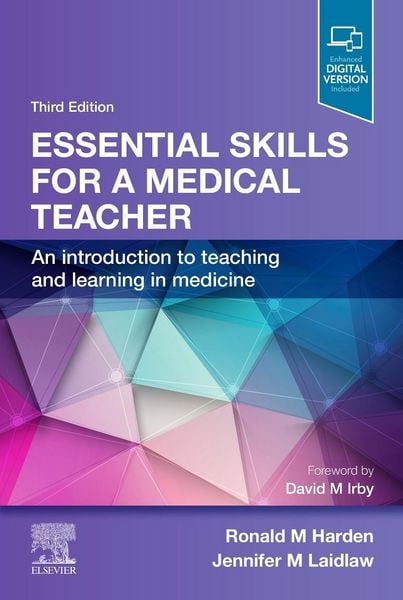
Essential Skills for a Medical Teacher An Introduction to Teaching and Learning in Medicine
-
- Taschenbuch ausgewählt
- eBook
-
Sprache:Englisch
59,99 €
inkl. gesetzl. MwSt.,
Beschreibung
Produktdetails
Einband
Taschenbuch
Erscheinungsdatum
25.06.2020
Verlag
ElsevierSeitenzahl
334
Maße (L/B/H)
22,7/14,9/1,3 cm
Gewicht
546 g
Auflage
3. Auflage
Sprache
Englisch
ISBN
978-0-7020-7854-5
Perfect for new teachers in undergraduate, postgraduate, or continuing education, as well as more experienced educators who want to assess, improve, and gain new perspectives on teaching and learning, Essential Skills for a Medical Teacher is a useful, easy-to-read professional resource. This book offers a concise introduction to the field of medical education, with key coverage of educational models and theory that can help inform teaching practice. Clear illustrations and practical tips throughout make it an excellent starting point for those new to the field of medical education or who want to facilitate more effective learning for their students or trainees.
- Provides hints drawn from practical experience that help you create powerful learning opportunities for your students, with readable guidelines and new techniques that can be adopted for use in any teaching program
- Includes new coverage of "just-in-time" learning, entrustable professional activities, steps on introducing outcome/competency-based education, selecting a teaching method, programmatic assessment, self-assessment, the student and patient as partners in the education process, the changing role of the teacher, bringing about change, and the future of medical education
- Covers recent developments in our understanding of the relationship between learning and technology, as well as curriculum planning and curriculum mapping
- Offers practical advice from leading international expert Professor Ronald Harden and co-author Jennifer Laidlaw, who has designed and taught many courses for medical teachers
- Prompts you to reflect on your own performance as an educator, as well as analyze with colleagues the different ways that your work can be approached and how your students’ or trainees’ learning can be made more effective
- Expert Consult(TM) eBook version included with purchase. This enhanced eBook experience allows you to search all of the text, figures, and references from the book on a variety of devices
Noch keine Bewertungen vorhanden
Verfassen Sie die erste Bewertung zu diesem Artikel
Helfen Sie anderen Kundinnen und Kunden durch Ihre Meinung.
Kurze Frage zu unserer Seite
Vielen Dank für Ihr Feedback
Wir nutzen Ihr Feedback, um unsere Produktseiten zu verbessern. Bitte haben Sie Verständnis, dass wir Ihnen keine Rückmeldung geben können. Falls Sie Kontakt mit uns aufnehmen möchten, können Sie sich aber gerne an unseren Kund*innenservice wenden.
zum Kundenservice