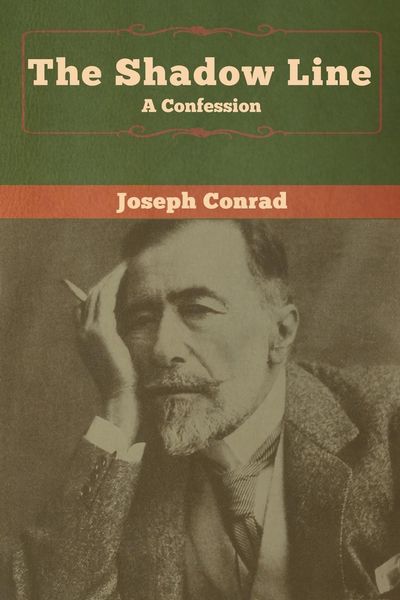
The Shadow Line A Confession
-
- Hardcover
- Taschenbuch ausgewählt
- eBook
- Hörbuch
-
Sprache:Englisch
- Deutsch 14,00 €
- Englisch 19,99 € ausgewählt
-
Verlag:Bibliotech Pr
- Outlook 26,99 €
- Vintage USA 18,99 €
- Waking Lion Press 18,99 €
- True Sign Publishing House 17,99 €
- Tredition 13,30 €
- Lushena Books 19,99 €
- Bibliotech Pr 19,99 € ausgewählt
- Book Jungle 19,99 €
- Alpha Edition 25,99 €
- Creative Media Partners, LLC 25,99 €
- 1St World Library 17,99 €
- Binker North 17,99 €
- Penguin Books 14,99 €
- Copycat 9,00 €
- Portmay Press 17,99 €
- Skinner Press 25,99 €
- Ingram Publishers Services 9,99 €
- Antigonos Verlag 26,99 €
19,99 €
inkl. gesetzl. MwSt.,
- Kostenlose Lieferung ab 30 € Einkaufswert
- Versandkostenfrei für Bonuscard-Kund*innen
Beschreibung
Produktdetails
Einband
Taschenbuch
Erscheinungsdatum
07.01.2020
Verlag
Bibliotech PrSeitenzahl
144
Maße (L/B/H)
22,9/15,2/0,8 cm
Gewicht
220 g
Sprache
Englisch
ISBN
978-1-61895-911-9
The Shadow-Line is a short novel based at sea by Joseph Conrad; it is one of his later works, being written from February to December 1915. It was first published in 1916 as a serial in New York's Metropolitan Magazine (September—October) in the English Review (September 1916-March 1917) and published in book form in 1917 in the UK (March) and America (April). The novella depicts the development of a young man upon taking a captaincy in the Orient, with the shadow line of the title representing the threshold of this development. The novella is notable for its dual narrative structure. The full, subtitled title of the novel is The Shadow-Line, A Confession, which immediately alerts the reader to the retrospective nature of the novella. The ironic constructions following from the conflict between the 'young' protagonist (who is never named) and the 'old' drive much of the underlying points of the novella, namely the nature of wisdom, experience and maturity. Conrad also extensively uses irony by comparison in the work, with characters such as Captain Giles and the ship's 'factotum' Ransome used to emphasise strengths and weaknesses of the protagonist. The novella has often been cited as a metaphor of the First World War, given its timing and references to a long struggle, the importance of camaraderie, etc. This viewpoint may also be reinforced by the knowledge that Conrad's elder son, Borys, was wounded in the First World War. Others however see the novel as having a strong supernatural influence, referring to various plot-lines in the novella such as the 'ghost' of the previous captain potentially cursing the ship, and the madness of first mate Mr Burns. Conrad himself, however, denied this link in his 'Author's Note' (1920), claiming that although critics had attempted to show this link, "The world of the living contains enough marvels and mysteries as it is." Andrzej Wajda has made a 1976 film adaptation of the novel under its Polish title - Smuga cienia.
Noch keine Bewertungen vorhanden
Verfassen Sie die erste Bewertung zu diesem Artikel
Helfen Sie anderen Kundinnen und Kunden durch Ihre Meinung.
Kurze Frage zu unserer Seite
Vielen Dank für Ihr Feedback
Wir nutzen Ihr Feedback, um unsere Produktseiten zu verbessern. Bitte haben Sie Verständnis, dass wir Ihnen keine Rückmeldung geben können. Falls Sie Kontakt mit uns aufnehmen möchten, können Sie sich aber gerne an unseren Kund*innenservice wenden.
zum Kundenservice