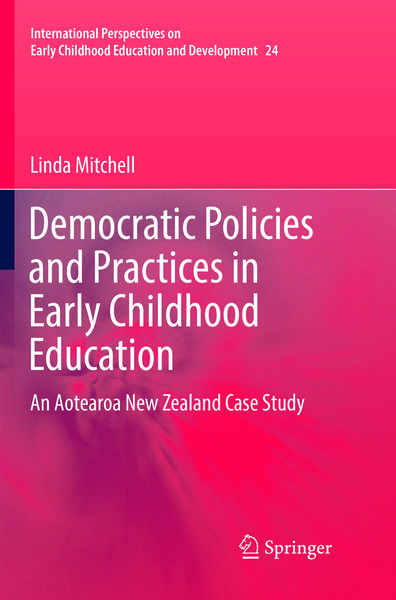
Democratic Policies and Practices in Early Childhood Education An Aotearoa New Zealand Case Study
-
- Hardcover
- Taschenbuch ausgewählt
- eBook
-
Sprache:Englisch
64,99 €
inkl. gesetzl. MwSt.,
Beschreibung
Produktdetails
Einband
Taschenbuch
Erscheinungsdatum
02.02.2019
Abbildungen
IX, 176 p. 3 illus.
Verlag
Springer SingaporeSeitenzahl
176
Maße (L/B/H)
23,5/15,5/1,1 cm
Gewicht
295 g
Auflage
Softcover reprint of the original 1st edition 2019
Sprache
Englisch
ISBN
978-981-13-4686-6
This book uses case studies of Aotearoa New Zealand policy formulation and practice to explore early childhood education and care (ECEC) as a site for democratic citizenship and social justice. Addressing fundamental questions about the purpose of education, it argues for explicit values focusing on children and childhood as a basis for ECEC policy to replace discourses of economic investment and child vulnerability that are dominant within policy goals in many countries. A commitment to democracy and equity is a good place to start. Aotearoa New Zealand is of special interest because of its world-renowned ECE curriculum, Te Whāriki, which is based on principles of social justice, respect for rights and an aim to support children growing up in a democracy. The curriculum upholds Māori rights to tino rangatiratanga (absolute authority over their lives and resources). Yet, Aotearoa New Zealand’s extreme market policies and harsh labour laws during recent periods run contrary to idealsof democracy and are puzzlingly inconsistent with curriculum principles.
The book starts with an analysis and critique of global trends in ECEC in countries that share capitalist mixed economies of welfare, and where competition and marketisation have become dominant principles. It then analyses ideas about children, childhood and ECEC within a framework of democracy, going back to the Athenean origins of democracy and including recent literature on meanings and traditions of democracy in education. The book uses vivid examples from researching curriculum, pedagogy and assessment practices within Aotearoa New Zealand ECEC settings and collective action to influence policy change in order to illustrate opportunities for democratic education. It concludes by examining what conditions might be needed for integrated and democratic ECEC provision in Aotearoa New Zealand, and what changes are necessary for the future. It offers a compass not a map; it points to promising directions and provides insights into issues in ECEC policy and practice that are of current global concern.
Noch keine Bewertungen vorhanden
Verfassen Sie die erste Bewertung zu diesem Artikel
Helfen Sie anderen Kundinnen und Kunden durch Ihre Meinung.
Kurze Frage zu unserer Seite
Vielen Dank für Ihr Feedback
Wir nutzen Ihr Feedback, um unsere Produktseiten zu verbessern. Bitte haben Sie Verständnis, dass wir Ihnen keine Rückmeldung geben können. Falls Sie Kontakt mit uns aufnehmen möchten, können Sie sich aber gerne an unseren Kund*innenservice wenden.
zum Kundenservice