KI-Beratung Beta

Gutscheinbedingungen

**Gültig am 27.11.2026 auf Spielzeug, Schreibwaren, Filme, Geschenke & Trends, Musik, tolino eReader & Zubehör, Hörbücher und Hörbuch-Downloads, nicht preisgebundene Bücher und Kalender online auf thalia.at und in der Thalia App. Einzelne Artikel können ausgeschlossen sein. Aufgrund der Buchpreisbindung sind deutschsprachige Bücher und eBooks ausgenommen. Zusätzlich ausgenommen sind Abos & Flatrates, Games, Geschenkkarten/-boxen, Shelfies, Software, Zeitschriften sowie einzelne Artikel von tonies®. Pro Einkauf einmal einlösbar. Click & Collect nur bei Onlinevorabzahlung möglich. Keine Barauszahlung. Nicht kombinierbar mit anderen Aktionen und Gutscheinen. Gutschein wird auf max. 500€ Bestellwert angerechnet. Nicht gültig für Versandkosten und Services.

  • Produktbild: Radicalization to Terrorism
  • Produktbild: Radicalization to Terrorism

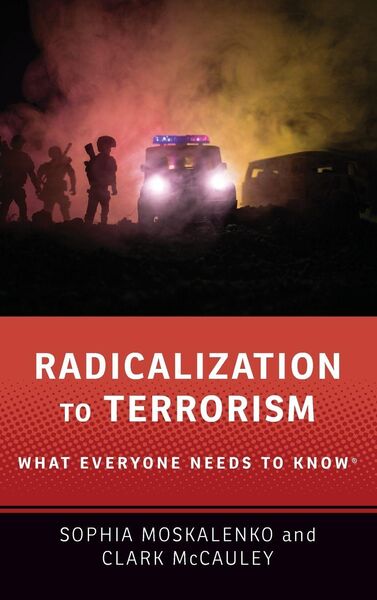
Radicalization to Terrorism

71,99 €

inkl. gesetzl. MwSt., Versandkostenfrei


Beschreibung

Terrorism and radicalization came to the forefront of news and politics in the US after the unforgettable attacks of September 11th, 2001. When George W. Bush famously asked "Why do they hate us?," the President echoed the confusion, anger and fear felt by millions of Americans, while also creating...

Beschreibung

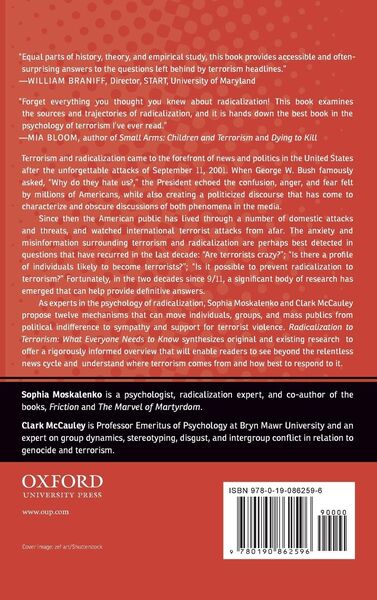
Terrorism and radicalization came to the forefront of news and politics in the US after the unforgettable attacks of September 11th, 2001. When George W. Bush famously asked "Why do they hate us?," the President echoed the confusion, anger and fear felt by millions of Americans, while also creating a politicized discourse that has come to characterize and obscure discussions of both phenomenon in the media. Since then the American public has lived through a number of domestic attacks and threats, and watched international terrorist attacks from afar on television sets and computer screens. The anxiety and misinformation surrounding terrorism and radicalization are perhaps best detected in questions that have continued to recur in the last decade: "Are terrorists crazy?"; "Is there a profile of individuals likely to become terrorists?"; "Is it possible to prevent radicalization to terrorism?" Fortunately, in the two decades since 9/11, a significant body of research has emerged that can help provide definitive answers. As experts in the psychology of radicalization, Sophia Moskalenko and Clark McCauley propose twelve mechanisms that can move individuals, groups, and mass publics from political indifference to sympathy and support for terrorist violence. Radicalization to Terrorism: What Everyone Needs to Know synthesizes original and existing research to answer the questions raised after each new attack, including those committed by radicalized Americans. It offers a rigorously informed overview of the insight that will enable readers to see beyond the relentless new cycle to understand where terrorism comes from and how best to respond to it.

Produktdetails

Einband

Gebundene Ausgabe

Erscheinungsdatum

25.08.2015

Verlag Oxford Academic
Seitenzahl

276

Produktdetails

Einband

Gebundene Ausgabe

Erscheinungsdatum

25.08.2015

Verlag Oxford Academic
Seitenzahl

276

Maße (L/B/H)

23,5/15,7/1,9 cm

Gewicht

507 g

Sprache

Englisch

ISBN

978-0-19-086259-6

Herstelleradresse

Libri GmbH
Europaallee 1
36244 Bad Hersfeld
DE

Email: gpsr@libri.de

Noch keine Bewertungen vorhanden

Verfassen Sie die erste Bewertung zu diesem Artikel

Helfen Sie anderen Kundinnen und Kunden durch Ihre Meinung.

Kundinnen und Kunden meinen

Bewertungen (0)

Die Leseprobe wird geladen.
  • Produktbild: Radicalization to Terrorism
  • Produktbild: Radicalization to Terrorism
    • Chapter 1. What is terrorism and who becomes a terrorist?
    • Chapter 2. What is radicalization?
    • Chapter 3. How are individuals radicalized to join a terrorist group?
    • Chapter 4. How are small groups radicalized to use terrorism as a tactic?
    • Chapter 5. How are mass publics radicalized to support terrorism?
    • Chapter 6. What is the relation between radical ideas and radical action?
    • Chapter 7. What's different about lone-wolf terrorists?
    • Chapter 8. Are suicide bombers suicidal?
    • Chapter 9. Is it possible to prevent radicalization to terrorism?
    • Chapter 10. Is it possible to de-radicalize terrorists?
    • Chapter 11. What are Mass Identity Manipulations (MIMs)--pictures, songs/chants, rumors, rituals and symbols?
    • Chapter 12. Mass radicalization in the United States
    • Chapter 13. Conclusions: What Everyone Needs to Know about Radicalization and Extremism