
KI-Beratung Beta

  • Produktbild: TARP and other Bank Bailouts and Bail-Ins around the World
  • Produktbild: TARP and other Bank Bailouts and Bail-Ins around the World

TARP and other Bank Bailouts and Bail-Ins around the World Connecting Wall Street, Main Street, and the Financial System

89,99 €

inkl. gesetzl. MwSt., Versandkostenfrei


Beschreibung

Produktdetails

Einband

Taschenbuch

Erscheinungsdatum

05.06.2020

Verlag

Elsevier Science & Technology

Seitenzahl

478

Maße (L/B/H)

22,9/15,2/2,4 cm

Gewicht

635 g

Sprache

Englisch

ISBN

978-0-12-813864-9

Beschreibung

Rezension

"Analyzes theoretical and empirical research evidence on the Troubled Asset Relief Program (TARP) in the United States and other bank bailouts and bail-ins in the United States and around the world, assessing the important costs and benefits of these programs in order to suggest potential policy implications for the future." --

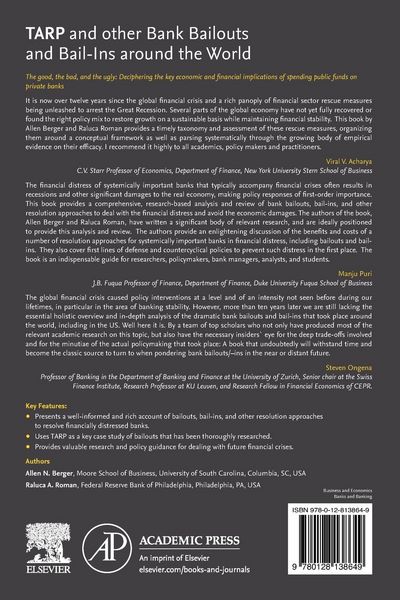
"It is now over twelve years since the global financial crisis and a rich panoply of financial sector rescue measures being unleashed to arrest the Great Recession. Several parts of the global economy have not yet fully recovered or found the right policy mix to restore growth on a sustainable basis while maintaining financial stability.? This book by Allen Berger and Raluca Roman provides a timely taxonomy and assessment of these rescue measures, organizing them around a conceptual framework as well as parsing systematically through the growing body of empirical evidence on their efficacy. I recommend it highly to all academics, policy makers and practitioners." -Viral V. Acharya, C.V.Starr Professor of Economics, Department of Finance, New York University Stern School of Business

"The financial distress of systemically important banks that typically accompany financial crises often results in recessions and other significant damages to the real economy, making policy responses of first-order importance. This book provides a comprehensive, research-based analysis and review of bank bailouts, bail-ins, and other resolution approaches to deal with the financial distress and avoid the economic damages. The authors of the book, Allen Berger and Raluca Roman, have written a significant body of relevant research, and are ideally positioned to provide this analysis and review. The authors provide an enlightening discussion of the benefits and costs of a number of resolution approaches for systemically important banks in financial distress, including bailouts and bail-ins. They also cover first lines of defense and countercyclical policies to prevent such distress in the first place. The book is an indispensable guide for researchers, policymakers, bank managers, analysts, and students." --Manju Puri, J.B. Fuqua Professor of Finance, Department of Finance, Duke University Fuqua School of Business

"The global financial crisis caused policy interventions at a level and of an intensity not seen before during our lifetimes, in particular in the area of banking stability. However, more than ten years later we are still lacking the essential holistic overview and in-depth analysis of the dramatic bank bailouts and bail-ins that took place around the world, including in the US. Well here it is. By a team of top scholars who not only have produced most of the relevant academic research on this topic, but also have the necessary insiders` eye for the deep trade-offs involved and for the minutiae of the actual policymaking that took place: A book that undoubtedly will withstand time and become the classic source to turn to when pondering bank bailouts/-ins in the near or distant future." --Steven Ongena, Professor of Banking in the Department of Banking and Finance at the University of Zurich, Senior chair at the Swiss Finance Institute, Research Professor at KU Leuven, and Research Fellow in Financial Economics of CEPR

Produktdetails

Einband

Taschenbuch

Erscheinungsdatum

05.06.2020

Verlag

Elsevier Science & Technology

Seitenzahl

478

Maße (L/B/H)

22,9/15,2/2,4 cm

Gewicht

635 g

Sprache

Englisch

ISBN

978-0-12-813864-9

EU-Ansprechpartner

Elsevier B.V.
Radarweg 29
1043 NX Amsterdam
NL
productsafety@elsevier.com

Herstelleradresse

Elsevier Science & Technology
London Wall 125
EC2Y 5AS London
GB
tradeorders@elsevier.com

Noch keine Bewertungen vorhanden

Verfassen Sie die erste Bewertung zu diesem Artikel

Helfen Sie anderen Kundinnen und Kunden durch Ihre Meinung.

Kundinnen und Kunden meinen

Bewertungen (0)

Die Leseprobe wird geladen.
  • Produktbild: TARP and other Bank Bailouts and Bail-Ins around the World
  • Produktbild: TARP and other Bank Bailouts and Bail-Ins around the World
  • I Introductory materials1. Introduction to bank bailouts, bail-ins and the related topics covered in the book2. Conditions that generally bring about bank bailouts, bail-ins, and other resolution methods3. Descriptions of the TARP program, other bank bailouts and bail-ins, and other resolution approaches in the United States and around the world4. Theoretical background on bank bailouts, bail-ins, and other resolution approaches

    II Empirical research on TARP5. Methodologies used in most of the TARP empirical studies6. Determinants of applying for and receiving TARP funds and exiting early from the program7. Effects of TARP on recipient banks' valuations8. Effects of TARP on market discipline9. Effects of TARP on bank leverage risk10. Effects of TARP on bank competition11. Effects of TARP on bank credit supply12. Effects of TARP on bank portfolio risk13. Effects of TARP on recipient banks' credit customers14. Effects of TARP on the real economy15. Effects of TARP on systemic risk

    III Empirical evidence bank bailouts other than TARP, bail-ins, and other resolution approaches16. Empirical research on bailouts other than TARP17. Empirical research on bail-ins18. Empirical research on other resolution approaches

    IV First lines of defense to help avoid bailouts, bail-ins, and other resolutions19. Mechanisms for the first lines of defense20. Capital requirements21. Liquidity requirements22. Stress tests23. Prudential regulatory activity restrictions24. Prudential supervision25. Deposit insurance26. Direct government ownership of banks

    V Looking toward the future27. Social costs and benefits28. Implications for bank policymakers and bank managers29. Open research questions to be addressed by future research