Gutscheinbedingungen

**Gültig bis 15.06.2026 auf Spiele & Spielzeug online auf thalia.at, in der Thalia App ab einem Mindestbestellwert von 30€ und in allen Thalia Buchhandlungen in Österreich. In den Buchhandlungen nur gültig auf lagernde Ware. Einzelne Artikel können ausgeschlossen sein. Ausgenommen sind preisgebundene Artikel sowie online auf thalia.at und in der Thalia App einzelne Artikel von tonies®. Pro Einkauf einmal einlösbar. Nur gültig gegen Vorlage oder im Onlineshop hinterlegter Bonuscard. Infos zur Einlösung in der Buchhandlung sind auf der Bonuscard-Vorteilspreisseite zu finden. Click & Collect nur bei Onlinevorabzahlung möglich. Keine Einlösung bei Scan & Go-Bezahlung. Keine Barauszahlung. Nicht kombinierbar mit anderen Aktionen und Gutscheinen. Gutschein wird auf max. 500€ Bestellwert angerechnet. Nicht gültig für Geschenkkarten, Versandkosten und Services.

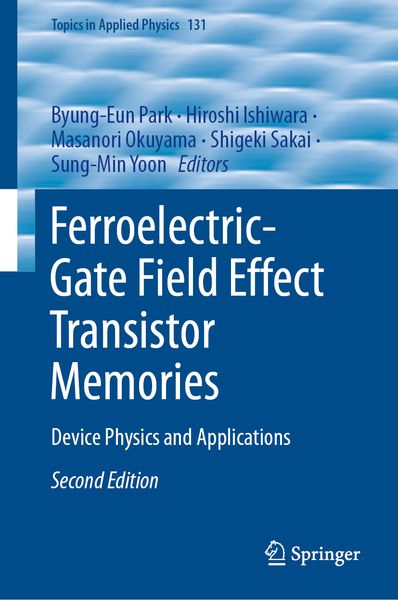
Produktbild: Ferroelectric-Gate Field Effect Transistor Memories
Band 131 - 23%

Ferroelectric-Gate Field Effect Transistor Memories Device Physics and Applications

23% sparen

125,99 € UVP 164,99 €

inkl. gesetzl. MwSt., Versandkostenfrei


Beschreibung

Produktdetails

Einband

Gebundene Ausgabe

Erscheinungsdatum

24.03.2020

Herausgeber

Byung-Eun Park + weitere

Verlag

Springer Singapore

Seitenzahl

425

Maße (L/B/H)

24,1/16/3 cm

Gewicht

822 g

Auflage

Second Edition 2020

Sprache

Englisch

ISBN

978-981-15-1211-7

Beschreibung

Portrait

Byung-Eun Park received the B.S. and M.S. degrees from the University of Seoul, Korea, and the Ph.D. degree in applied engineering from the Tokyo Institute of Technology, Tokyo, Japan.

He is a Professor at School of Electrical and Computer Engineering, University of Seoul, Korea. Prior to joining the University of Seoul in 2004, he was an Assistant Professor in Tokyo Institute of Technology, and had joined the R&D Association for Future Electron Devices, Japan. In the period from 2008 to 2011, he was a member of Technical Innovation Evaluation Committee of Ministry of Knowledge Economy. In 2012 and 2015, he was a non-executive director of Korea Intellectual Property Strategy Institute. Now, he is Present of Association of the Korea-Japan Researcher Network and a member of Compensation Council for duty invention of Seoul Metropolitan Government. He has over 300 patents including pending. His research interests are device and process technologies in next-generation electronic devices. He also interests display devices, solar cells, sensors and brain science.


Hiroshi Ishiwara was born in Japan in 1945. He received the B.S., M.S., and Ph.D. degrees in electronic engineering from Tokyo Institute of Technology, Tokyo, Japan, in 1968, 1970, and 1973, respectively.

He was with the Tokyo Institute of Technology, as Research Associate (1973-1976), Associate Professor (1976-1989), and Professor (1989-2011). In 2004 and 2005, he was the Dean of professor at Interdisciplinary Graduate School of Science and Engineering. He retired from Tokyo Institute of Technology in 2011 and he is now a Professor Emeritus. In the period from 2010 to 2013, he was a WCU (World Class University) Professor in Department of Physics, Konkuk University, Korea. His research interests are device and process technologies in integrated circuits, particularly in ferroelectric memories. He has published 450 peer-reviewed papers with total citations morethan 6,000.

He was awarded the Japan IBM Science Prize in 1990, International Symposium on Integrated Ferroelectrics 2000 Honors, the Purple Ribbon Medal by Japanese Government in 2003, Certificate of Merit in Nano Research Innovation Category by Korean Deputy Prime Minister and Minister of Science & Technology in 2007, and SSDM (Solid State Devices and Materials) Award in 2008. He was the President of the Japan Society of Applied Physics (JSAP) in 2008 and 2009. He is fellows of IEEE (the Institute of Electrical and Electronics Engineers), MRS (Materials Research Society), IEICE (the Institute of Electronics, Information and Communication Engineers), and IEEJ (the Institute of Electrical Engineers of Japan), and an honorable member of JSAP.


Masanori Okuyama is a Professor Emeritus and a Specially Appointed Professor of Institute for NanoScience Design at Osaka University.  He has received the B. S., M. E. and D. E. degrees in electrical engineering from Osaka University, Japan in 1968, 1970 and 1973, respectively. 

He was a researcher of Japan Society for the Promotion of Science from 1973 to 1974, a Research Associate, the Faculty of Engineering Science, Osaka University from 1974 to 1986, an Associate Professor from 1986 to 1991 and a Professor from 1991 to 2009.

His current interests are preparation and characterization of ferroelectric and dielectric thin films and their applications to electronic devices including nonvolatile memory, MOS structure, sensors and actuators. He is a President of The Society of Sensing Technology of Japan and a director of Japan Society of Next Generation Sensor Technology.  He was a director of The Institute of Electrical Engineers of Japan and a director of The Japan Society of Applied Physics from 2006 to 2007.

He is also an editor of Topics in Applied Physics Volumes 93 and 98, Springer.


Shigeki Sakai received the B.S. degree in electric engineering, and M.S. and Ph. D. degrees in electronic engineering from the University of Tokyo in1974, 1976, and 1979, respectively.

He is now the Invited Senior Researcher in National Institute of Advanced Industrial Science and Technology (AIST), and is also Guest Professor of Kanazawa Institute of Technology. He was the leader of the Ferroelectric Memory Group at the Nanoelectronics Research Institute in AIST, and the project leader of the research program on "Research and Development of Ferroelectric-Flash-Memory Basic Technology" at the New Energy and Industrial Technology Development Organization (NEDO) in Japan. He was also Guest Professor of the University of Tsukuba. He is a member of The Japan Society of Applied Physics and The Institute of Electronics, Information and Communication Engineers.


Sung-Min Yoon received the B.S. in Department of Inorganic Material Engineering from Seoul National University, 1995. He received the M.S. and Ph.D. in Department of Applied Electronics from Tokyo Institute of Technology, 1997 and 2000, respectively.

He was a Senior Research Engineer at ETRI from 2001 to 2011. He is currently an Associate Professor with Kyunghee University. His research interests include the characterization of nonvolatile memory devices, device physics and process technologies for functional electronic devices, and oxide electronics.

Produktdetails

Einband

Gebundene Ausgabe

Erscheinungsdatum

24.03.2020

Herausgeber

Verlag

Springer Singapore

Seitenzahl

425

Maße (L/B/H)

24,1/16/3 cm

Gewicht

822 g

Auflage

Second Edition 2020

Sprache

Englisch

ISBN

978-981-15-1211-7

Herstelleradresse

Springer-Verlag KG
Sachsenplatz 4-6
1201 Wien
AT

Email: ProductSafety@springernature.com

Kundinnen und Kunden meinen

0 Bewertungen

Informationen zu Bewertungen

Zur Abgabe einer Bewertung ist eine Anmeldung im Konto notwendig. Die Authentizität der Bewertungen wird von uns nicht überprüft. Wir behalten uns vor, Bewertungstexte, die unseren Richtlinien widersprechen, entsprechend zu kürzen oder zu löschen.

Die Bewertungen sind nach Format, Anzahl Sterne und Datum sortiert.

Verfassen Sie die erste Bewertung zu diesem Artikel

Helfen Sie anderen Kund*innen durch Ihre Meinung

Kundinnen und Kunden meinen

0 Bewertungen filtern

  • Produktbild: Ferroelectric-Gate Field Effect Transistor Memories
  • I. Introduction.- II. Practical Characteristics of Inorganic Ferroelectric-gate FETs: Si-Based Ferroelectric-gate Field Effect Transistors.- III. Practical Characteristics of Inorganic Ferroelectric-Gate FETs: Thin Film-Based Ferroelectric-Gate Field Effect Transistors.- Ⅳ Practical Characteristics of Organic Ferroelectric-Gate FETs: Si-Based Ferroelectric-Gate Field Effect Transistors.- V Practical Characteristics of Organic Ferroelectric-Gate FETs: Thin Film-Based Ferroelectric-Gate Field Effect Transistors.- VI Practical Characteristics of Organic Ferroelectric-Gate FETs : Ferroelectric-Gate Field Effect Transistors with Flexible Substrates.- Ⅶ Applications and Future Prospects.