Gutscheinbedingungen

**Gültig bis 25.08.2026 ab einem Mindestbestellwert von 30€ auf Spielzeug, Schreibwaren, Filme, Geschenke & Trends, Musik, tolino eReader & Zubehör, Hörbücher und Hörbuch-Downloads (außer Abo), nicht preisgebundene Bücher und Kalender online auf thalia.at und in der Thalia App. Einzelne Artikel können ausgeschlossen sein. Aufgrund der Buchpreisbindung sind deutschsprachige Bücher und eBooks ausgenommen. Zusätzlich ausgenommen sind preisgebundene Artikel, Abos & Flatrates, eBooks, Games, Geschenkkarten/-boxen, Shelfies, Software, Zeitschriften sowie einzelne Artikel von tonies®. Pro Einkauf einmal einlösbar. Click & Collect nur bei Onlinevorabzahlung möglich. Keine Barauszahlung. Nicht kombinierbar mit anderen Aktionen und Gutscheinen. Gutschein wird auf max. 500€ Bestellwert angerechnet. Nicht gültig für Versandkosten und Services. Preisgebundene Artikel sind vom Mindestbestellwert ausgeschlossen.

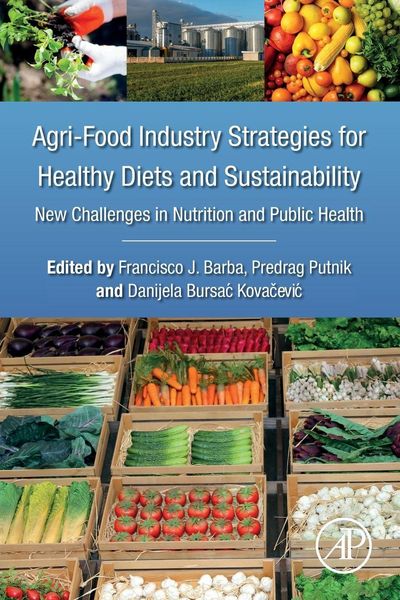
  • Produktbild: Agri-Food Industry Strategies for Healthy Diets and Sustainability
  • Produktbild: Agri-Food Industry Strategies for Healthy Diets and Sustainability

Agri-Food Industry Strategies for Healthy Diets and Sustainability New Challenges in Nutrition and Public Health

151,99 €

inkl. gesetzl. MwSt., Versandkostenfrei


Beschreibung

Produktdetails

Einband

Taschenbuch

Erscheinungsdatum

10.03.2020

Herausgeber

Francisco J. Barba + weitere

Verlag

Elsevier Science & Technology

Seitenzahl

298

Maße (L/B/H)

22,9/15,2/1,6 cm

Gewicht

403 g

Sprache

Englisch

ISBN

978-0-12-817226-1

Beschreibung

Portrait

Dr. Francisco J. Barba is an associate professor in Nutrition and Food Science, Faculty of Pharmacy, University of Valencia, Spain. He holds a Ph.D. from the University of Valencia and degrees in Pharmacy, Food and Technology. He performed postdoctoral stays in the Université de Technologie de Compiègne (UTC), Département de Génie des Procédés Industriels, Laboratoire Transformations Intégrées de la Matière Renouvelable (Compiegne, France) and Marie Curie IEF in the Department of Food Chemistry (University of Copenhagen) to explore different non-thermal applications for preserving and extracting bioactive compounds from plant food materials and by products. Prior to his current appointment, he was also engaged as a visiting researcher in the Department of Food Biotechnology and Food Process Engineering in Technological University of Berlin, Germany. His research focus is on non-thermal processing for preservation and/or extraction of bioactive compounds from liquid and solid foods. He has authored approximately 200 peer reviewed papers in international food science and technology journals.

Professor Predrag Putnik, PhD has more than 100 peer-reviewed scientific papers and book chapters. He co-edited Elsevier's" Agri-Food Industry Strategies for Healthy Diets and Sustainability" and is associate editor in Food Chemistry Advances, Elsevier. He was invited as guest editor for Food Research International, Elsevier, Special issue "Conventional, Non-Conventional Extraction Techniques and New Strategies for The Recovery of Bioactive Compounds from Plant Material for Human Nutrition" and Foods, MDPI; "Novel food processing and extraction technologies" and for "Sustainable Functional Food Processing." He is review editor of "Frontiers in Nutrition”, and member of the Editorial Board of reputed journals from Elsevier, Springer and Wiley. In 2021 he received Tanner Award for co-authoring the most-cited paper published in Comprehensive Reviews in Food Science and Food Safety (2018). In 2021 he was elected as Highly Cited Researcher ranked in the top 1% by citations for Agricultural Sciences by the Web of ScienceT.

Dr. Danijela Bursac Kovacevic earned her PhD (2010) in Food Science and Technology from the University of Zagreb, Faculty of Food Technology and Biotechnology (Croatia). She is currently Assistant Professor at the Faculty of Food Technology and Biotechnology, University of Zagreb. Her main research activities include innovative and emerging technologies in both liquid and solid food processing as well as in monitoring of stability of biologically active compounds during processing. A particular focus relates to non-thermal extraction technologies for extraction of biomolecules from food and plant matrices. Results of her work have been published in over 60 papers with most of them in high impact factor journals in the Food Science and Technology area, 2 book chapters, and over 90 presentations at conferences.

Produktdetails

Einband

Taschenbuch

Erscheinungsdatum

10.03.2020

Herausgeber

Verlag

Elsevier Science & Technology

Seitenzahl

298

Maße (L/B/H)

22,9/15,2/1,6 cm

Gewicht

403 g

Sprache

Englisch

ISBN

978-0-12-817226-1

EU-Ansprechpartner

Zeitfracht Medien GmbH
Ferdinand-Jühlke-Straße 7|99095|Erfurt|DE
produktsicherheit@zeitfracht.de

Herstelleradresse

Elsevier Science & Technology
125 London Wall|EC2Y 5AS|London|GB
tradeorders@elsevier.com

Noch keine Bewertungen vorhanden

Verfassen Sie die erste Bewertung zu diesem Artikel

Helfen Sie anderen Kundinnen und Kunden durch Ihre Meinung.

Kundinnen und Kunden meinen

Bewertungen (0)

Die Leseprobe wird geladen.
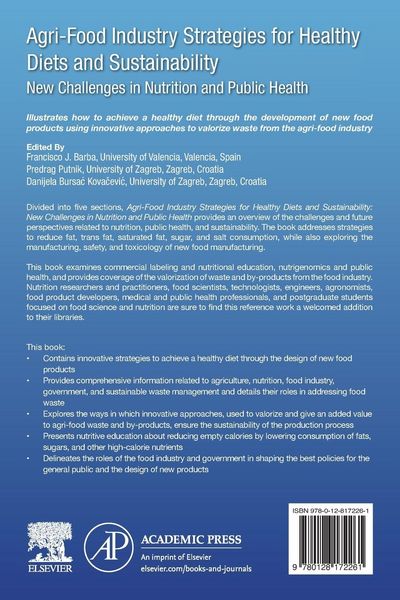
  • Produktbild: Agri-Food Industry Strategies for Healthy Diets and Sustainability
  • Produktbild: Agri-Food Industry Strategies for Healthy Diets and Sustainability
  • Section I: Introduction
    1. Nutrition, public health and sustainability. An overview of current challenges and future perspectives
    2. Strategies to achieve a healthy and balanced diet: Fruits and vegetables as a natural source of bioactive compounds

    Section II. Reduction of caloric intake
    3. Strategies to reduce lipid consumption
    4. Strategies to achieve a healthy diet and health: Reduction of trans fat and saturated fatty acids
    5. Sugar reduction: Stevia rebaudiana Bertoni as a natural sweetener

    Section III. Salt reduction and development of new foods
    6. Current and future strategies to reduce salt consumption
    7. Edible whey protein films and coatings added with prebiotic ingredients

    Section IV. Labelling, nutritional education and new strategies 
    8. Labelling and nutritional education
    9. Nutrigenomics and public health
    10. Nutrition, public health politics and dietary tools

    Section V. Sustainability and public health: Use of waste and by-products
    11. Valorization of waste and by-products from the food industries through the use of innovative technologies