KI-Beratung Beta

Gutscheinbedingungen

**Gültig am 20.11.2026 ab einem Mindestbestellwert von 30€ auf Spielzeug, Schreibwaren, Filme, Geschenke & Trends, Musik, tolino eReader & Zubehör, Hörbücher und Hörbuch-Downloads, nicht preisgebundene Bücher und Kalender online auf thalia.at und in der Thalia App. Einzelne Artikel können ausgeschlossen sein. Aufgrund der Buchpreisbindung sind deutschsprachige Bücher und eBooks ausgenommen. Zusätzlich ausgenommen sind Abos & Flatrates, Games, Geschenkkarten/-boxen, Shelfies, Software, Zeitschriften sowie einzelne Artikel von tonies®. Pro Einkauf einmal einlösbar. Click & Collect nur bei Onlinevorabzahlung möglich. Keine Barauszahlung. Nicht kombinierbar mit anderen Aktionen und Gutscheinen. Gutschein wird auf max. 500€ Bestellwert angerechnet. Nicht gültig für Versandkosten und Services. Preisgebundene Artikel sind vom Mindestbestellwert ausgeschlossen.

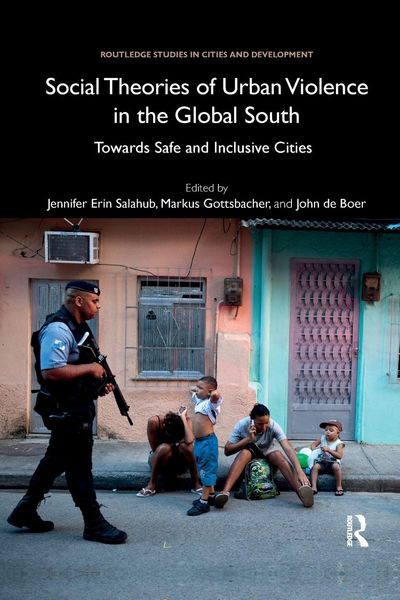
  • Produktbild: Social Theories of Urban Violence in the Global South
  • Produktbild: Social Theories of Urban Violence in the Global South

Social Theories of Urban Violence in the Global South Towards Safe and Inclusive Cities

86,99 €

inkl. gesetzl. MwSt., Versandkostenfrei


Beschreibung

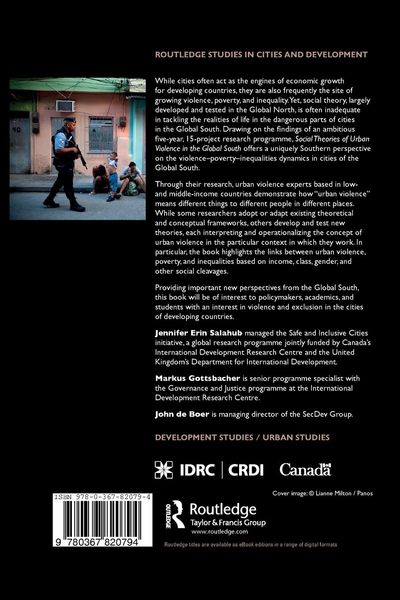
Safer Cities in the Global South asks what happens when social theory, largely developed and tested in the Global North, meets the realities of life in the violent parts of cities in the Global South.

Beschreibung

Safer Cities in the Global South asks what happens when social theory, largely developed and tested in the Global North, meets the realities of life in the violent parts of cities in the Global South.

Produktdetails

Einband

Taschenbuch

Erscheinungsdatum

17.10.2019

Abbildungen

schwarz-weiss Illustrationen, Raster,schwarz-weiss, Zeichnungen, schwarz-weiss, Tabellen, schwarz-weiss

Herausgeber Jennifer Erin Salahub + weitere

Produktdetails

Einband

Taschenbuch

Erscheinungsdatum

17.10.2019

Abbildungen

schwarz-weiss Illustrationen, Raster,schwarz-weiss, Zeichnungen, schwarz-weiss, Tabellen, schwarz-weiss

Herausgeber
Verlag Taylor and Francis
Seitenzahl

244

Maße (L/B/H)

23,4/15,6/1,3 cm

Gewicht

377 g

Sprache

Englisch

ISBN

978-0-367-82079-4

Herstelleradresse

Libri GmbH
Europaallee 1
36244 Bad Hersfeld
DE

Email: gpsr@libri.de

Noch keine Bewertungen vorhanden

Verfassen Sie die erste Bewertung zu diesem Artikel

Helfen Sie anderen Kundinnen und Kunden durch Ihre Meinung.

Kundinnen und Kunden meinen

Bewertungen (0)

Die Leseprobe wird geladen.
  • Produktbild: Social Theories of Urban Violence in the Global South
  • Produktbild: Social Theories of Urban Violence in the Global South
  • Introduction: Global South theories of urban violence, poverty, and inequalities Jennifer Erin Salahub, John de Boer, and Markus Gottsbacher Part I Gendered violences 1. Intersections of gender, mobility, and violence in urban Pakistan Nausheen H. Anwar, Sarwat Viqar, and Daanish Mustafa 2. Men in the city: changing gender relations and masculinities in Maputo, Mozambique Esmeralda Mariano, Henny Slegh, and Sílvia Roque 3. "We don't know when the trucks will come": the quest for safe and inclusive cities in Zimbabwe Julie Stewart and Rosalie Katsande, with Olga Chisango and Sian Maseko Part II State violence 4. The state, violence, and everydayness: some insights from Delhi Manoj Bandan Balsamanta and Bhim Reddy 5. Urban community profiles: safe relocation and resettlement in post-war Sri Lanka Danesh Jayatilaka, Rajith W. D. Lakshman, and Iresha M. Lakshman Part III Exclusion and violences 6. Violence and social exclusion in urban contexts in Central America Rodolfo Calderón Umaña 7. Social disorganisation and neighbourhood effects in Latin America: insights and limitations Enrique Desmond Arias and Ximena Tocornal Montt 8. Urban poverty and institutions in Venezuela Roberto Briceño-León Part IV Interpersonal violence 9. Understanding Côte d'Ivoire's "Microbes": the political economy of a youth gang Francis Akindès 10. Preventing violence in Cape Town: the public-health approach Sam Lloyd and Richard Matzopoulos Conclusion: New perspectives on lasting solutions John de Boer, Jennifer Erin Salahub, and Markus Gottsbacher