Gutscheinbedingungen

**Gültig bis 24.09.2026 ab einem Mindestbestellwert von 30€ auf Spielzeug, Schreibwaren, Filme, Geschenke & Trends, Musik, tolino eReader & Zubehör, Hörbücher und Hörbuch-Downloads, nicht preisgebundene Bücher und Kalender online auf thalia.at und in der Thalia App. Einzelne Artikel können ausgeschlossen sein. Aufgrund der Buchpreisbindung sind deutschsprachige Bücher und eBooks ausgenommen. Zusätzlich ausgenommen sind Abos & Flatrates, Games, Geschenkkarten/-boxen, Shelfies, Software, Zeitschriften sowie einzelne Artikel von tonies®. Pro Einkauf einmal einlösbar. Click & Collect nur bei Onlinevorabzahlung möglich. Keine Barauszahlung. Nicht kombinierbar mit anderen Aktionen und Gutscheinen. Gutschein wird auf max. 500€ Bestellwert angerechnet. Nicht gültig für Versandkosten und Services. Preisgebundene Artikel sind vom Mindestbestellwert ausgeschlossen.

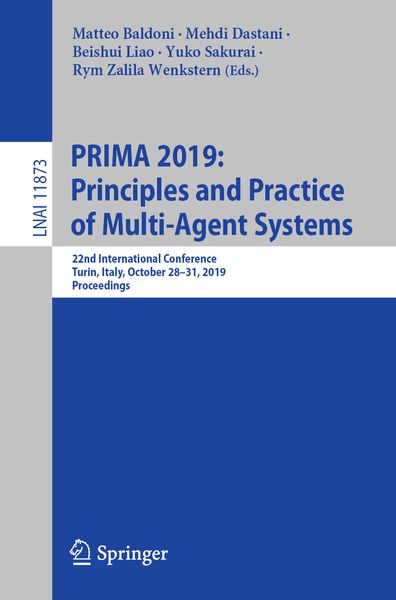
Produktbild: PRIMA 2019: Principles and Practice of Multi-Agent Systems
Band 11873

PRIMA 2019: Principles and Practice of Multi-Agent Systems 22nd International Conference, Turin, Italy, October 28–31, 2019, Proceedings

99,99 €

inkl. gesetzl. MwSt., Versandkostenfrei


Beschreibung

Produktdetails

Einband

Taschenbuch

Erscheinungsdatum

26.10.2019

Abbildungen

XVII, 646 p. 432 illus., 98 illus. in color.

Herausgeber

Matteo Baldoni + weitere

Verlag

Springer

Seitenzahl

646

Maße (L/B/H)

23,5/15,5/3,6 cm

Gewicht

990 g

Auflage

1st ed. 2019

Sprache

Englisch

ISBN

978-3-030-33791-9

Beschreibung

Produktdetails

Einband

Taschenbuch

Erscheinungsdatum

26.10.2019

Abbildungen

XVII, 646 p. 432 illus., 98 illus. in color.

Herausgeber

Verlag

Springer

Seitenzahl

646

Maße (L/B/H)

23,5/15,5/3,6 cm

Gewicht

990 g

Auflage

1st ed. 2019

Sprache

Englisch

ISBN

978-3-030-33791-9

Herstelleradresse

Springer-Verlag KG
Sachsenplatz 4-6
1201 Wien
AT

Email: ProductSafety@springernature.com

Noch keine Bewertungen vorhanden

Verfassen Sie die erste Bewertung zu diesem Artikel

Helfen Sie anderen Kundinnen und Kunden durch Ihre Meinung.

Kundinnen und Kunden meinen

Bewertungen (0)

  • Produktbild: PRIMA 2019: Principles and Practice of Multi-Agent Systems
  • Main track full papers.- Deliberation towards transitivity with unshared features.- K-ACE: a Flexible Environment for Knowledge-Aware Multi-Agent Systems.- Formal analysis of responsibility attribution in a multimodal framework.- Decidable Verification of Agent-Based Data-aware Systems.- New Distributed Constraint Reasoning Algorithms for Load Balancing in Edge Computing.- A Distributed and Clustering-based Algorithm for the Enumeration Problem in Abstract Argumentation.- Dynamic multi-agent systems: conceptual framework, automata-based modelling and verification.- Usefulness of Information for Goal Achievement.- A Scheduler for Smart Homes with Probabilistic User Preferences.- Supply Chain Management World: A benchmark environment for situated negotiations.- Coordination of Mobile Agents for Simultaneous Coverage.- MCTS-based Automated Negotiation Agent.- Automating Agential Reasoning: Proof-Calculi and Syntactic Decidability for STIT Logics.- Selfish Mining in Proof-of-Work Blockchain with Multiple Miners: An Empirical Evaluation.- A Co-Evolutionary Approach to Analyzing the Impact of Rationality on the Italian Electricity Market.- Modelling Shared Decision Making in Medical Negotiations: Interactive Training with Cognitive Agents.- Doxastic Group Reasoning via Multiple Belief Shadowing.- Subset Spaces for Conditional Norms.- Integrating CP-nets in Reactive BDI Agents.- SAT-Based Automated Mechanism Design for False-Name-Proof Facility Location.- Solving Coalition Structure Generation Problems over Weighted Graph.- From good intentions to behaviour change: Probabilistic Feature Diagrams for Behaviour Support Agents.- Identifying Belief Sequences in a Network of Communicating Agents.- Non-monotonic collective decisions.- A Coalitional Algorithm for Recursive Delegation.- Short papers.- Compact Frequency Memory for Reinforcement Learning with Hidden States.- Leveraging Symmetric Relations for Approximation Coalition Structure Generation.- Deception/Honesty Detection and (Mis)trust Building in Manipulable Multi-Agent Argumentation: an Insight.- Self-Vehicle Positioning Using Smart Infrastructures.- A Combined Netflow-driven and Agent-based Social Modeling Approach for Building Evacuation.- Imperfect Information in Alternating-time Temporal Logic on Finite Traces.- TAMER: Task Allocation in Multi-Robot Systems Through an Entity-Relationship Model.- A Modeling Environment for Reified Temporal-Causal Networks: Modeling Plasticity and Metaplasticity in Cognitive Agent Models.- The Choice Between Bad and Worse: A Cognitive Agent Model for Desire Regulation under Stress.- Modeling Higher-Order Adaptive Evolutionary Processes by Multilevel Adaptive Agent Models.- Emergent Privacy Norms for Collaborative Systems.- Estimating Missing Environmental Information by Contextual Data Cooperation.- Semantics of extended argumentation frameworks defined by renovation sets.- Smart RogAgent: where Agents and Humans Team Up.- Coordination in Collaborative Work by Deep Reinforcement Learning with Various State Descriptions.- Learning to Explain Anger : An Adaptive Humanoid-Agent for Cyber-Aggression.- SPSC: a new execution policy for exploring discrete-time stochastic simulations.- Computational Complexity of Hedonic Games on Sparse Graphs.- Strategies for Energy-Aware Multi-Agent Continuous Cooperative Patrolling Problems subject to Requirements.- Deep false-name-proof auction mechanisms.- Ubiquitous computing and multi-agent systems: clarification of the lexicon.- Explainable ASP.- Block Argumentation.- DyNeMoC: Statistical Model Checking for Agent Based Systems on Graphs.- An Adaptive Cognitive Agent Model for Development of a Hoarding Disorder and Recovery from it by Therapy.