KI-Beratung Beta

Gutscheinbedingungen

**Gültig am 20.11.2026 ab einem Mindestbestellwert von 30€ auf Spielzeug, Schreibwaren, Filme, Geschenke & Trends, Musik, tolino eReader & Zubehör, Hörbücher und Hörbuch-Downloads, nicht preisgebundene Bücher und Kalender online auf thalia.at und in der Thalia App. Einzelne Artikel können ausgeschlossen sein. Aufgrund der Buchpreisbindung sind deutschsprachige Bücher und eBooks ausgenommen. Zusätzlich ausgenommen sind Abos & Flatrates, Games, Geschenkkarten/-boxen, Shelfies, Software, Zeitschriften sowie einzelne Artikel von tonies®. Pro Einkauf einmal einlösbar. Click & Collect nur bei Onlinevorabzahlung möglich. Keine Barauszahlung. Nicht kombinierbar mit anderen Aktionen und Gutscheinen. Gutschein wird auf max. 500€ Bestellwert angerechnet. Nicht gültig für Versandkosten und Services. Preisgebundene Artikel sind vom Mindestbestellwert ausgeschlossen.

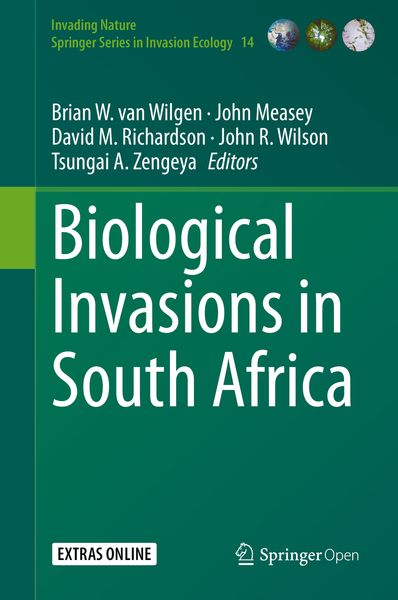
Produktbild: Biological Invasions in South Africa
Band 14

Biological Invasions in South Africa

54,99 €

inkl. gesetzl. MwSt., Versandkostenfrei


Beschreibung

This open access volume presents a comprehensive account of all aspects of biological invasions in South Africa, where research has been conducted over more than three decades, and where bold initiatives have been implemented in attempts to control invasions and to reduce their ecological, economic and...

Beschreibung

This open access volume presents a comprehensive account of all aspects of biological invasions in South Africa, where research has been conducted over more than three decades, and where bold initiatives have been implemented in attempts to control invasions and to reduce their ecological, economic and social effects. It covers a broad range of themes, including history, policy development and implementation, the status of invasions of animals and plants in terrestrial, marine and freshwater environments, the development of a robust ecological theory around biological invasions, the effectiveness of management interventions, and scenarios for the future. The South African situation stands out because of the remarkable diversity of the country, and the wide range of problems encountered in its varied ecosystems, which has resulted in a disproportionate investment into both research and management. The South African experience holds many lessons for other parts of the world, and thisbook should be of immense value to researchers, students, managers, and policy-makers who deal with biological invasions and ecosystem management and conservation in most other regions.

Rezension

“This resource will be valuable both to seasoned practitioners or academic researchers as well as to students just embarking on their careers. … Biological Invasions in South Africa will be seen as a pivotal milestone on the path to achieving these positive outcomes.” (Philip E. Hulme, South African Journal of Science, Vol. 117 (1-2), 2021)

Portrait

Brian W. van Wilgen is Emeritus Professor at the DST-NRF Centre of Excellence for Invasion Biology at Stellenbosch University, South Africa. His interests include applied ecology and the development of evidence-based approaches to conservation management in Africa and beyond. His work has focussed mainly on fire ecology and biological invasions, and he has published over 250 peer-reviewed journal papers and book chapters. 

John Measey is Chief Researcher at the NRF-DST Centre of Excellence for Invasion Biology, based in the Department of Botany and Zoology at Stellenbosch University, South Africa. He is author/co-author of over 200 peer-reviewed journal papers and chapters in edited books. His research focuses on animal invasions, especially those of reptiles and amphibians.  

David M. Richardson is Director of the DST-NRF Centre of Excellence for Invasion Biology and a Distinguished Professor of Ecology at Stellenbosch University, South Africa. His research focuses mainly on plant invasions, especially trees and shrubs. He is author/co-author of over 430 peer-reviewed journal papers and chapters in edited books. He has edited/co-edited six books, including Fifty years of invasion ecology (Wiley-Blackwell, 2011) and is co-author of Invasion Dynamics (Oxford University Press; 2017).

John R. Wilson is the science lead for the South African National Biodiversity Institute's Biological Invasions Directorate.  He is author/co-author of over 120 papers in peer-reviewed journals with a particular focus on invasion science, and was the lead author of a recent book on detecting and responding to alien plant incursions (Cambridge University Press; 2017).  He is a member of the IUCN's Invasive Species Specialist Group, and works across science, management, and policy (e.g. as a lead editor of South Africa's National Status Report on Biological Invasions, and current chair of the South African Alien Species Risk Analysis Review Panel).

Tsungai Zengeya is a senior researcher in the Biological Invasions Directorate at the South African National Biodiversity Institute and leads up the team producing the South African National Status Report on Biological Invasions. His research interests are in aquatic ecology, with a focus on understanding the impacts of, and managing and preventing biological invasions. His is also a core team member of the DST-NRF Centre of Excellence for Invasion Biology at University of Pretoria, South Africa.


Produktdetails

Einband

Gebundene Ausgabe

Erscheinungsdatum

11.03.2020

Abbildungen

XXIV, 975 p. 155 illus., 111 illus. in color. With online files/update.

Herausgeber Brian W. van Wilgen + weitere

Produktdetails

Einband

Gebundene Ausgabe

Erscheinungsdatum

11.03.2020

Abbildungen

XXIV, 975 p. 155 illus., 111 illus. in color. With online files/update.

Herausgeber
Verlag Springer
Seitenzahl

975

Maße (L/B/H)

24,1/16/5,9 cm

Gewicht

1591 g

Auflage

20001 Auflage 1st edition 2020

Sprache

Englisch

ISBN

978-3-030-32393-6

Herstelleradresse

Springer-Verlag KG
Sachsenplatz 4-6
1201 Wien
AT

Email: ProductSafety@springernature.com

Noch keine Bewertungen vorhanden

Verfassen Sie die erste Bewertung zu diesem Artikel

Helfen Sie anderen Kundinnen und Kunden durch Ihre Meinung.

Kundinnen und Kunden meinen

Bewertungen (0)

Weitere Artikel finden Sie in

  • Produktbild: Biological Invasions in South Africa
  • PART 1: BACKGROUND.- Chapter 1: Biological invasions in South Africa: An overview.- Chapter 2: A brief, selective history of researchers and research initiatives related to biological invasions in South Africa.- PART 2: BIOLOGICAL INVASIONS IN SOUTH AFRICA.- Chapter 3: The biogeography of South African terrestrial plant invasions.- Chapter 4:Invasive alien aquatic plants in freshwater ecosystems.- Chapter 5: Terrestrial Vertebrate Invasions in South Africa.- Chapter 6: Alien freshwater fauna in South Africa.- Chapter 7: Alien terrestrial invertebrates in South Africa.- Chapter 8: Biological invasions in South Africa’s offshore sub-Antarctic territories.- Chapter 9: Coastal invasions: The South African context.- Chapter 10: Pathogens of vertebrate animals as invasive species: Insights from South Africa.- Chapter 11: Biological invasions in South Africa’s urban ecosystems: Patterns, processes, impacts and management.- PART 3: DRIVERS OF INVASION.- Chapter 12: South Africa’s pathways of introduction and dispersal and how they have changed over time.- Chapter 13: The role of environmental factors in promoting and limiting biological invasions in South Africa.- Chapter 14: Biotic interactions as mediators of biological invasions: Insights from South Africa.- PART 4: IMPACTS OF INVASION.- Chapter 15:Impacts of invasions on terrestrial water resources in South Africa.- Chapter 16:The impact of invasive alien plants on rangelands in South Africa.- Chapter 17: An evaluation of the impacts of alien species on biodiversity in South Africa using different methods.- PART 5: MANAGEMENT OF INVASIONS.- Chapter 18: Biological invasion policy and legislation development and implementation in South Africa.- Chapter 19: More than a century of biological control against invasive alien plants in South Africa: a synoptic view of what has been accomplished.- Chapter 20:Analysing the risks posed by biological invasions to South Africa.- Chapter 21:The extent and effectiveness of alien plantcontrol projects in South Africa.- Chapter 22: Experience and lessons from alien and invasive animal control projects carried out in South Africa.- Chapter 23: Biological invasions and ecological restoration in South Africa.- Chapter 24: The social dimensions of biological invasions in South Africa.- Chapter 25: Education, training and capacity building in the field of biological invasions in South Africa.- PART 6: NEW INSIGHTS.-  Chapter 26: South Africa as a donor of naturalized and invasive alien plants to other parts of the world.- Chapter 27: South Africa as a donor of alien animals.- Chapter 28: Knowing-doing continuum or knowing-doing gap? Transferring research results to managers of biological invasions in South Africa.- Chapter 29: Biological invasions as a component of South Africa’s global change research effort.- Chapter 30: South Africa’s Centre for Invasion Biology: An experiment in invasion science for society.- PART 7: THE WAY FORWARD.- Chapter 31:Potential futures of biological invasions in South Africa.