KI-Beratung Beta

Gutscheinbedingungen

**Gültig bis 18.11.2026 auf englischsprachige Klassiker (klassiker-32728) online auf thalia.at und in der Thalia App. Einzelne Artikel können ausgeschlossen sein. Ausgenommen sind preisgebundene Artikel & eBooks. Pro Einkauf einmal einlösbar. Click & Collect nur bei Onlinevorabzahlung möglich. Keine Barauszahlung. Nicht kombinierbar mit anderen Aktionen und Gutscheinen. Gutschein wird auf max. 500€ Bestellwert angerechnet. Nicht gültig für Geschenkkarten, Versandkosten und Services.

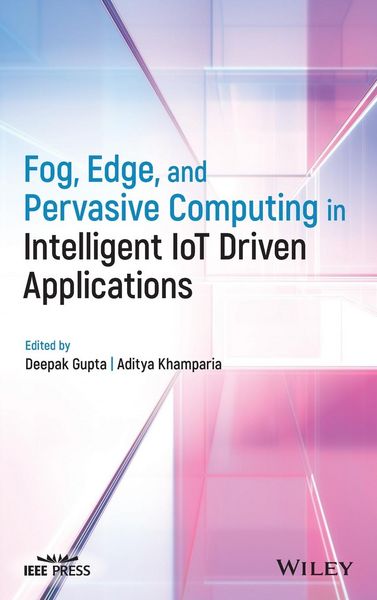
Produktbild: Fog, Edge, and Pervasive Computing in Intelligent Iot Driven Applications

Fog, Edge, and Pervasive Computing in Intelligent Iot Driven Applications

139,99 €

inkl. gesetzl. MwSt., Versandkostenfrei


Beschreibung

A practical guide to the design, implementation, evaluation, and deployment of emerging technologies for intelligent IoT applications   With the rapid development in artificially intelligent and hybrid technologies, IoT, edge, fog-driven, and pervasive computing techniques are becoming important parts...

Beschreibung

A practical guide to the design, implementation, evaluation, and deployment of emerging technologies for intelligent IoT applications
 
With the rapid development in artificially intelligent and hybrid technologies, IoT, edge, fog-driven, and pervasive computing techniques are becoming important parts of our daily lives. This book focuses on recent advances, roles, and benefits of these technologies, describing the latest intelligent systems from a practical point of view. Fog, Edge, and Pervasive Computing in Intelligent IoT Driven Applications is also valuable for engineers and professionals trying to solve practical, economic, or technical problems. With a uniquely practical approach spanning multiple fields of interest, contributors cover theory, applications, and design methodologies for intelligent systems. These technologies are rapidly transforming engineering, industry, and agriculture by enabling real-time processing of data via computational, resource-oriented metaheuristics and machine learning algorithms. As edge/fog computing and associated technologies are implemented far and wide, we are now able to solve previously intractable problems. With chapters contributed by experts in the field, this book:
* Describes Machine Learning frameworks and algorithms for edge, fog, and pervasive computing
* Considers probabilistic storage systems and proven optimization techniques for intelligent IoT
* Covers 5G edge network slicing and virtual network systems that utilize new networking capacity
* Explores resource provisioning and bandwidth allocation for edge, fog, and pervasive mobile applications
* Presents emerging applications of intelligent IoT, including smart farming, factory automation, marketing automation, medical diagnosis, and more
 
Researchers, graduate students, and practitioners working in the intelligent systems domain will appreciate this book's practical orientation and comprehensive coverage. Intelligent IoT is revolutionizing every industry and field today, and Fog, Edge, and Pervasive Computing in Intelligent IoT Driven Applications provides the background, orientation, and inspiration needed to begin.

Produktdetails

Einband

Gebundene Ausgabe

Erscheinungsdatum

07.01.2021

Herausgeber Deepak Gupta + weitere
Verlag John Wiley & Sons Inc

Produktdetails

Einband

Gebundene Ausgabe

Erscheinungsdatum

07.01.2021

Herausgeber
Verlag John Wiley & Sons Inc
Seitenzahl

464

Maße (L/B/H)

23,5/15,7/2,9 cm

Gewicht

814 g

Auflage

1. Auflage

Sprache

Englisch

ISBN

978-1-119-67007-0

Herstelleradresse

Libri GmbH
Europaallee 1
36244 Bad Hersfeld
DE

Email: gpsr@libri.de

Noch keine Bewertungen vorhanden

Verfassen Sie die erste Bewertung zu diesem Artikel

Helfen Sie anderen Kundinnen und Kunden durch Ihre Meinung.

Kundinnen und Kunden meinen

Bewertungen (0)

Die Leseprobe wird geladen.
  • Produktbild: Fog, Edge, and Pervasive Computing in Intelligent Iot Driven Applications
  • About the Editors xvii
     
    List of Contributors xix
     
    Preface xxv
     
    Acknowledgments xxxiii
     
    1 Fog, Edge and Pervasive Computing in Intelligent Internet of Things Driven Applications in Healthcare: Challenges, Limitations and Future Use 1
    Afroj Alam, Sahar Qazi, Naiyar Iqbal, and Khalid Raza
     
    1.1 Introduction 1
     
    1.2 Why Fog, Edge, and Pervasive Computing? 3
     
    1.3 Technologies Related to Fog and Edge Computing 6
     
    1.4 Concept of Intelligent IoT Application in Smart (Fog) Computing Era 9
     
    1.5 The Hierarchical Architecture of Fog/Edge Computing 12
     
    1.6 Applications of Fog, Edge and Pervasive Computing in IoT-based Healthcare 15
     
    1.7 Issues, Challenges, and Opportunity 17
     
    1.7.1 Security and Privacy Issues 18
     
    1.7.2 Resource Management 19
     
    1.7.3 Programming Platform 19
     
    1.8 Conclusion 20
     
    Bibliography 20
     
    2 Future Opportunistic Fog/Edge Computational Models and their Limitations 27
    Sonia Singla, Naveen Kumar Bhati, and S. Aswath
     
    2.1 Introduction 28
     
    2.2 What are the Benefits of Edge and Fog Computing for the Mechanical Web of Things (IoT)? 32
     
    2.3 Disadvantages 34
     
    2.4 Challenges 34
     
    2.5 Role in Health Care 35
     
    2.6 Blockchain and Fog, Edge Computing 38
     
    2.7 How Blockchain will Illuminate Human Services Issues 40
     
    2.8 Uses of Blockchain in the Future 41
     
    2.9 Uses of Blockchain in Health Care 42
     
    2.10 Edge Computing Segmental Analysis 42
     
    2.11 Uses of Fog Computing 43
     
    2.12 Analytics in Fog Computing 44
     
    2.13 Conclusion 44
     
    Bibliography 44
     
    3 Automating Elicitation Technique Selection using Machine Learning 47
    Hatim M. Elhassan Ibrahim Dafallaa, Nazir Ahmad, Mohammed Burhanur Rehman, Iqrar Ahmad, and Rizwan khan
     
    3.1 Introduction 47
     
    3.2 Related Work 48
     
    3.3 Model: Requirement Elicitation Technique Selection Model 52
     
    3.3.1 Determining Key Attributes 54
     
    3.3.2 Selection Attributes 54
     
    3.3.2.1 Analyst Experience 55
     
    3.3.2.2 Number of Stakeholders 55
     
    3.3.2.3 Technique Time 56
     
    3.3.2.4 Level of Information 56
     
    3.3.3 Selection Attributes Dataset 56
     
    3.3.3.1 Mapping the Selection Attributes 57
     
    3.3.4 k-nearest Neighbor Algorithm Application 57
     
    3.4 Analysis and Results 60
     
    3.5 The Error Rate 61
     
    3.6 Validation 61
     
    3.6.1 Discussion of the Results of the Experiment 62
     
    3.7 Conclusion 62
     
    Bibliography 65
     
    4 Machine Learning Frameworks and Algorithms for Fog and Edge Computing 67
    Murali Mallikarjuna Rao Perumalla, Sanjay Kumar Singh, Aditya Khamparia, Anjali Goyal, and Ashish Mishra
     
    4.1 Introduction 68
     
    4.1.1 Fog Computing and Edge Computing 68
     
    4.1.2 Pervasive Computing 68
     
    4.2 Overview of Machine Learning Frameworks for Fog and Edge Computing 69
     
    4.2.1 TensorFlow 69
     
    4.2.2 Keras 70
     
    4.2.3 PyTorch 70
     
    4.2.4 TensorFlow Lite 70
     
    4.2.4.1 Use Pre-train Models 70
     
    4.2.4.2 Convert the Model 70
     
    4.2.4.3 On-device Inference 71
     
    4.2.4.4 Model Optimization 71
     
    4.2.5 Machine Learning and Deep Learning Techniques 71
     
    4.2.5.1 Supervised, Unsupervised and Reinforcement Learning 71
     
    4.2.5.2 Machine Learning, Deep Learning Techniques 72
     
    4.2.5.3 Deep Learning Techniques 75
     
    4.2.5.4 Efficient Deep Learning Algorithms for Inference 77
     
    4.2.6 Pros and Cons of ML Algorithms for Fog and Edge Computing 78
     
    4.2.6.1 Advantages using