KI-Beratung Beta

Gutscheinbedingungen

**Gültig am 20.11.2026 ab einem Mindestbestellwert von 30€ auf Spielzeug, Schreibwaren, Filme, Geschenke & Trends, Musik, tolino eReader & Zubehör, Hörbücher und Hörbuch-Downloads, nicht preisgebundene Bücher und Kalender online auf thalia.at und in der Thalia App. Einzelne Artikel können ausgeschlossen sein. Aufgrund der Buchpreisbindung sind deutschsprachige Bücher und eBooks ausgenommen. Zusätzlich ausgenommen sind Abos & Flatrates, Games, Geschenkkarten/-boxen, Shelfies, Software, Zeitschriften sowie einzelne Artikel von tonies®. Pro Einkauf einmal einlösbar. Click & Collect nur bei Onlinevorabzahlung möglich. Keine Barauszahlung. Nicht kombinierbar mit anderen Aktionen und Gutscheinen. Gutschein wird auf max. 500€ Bestellwert angerechnet. Nicht gültig für Versandkosten und Services. Preisgebundene Artikel sind vom Mindestbestellwert ausgeschlossen.

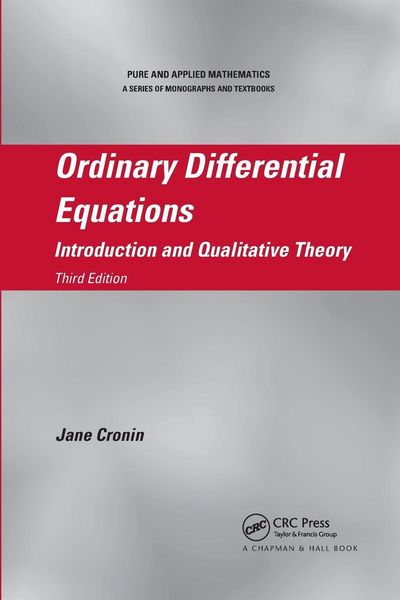
Produktbild: Ordinary Differential Equations

Ordinary Differential Equations Introduction and Qualitative Theory, Third Edition

96,99 €

inkl. gesetzl. MwSt., Versandkostenfrei


Beschreibung

Designed for a rigorous first course in ordinary differential equations, Ordinary Differential Equations: Introduction and Qualitative Theory, Third Edition includes basic material such as the existence and properties of solutions, linear equations, autonomous equations, and stability as well as more...

Beschreibung

Designed for a rigorous first course in ordinary differential equations, Ordinary Differential Equations: Introduction and Qualitative Theory, Third Edition includes basic material such as the existence and properties of solutions, linear equations, autonomous equations, and stability as well as more advanced topics in periodic solutions of nonlinear equations. Requiring only a background in advanced calculus and linear algebra, the text is appropriate for advanced undergraduate and graduate students in mathematics, engineering, physics, chemistry, or biology.

This third edition of a highly acclaimed textbook provides a detailed account of the Bendixson theory of solutions of two-dimensional nonlinear autonomous equations, which is a classical subject that has become more prominent in recent biological applications. By using the Poincaré method, it gives a unified treatment of the periodic solutions of perturbed equations. This includes the existence and stability of periodic solutions of perturbed nonautonomous and autonomous equations (bifurcation theory). The text shows how topological degree can be applied to extend the results. It also explains that using the averaging method to seek such periodic solutions is a special case of the use of the Poincaré method.

Rezension

... a classic treatment of many of the topics an instructor would want in such a course, with particular emphasis on those aspects of the qualitative theory that are important for applications to mathematical biology. ... A nice feature of this edition is an extended and unified treatment of the perturbation problem for periodic solutions. ... a solid graduate-level introduction to ordinary differential equations, especially for applications. ...
-MAA Reviews, August 2010

Produktdetails

Einband

Taschenbuch

Erscheinungsdatum

05.09.2019

Abbildungen

48 SW-Abb.

Verlag Taylor & Francis

Produktdetails

Einband

Taschenbuch

Erscheinungsdatum

05.09.2019

Abbildungen

48 SW-Abb.

Verlag Taylor & Francis
Seitenzahl

404

Maße (L/B/H)

22,9/15,2/2,2 cm

Gewicht

583 g

Auflage

3. Auflage

Sprache

Englisch

ISBN

978-0-367-38796-9

EU-Ansprechpartner

Taylor & Francis Verlag GmbH
Kaufingerstraße 24
80331 München
DE
GPSR@taylorandfrancis.com

Herstelleradresse

Taylor & Francis Group
5 Howick Place
SW1P 1WG London
UK
GPSR@taylorandfrancis.com

Noch keine Bewertungen vorhanden

Verfassen Sie die erste Bewertung zu diesem Artikel

Helfen Sie anderen Kundinnen und Kunden durch Ihre Meinung.

Kundinnen und Kunden meinen

Bewertungen (0)

Die Leseprobe wird geladen.
  • Produktbild: Ordinary Differential Equations
  • Prefaces. Introduction. Existence Theorems. Linear Systems. Autonomous Systems. Stability. The Lyapunov Second Method. Periodic Solutions. Perturbation Theory: The Poincaré Method. Perturbation Theory: Autonomous Systems and Bifurcation Problems. Using the Averaging Method: An Introduction. Appendix. References. Index.