• Produktbild: Handbook of Variational Methods for Nonlinear Geometric Data
  • Produktbild: Handbook of Variational Methods for Nonlinear Geometric Data

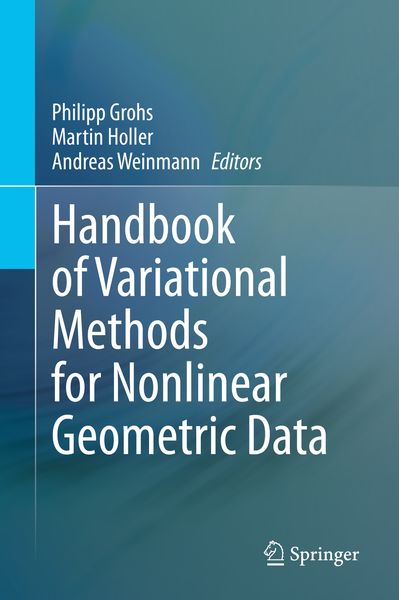
Handbook of Variational Methods for Nonlinear Geometric Data

199,99 €

inkl. gesetzl. MwSt., Versandkostenfrei


Beschreibung

Produktdetails

Einband

Gebundene Ausgabe

Erscheinungsdatum

04.04.2020

Herausgeber

Philipp Grohs + weitere

Verlag

Springer

Seitenzahl

701

Maße (L/B/H)

24,1/16/4,5 cm

Gewicht

1228 g

Auflage

1st ed. 2020

Sprache

Englisch

ISBN

978-3-030-31350-0

Beschreibung

Portrait

Prof. Dr. Philipp Grohs was born on July 7, 1981 in Austria and has been a professor at the University of Vienna since 2016. In 2019, he also became a group leader at RICAM, the Johann Radon Institute for Computational and Applied Mathematics in the Austrian Academy of Sciences in Linz. After studying, completing his doctorate and working as a postdoc at TU Wien, Grohs transferred to King Abdullah University of Science and Technology in Thuwal, Saudi Arabia, and then to ETH Zürich, Switzerland, where he was an assistant professor from 2011 to 2016. Grohs was awarded the ETH Zurich Latsis Prize in 2014. In 2020 he was selected for an Alexander-von-Humboldt-Professorship award, the highest endowed research prize in Germany. He is a member of the board of the Austrian Mathematical Society, a member of IEEE Information Theory Society and on the editorial boards of various specialist journals.

Martin Holler was born on May 21, 1986 in Austria. He received his MSc (2010) and his PhD (2013) with a "promotio sub auspiciis praesidentis rei publicae" in Mathematics from the University of Graz. After research stays at the University of Cambridge, UK, and the Ecole Polytechnique, Paris, he currently holds a University Assistant position at the Institute of Mathematics and Scientific Computing of the University of Graz. His research interests include inverse problems and mathematical image processing, in particular the development and analysis of mathematical models in this context as well as applications in biomedical imaging, image compression and beyond.

Andreas Weinmann was born on July 18, 1979 in Augsburg, Germany. He studied mathematics with minor in computer science at TU Munich, and received his Diploma degree in mathematics and computer science from TU Munich in 2006 (with highest distinction). He was assistant at the Institute of Geometry, TU Graz. He obtained his Ph.D. degree from TU Graz in 2010 (with highest distinction). Thenhe worked as a researcher at Helmholtz Center Munich and TU Munich. Since 2015 he holds a position as Professor of Mathematics and Image Processing at Hochschule Darmstadt. He received his habilitation in 2018 from University Osnabruck. Andreas’s research interests include applied analysis, in particular variational methods, nonlinear geometric data spaces, inverse problems as well as computer vision, signal and image processing and imaging applications, in particular Magnetic Particle Imaging.


Produktdetails

Einband

Gebundene Ausgabe

Erscheinungsdatum

04.04.2020

Herausgeber

Verlag

Springer

Seitenzahl

701

Maße (L/B/H)

24,1/16/4,5 cm

Gewicht

1228 g

Auflage

1st ed. 2020

Sprache

Englisch

ISBN

978-3-030-31350-0

Herstelleradresse

Springer-Verlag KG
Sachsenplatz 4-6
1201 Wien
AT

Email: GPSR Kontakt

Noch keine Bewertungen vorhanden

Verfassen Sie die erste Bewertung zu diesem Artikel

Helfen Sie anderen Kundinnen und Kunden durch Ihre Meinung.

Kundinnen und Kunden meinen

Bewertungen (0)

  • Produktbild: Handbook of Variational Methods for Nonlinear Geometric Data
  • Produktbild: Handbook of Variational Methods for Nonlinear Geometric Data
  • Part I Processing geometric data

    1 Geometric Finite Elements

    Hanne Hardering and Oliver Sander

    1.1 Introduction

    1.2 Constructions of geometric finite elements

    1.2.1 Projection-based finite elements

    1.2.2 Geodesic finite elements

    1.2.3 Geometric finite elements based on de Casteljau’s algorithm

    1.2.4 Interpolation in normal coordinates

    1.3 Discrete test functions and vector field interpolation

    1.3.1 Algebraic representation of test functions

    1.3.2 Test vector fields as discretizations of maps into the tangent bundle

    1.4 A priori error theory

    1.4.1 Sobolev spaces of maps into manifolds

    1.4.2 Discretization of elliptic energy minimization problems

    1.4.3 Approximation errors . .

    1.5 Numerical examples

    1.5.1 Harmonic maps into the sphere

    1.5.2 Magnetic Skyrmions in the plane

    1.5.3 Geometrically exact Cosserat plates

    2 Non-smooth variational regularization for processing manifold-valued

    data

    M. Holler and A. Weinmann

    2.1 Introduction

    2.2 Total Variation Regularization of Manifold Valued Data

    vii

    viii Contents

    2.2.1 Models

    2.2.2 Algorithmic Realization

    2.3 Higher Order Total Variation Approaches, Total GeneralizedVariation

    2.3.1 Models

    2.3.2 Algorithmic Realization

    2.4 Mumford-Shah Regularization for Manifold Valued Data

    2.4.1 Models

    2.4.2 Algorithmic Realization

    2.5 Dealing with Indirect Measurements: Variational Regularization

    of Inverse Problems for Manifold Valued Data

    2.5.1 Models

    2.5.2 Algorithmic Realization

    2.6 Wavelet Sparse Regularization of Manifold Valued Data

    2.6.1 Model

    2.6.2 Algorithmic Realization

    3 Lifting methods for manifold-valued variational problems

    Thomas Vogt, Evgeny Strekalovskiy, Daniel Cremers, Jan Lellmann

    3.1 Introduction

    3.1.1 Functional lifting in Euclidean spaces

    3.1.2 Manifold-valued functional lifting

    3.1.3 Further related work

    3.2 Submanifolds of RN

    3.2.1 Calculus of Variations on submanifolds

    3.2.2 Finite elements on submanifolds

    3.2.3 Relation to [47]

    3.2.4 Full discretization and numerical implementation

    3.3 Numerical Results

    3.3.1 One-dimensional denoising on a Klein bottle

    3.3.2 Three-dimensional manifolds: SO¹3º

    3.3.3 Normals fields from digital elevation data

    3.3.4 Denoising of high resolution InSAR data

    3.4 Conclusion and Outlook

    4 Geometric subdivision and multiscale transforms

    Johannes Wallner

    4.1 Computing averages in nonlinear geometries

    The Fréchet mean

    The exponential mapping

    Averages defined in terms of the exponential mapping

    4.2 Subdivision

    4.2.1 Defining stationary subdivision

    Linear subdivision rules and their nonlinear analogues

    4.2.2 Convergence of subdivision processes

    4.2.3 Probabilistic interpretation of subdivision in metric spaces

    4.2.4 The convergence problem in manifolds

    4.3 Smoothness analysis of subdivision rules

    4.3.1 Derivatives of limits

    4.3.2 Proximity inequalities

    4.3.3 Subdivision of Hermite data

    4.3.4 Subdivision with irregular combinatorics

    4.4 Multiscale transforms

    4.4.1 Definition of intrinsic multiscale transforms

    4.4.2 Properties of multiscale transforms

    Conclusion

    5 Variational Methods for Discrete Geometric Functionals

    Henrik Schumacher and Max Wardetzky

    5.1 Introduction

    5.2 Shape Space of Lipschitz Immersions

    5.3 Notions of Convergence for Variational Problems

    5.4 Practitioner’s Guide to Kuratowski Convergence of Minimizers

    5.5 Convergence of Discrete Minimal Surfaces and Euler Elasticae

    Part II Geometry as a tool

    6 Variational methods for fluid-structure interactions

    François Gay-Balmaz and Vakhtang Putkaradze

    6.1 Introduction

    6.2 Preliminaries on variational methods

    6.2.1 Exact geometric rod theory via variational principles

    6.3 Variational modeling for flexible tubes conveying fluids

    6.3.1 Configuration manifold for flexible tubes conveying fluid

    6.3.2 Definition of the Lagrangian

    6.3.3 Variational principle and equations of motion

    6.3.4 Incompressible fluids

    6.3.5 Comparison with previous models

    6.3.6 Conservation laws for gas motion and Rankine-Hugoniot conditions

    6.4 Variational discretization for flexible tubes conveying fluids

    6.4.1 Spatial discretization 6.4.2 Variational integrator in space and time

    6.5 Further developments

    7 Convex lifting-type methods for curvature regularization

    Ulrich Böttcher and Benedikt Wirth

    7.1 Introduction .

    7.1.1 Curvature-dependent functionals and regularization

    7.1.2 Convex relaxation of curvature regularization functionals

    7.2 Lifting-type methods for curvature regularization .

    7.2.1 Concepts for curve- (and surface-) lifting

    7.2.2 The curvature varifold approach

    7.2.3 The hyper-varifold approach

    7.2.4 The Gauss graph current approach

    7.2.5 The jump set calibration approach

    7.3 Discretization strategies

    7.3.1 Finite differences

    7.3.2 Line measure segments

    7.3.3 Raviart–Thomas Finite Elements on a staggered gri

    7.3.4 Adaptive line measure segments

    7.4 The jump set calibration approach in 3D

    7.4.1 Regularization model

    7.4.2 Derivation of Theorem 7.4.2

    7.4.3 Adaptive discretization with surface measures

    8 Assignment Flows

    Christoph Schnörr                                                  

    8.1 Introduction

    8.2 The Assignment Flow for Supervised Data Labeling

    8.2.1 Elements of Information Geometry

    8.2.2 The Assignment Flow

    8.3 Unsupervised Assignment Flow and Self-Assignment

    8.3.1 Unsupervised Assignment Flow: Label Evolution

    8.3.2 Self-Assignment Flow: Learning Labels from Data

    8.4 Regularization Learning by Optimal Control

    8.4.1 Linear Assignment Flow

    8.4.2 Parameter Estimation and Prediction

    8.5 Outlook

    9 Geometric methods on low-rank matrix and tensor manifolds

    André Uschmajew and Bard Vandereycken

    9.1 Introduction

    9.1.1 Aims and outline

    9.2 The geometry of low-rank matrices

    9.2.1 Singular value decomposition and low-rank approximation

    9.2.2 Fixed rank manifold

    9.2.3 Tangent space

    9.2.4 Retraction

    9.3 The geometry of the low-rank tensor train decomposition

    9.3.1 The tensor train decomposition

    9.3.2 TT-SVD and quasi optimal rank truncation

    9.3.3 Manifold structure

    9.3.4 Tangent space and retraction

    9.3.5 Elementary operations and TT matrix format

    9.4 Optimization problems

    9.4.1 Riemannian optimization

    9.4.2 Linear systems

    9.4.3 Computational cost

    9.4.4 Difference to iterative thresholding methods

    9.4.5 Convergence

    9.4.6 Eigenvalue problems

    9.5 Initial value problems

    9.5.1 Dynamical low-rank approximation

    9.5.2 Approximation properties

    9.5.3 Low-dimensional evolution equations

    9.5.4 Projector-splitting integrator

    9.6 Applications

    9.6.1 Matrix equations

    9.6.2 Schrödinger equation

    9.6.3 Matrix and tensor completion

    9.6.4 Stochastic and parametric equations

    9.6.5 Transport equations

    9.7 Conclusions

    Part III Statistical methods and non-linear geometry

    10 Statistical Methods Generalizing Principal Component Analysis to

    Non-Euclidean Spaces

    Stephan Huckemann and Benjamin Eltzner

    10.1 Introduction

    10.2 Some Euclidean Statistics Building on Mean and Covariance

    10.3 Fréchet _-Means and Their Strong Laws

    10.4 Procrustes Analysis Viewed Through Fréchet Means

    10.5 A CLT for Fréchet _-Means

    10.6 Geodesic Principal Component Analysis

    10.7 Backward Nested Descriptors Analysis (BNDA)

    10.8 Two Bootstrap Two-Sample Tests

    10.9 Examples of BNDA

    10.10 Outlook

    11 Advances in Geometric Statistics for manifold dimension reduction

    Xavier Pennec

    11.1 Introduction

    11.2 Means on manifolds

    11.3 Statistics beyond the mean value: generalizing PCA.

    11.3.1 Barycentric subspaces in manifolds

    11.3.2 From PCA to barycentric subspace analysis

    11.3.3 Sample-limited Lp barycentric subspace inference

    11.4 Example applications of Barycentric subspace analysis

    11.4.1 Example on synthetic data in a constant curvature space

    11.4.2 A symmetric group-wise analysis of cardiac motion in 4D image sequences

    12 Deep Variational Inference

    Iddo Drori

    12.1 Variational Inference

    12.1.1 Score Gradient

    12.1.2 Reparametrization Gradient

    12.2 Variational Autoencoder

    12.2.1 Autoencoder

    12.2.2 Variational Autoencoder

    12.3 Generative Flows

    12.4 Geometric Variational Inference

    Part IV Shapes spaces and the analysis of geometric data

    13 Shape Analysis of Functional Data

    Xiaoyang Guo, Anuj Srivastava

    13.1 Introduction

    13.2 Registration Problem and Elastic Framework

    13.2.1 The Use of the L2 Norm and Its Limitations

    13.2.2 Elastic Registration of Scalar Functions

    13.2.3 Elastic Shape Analysis of Curves

    13.3 Shape Summary Statistics, Principal Modes and Models

    14 Statistical Analysis of Trajectories of Multi-Modality Data

    Mengmeng Guo, Jingyong Su, Zhipeng Yang and Zhaohua Ding

    14.1 Introduction and Background

    14.2 Elastic Shape Analysis of Open Curves

    14.3 Elastic Analysis of Trajectories

    14.4 Joint Framework of Analyzing Shapes and Trajectories

    14.4.1 Trajectories of Functions

    14.4.2 Trajectories of Tensors

    15 Geometric Metrics for Topological Representations

    Anirudh Som, Karthikeyan Natesan Ramamurthy and Pavan Turaga

    15.1 Introduction

    15.2 Background and Definitions

    15.3 Topological Feature Representations

    15.4 Geometric Metrics for Representations

    15.5 Applications

    15.5.1 Time-series Analysis

    15.5.2 Image Analysis

    15.5.3 Shape Analysis .

    16 On Geometric Invariants, Learning, and Recognition of Shapes and

    Forms

    Gautam Pai, Mor Joseph-Rivlin, Ron Kimmel and Nir Sochen

    16.1 Introduction

    16.2 Learning Geometric Invariant Signatures For Planar Curves

    16.2.1 Geometric Invariants of Curves

    16.2.2 Learning Geometric Invariant Signatures of Planar Curves

    16.3 Geometric Moments for Advanced Deep Learning on Point Clouds

    16.3.1 Geometric Moments as Class Identifiers

    16.3.2 Raw Point Cloud Classification based on Moments

    Performance Evaluation

    17 Sub-Riemannian Methods in Shape Analysis

    Laurent Younes and Barbara Gris and Alain Trouvé

    17.1 Introduction

    17.2 Shape Spaces, Groups of Diffeomorphisms and Shape Motion

    17.2.1 Spaces of Plane Curves

    17.2.2 Basic Sub-Riemannian Structure

    17.2.3 Generalization

    17.2.4 Pontryagin’s Maximum Principle

    17.3 Approximating Distributions

    17.3.1 Control Points

    17.3.2 Scale Attributes

    17.4 Deformation Modules

    17.4.1 Definition

    17.4.2 Basic deformation modules

    17.4.3 Simple matching example

    17.4.4 Population analysis

    17.5 Constrained Evolution

    Normal Streamlines

    Multi-shapes

    Atrophy Constraints

    Part V Optimization algorithms and numerical methods

    18 First order methods for optimization on Riemannian manifolds

    Orizon P. Ferreira, Maurício S. Louzeiro and Leandro F. Prudente

    18.1 Introduction

    18.2 Notations and Basic Results.

    18.3 Examples of convex functions on Riemannian manifolds

    18.3.1 General examples .

    18.3.2 Example in the Euclidean space with a new Riemannianmetric

    18.3.3 Examples in the positive orthant with a new Riemannian

    18.3.4 Examples in the cone of SPD matrices with a new Riemannian metric

    Bibliographic notes and remarks

    18.4 Gradient method for optimization

    18.4.1 Asymptotic convergence analysis

    18.4.2 Iteration-complexity analysis

    Bibliographic notes and remarks

    18.5 Subgradient method for optimization

    18.5.1 Asymptotic convergence analysis

    18.5.2 Iteration-complexity analysis

    Bibliographic notes and remarks

    18.6 Proximal point method for optimization

    18.6.1 Asymptotic convergence analysis

    18.6.2 Iteration-complexity analysis

    Bibliographic notes and remarks

    19 Recent Advances in Stochastic Riemannian Optimization

    Reshad Hosseini and Suvrit Sra

    19.1 Introduction

    Additional Background and Summary

    19.2 Key Definitions

    19.3 Stochastic Gradient Descent on Manifolds

    19.4 Accelerating Stochastic Gradient Descent

    19.5 Analysis for G-Convex and Gradient Dominated Functions

    19.6 Example applications

    20 Averaging symmetric positive-definite matrices

    Xinru Yuan, Wen Huang, P.-A. Absil and K. A. Gallivan

    20.1 Introduction

    20.2 ALM Properties

    20.3 Geodesic Distance Based Averaging Techniques

    20.3.1 Karcher Mean (L2 Riemannian mean)

    20.3.2 Riemannian Median (L1 Riemannian mean)

    20.3.3 Riemannian Minimax Center (L1 Riemannian mean)

    20.4 Divergence-based Averaging Techniques

    20.4.1 Divergences

    20.4.2 Left, Right, and Symmetrized Means Using Divergences

    20.4.3 Divergence-based Median and Minimax Center

    20.5 Alternative Metrics on SPD Matrices

    21 Rolling Maps and Nonlinear Data

    Knut Hüper and Krzysztof A. Krakowski and Fátima Silva Leite

    21.1 Introduction

    21.2 Rolling Manifolds Along Affine Tangent Spaces

    21.2.1 Mathematical Setting

    21.2.2 Rolling Manifolds

    21.2.3 Parallel Transport

    21.3 Rolling to Solve Interpolation Problems on Manifolds

    21.3.1 Formulation of the Problem

    21.3.2 Motivation

    21.3.3 Solving the Interpolation Problem

    21.3.4 Examples

    21.3.5 Implementation of the Algorithm on S2

    21.4 Some Extensions

    21.4.1 Rolling a Hypersurface .

    21.4.2 The Case of an Ellipsoid

    21.4.3 Related Work

    Part VI Applications

    22 Manifold-valued Data in Medical Imaging Applications

    Maximilian Baust and Andreas Weinmann

    22.1 Introduction

    22.1.1 Motivation

    22.1.2 General Model

    22.1.3 Organization of the Chapter

    22.2 Pose Signals and 3D Ultrasound Compounding

    22.2.1 Problem-specific Manifold and Model

    22.2.2 Numerical Approach

    22.2.3 Experiments

    22.2.4 Discussion

    22.3 Diffusion Tensor Imaging

    22.3.1 Problem-specific Manifold and Model

    22.3.2 Algorithmic Approach

    22.3.3 Experiments

    22.3.4 Discussion

    22.4 Geometry Processing and Medical Image Segmentation

    22.4.1 Problem-specific Manifold, Basic Model and Algorithm

    22.4.2 Experiments

    22.4.3 Extensions

    22.4.4 Discussion

    23 The Riemannian and Affine Geometry of Facial Expression and

    Action Recognition

    Mohamed Daoudi, Juan-Carlos Alvarez Paiva and Anis Kacem

    23.1 Landmark representation

    23.1.1 Challenges

    23.2 Static representation

    23.3 Riemannian geometry of the space of Gram matrices

    23.3.1 Mathematical preliminaries

    23.3.2 Riemannian manifold of positive semi-definite matrices of fixed rank

    23.3.3 Affine-invariant and spatial covariance information of Gram matrices

    23.4 Gram matrix trajectories for temporal modeling of landmark sequences

    23.4.1 Rate-invariant comparison of Gram matrix trajectories

    23.5 Classification of Gram matrix trajectories

    23.5.1 Pairwise proximity function SVM

    23.6 Application to Facial Expression and Action Recognition

    23.6.1 2D facial expression recognition

    23.6.2 3D action recognition

    23.7 Affine-invariant shape representation using barycentric coordinates554

    23.7.1 Relationship with the conventional Grassmannian representation

    23.8 Metric learning on barycentric representation for expression recognition in unconstrained environments

    23.8.1 Experimental results

    24 Biomedical Applications of Geometric Functional Data Analysis

    James Matuk, Shariq Mohammed, Sebastian Kurtek and Karthik

    Bharath

    24.1 Introduction

    24.2 Mathematical Representation: Riemannian Metrics and

    Simplifying Transforms .

    24.2.1 Probability Density Functions

    24.2.2 Amplitude and Phase in Elastic Functional Data

    24.2.3 Shapes of Open and Closed Curves

    24.2.4 Shapes of Surfaces

    24.3 Nonparametric Metric-based Statistics

    24.3.1 Karcher Mean

    24.3.2 Covariance Estimation and Principal Component Analysis

    24.4 Biomedical Case Studies

    24.4.1 Probability Density Functions

    24.4.2 Amplitude and Phase in Elastic Functional Data

    24.4.3 Shapes of Open and Closed Curves

    24.4.4 Shapes of Surfaces