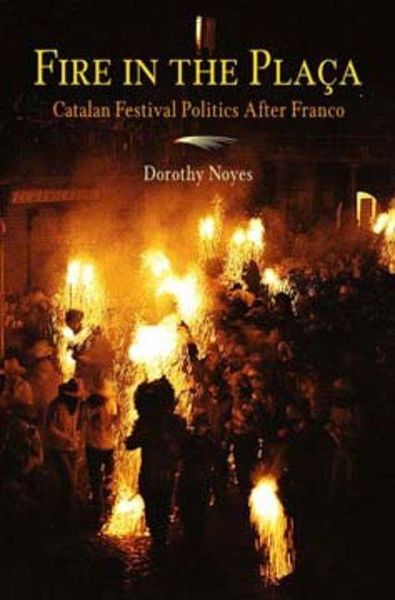
Fire in the Placa Catalan Festival Politics After Franco
-
- Taschenbuch
- eBook ausgewählt
-
Form:Einzelkauf Download
-
Sprache:Englisch
38,49 €
inkl. gesetzl. MwSt.Beschreibung
Produktdetails
Format
ePUB
Kopierschutz
Nein
Family Sharing
Nein
Text-to-Speech
Ja
Erscheinungsdatum
07.03.2012
Verlag
VersoSeitenzahl
336 (Printausgabe)
Sprache
Englisch
EAN
9780812202991
Selected by Choice magazine as an Outstanding Academic Title Fire in the Plaça is the first full-length study in English of the Patum, a Corpus Christi fire festival unique to Berga, Catalonia, Spain, celebrated annually since the seventeenth century. Participants in the festival are transformed through drink, sleep deprivation, crowding, constant motion, and the smoke and sparks of close-range firecrackers into passionate members of a precarious body politic. Combining richly layered symbolism with intense bodily expression, the Patum has long served as a grassroots equivalent of grand social theory; it moves from a representation of social divisions to a forcible communion among them. The Patum's dancing effigies-giants, dwarves, Turks and Christian knights, devils and angels, a crowned eagle, and two flaming mule-dragons-have provided local allegories for a long series of political conflicts, but the festival obscures its own messages in smoke and motion to enable a temporary merging of opposites. Activists in the 1970s transition to democracy in Spain took the Patum as a model of how old adversaries might collaborate: it helped to shape the mix of assertiveness in performance and compromise in practice that is typical of contemporary Catalan nationalism. The Patum became a focus of resistance to the Franco regime and drew visitors from all over Catalonia, serving as a rehearsal for the mass protests in Barcelona. Later, it provided the newly autonomous region with a vehicle for integrating immigrants and a vocabulary of belonging, culminating in the Patum-derived devils of the closing ceremonies of the 1992 Olympic games. Today, as mines and factories have closed in Berga, the Patum serves as an arena in which provincial Catalans model their relationship to Barcelona, Europe, and the world, and reflects their ambivalence about the choices open to them. Seeking a third way between tourism and terrorism, provincial towns like Berga show us the future of all local communities under globalization. In collective performances such as the Patum, tensions between cultural and political representation are made visible, and the gap between aspiration and possibility is both bridged and acknowledged. In this exceptionally rich ethnographic study, Dorothy Noyes explores the predicament of provincial communities striving to overcome internal conflict and participate in a wider world.
Noch keine Bewertungen vorhanden
Verfassen Sie die erste Bewertung zu diesem Artikel
Helfen Sie anderen Kundinnen und Kunden durch Ihre Meinung.
Kurze Frage zu unserer Seite
Vielen Dank für Ihr Feedback
Wir nutzen Ihr Feedback, um unsere Produktseiten zu verbessern. Bitte haben Sie Verständnis, dass wir Ihnen keine Rückmeldung geben können. Falls Sie Kontakt mit uns aufnehmen möchten, können Sie sich aber gerne an unseren Kund*innenservice wenden.
zum Kundenservice