
KI-Beratung Beta

Gutscheinbedingungen

**Gültig am 25.11.2026 auf fremdsprachige Bücher online auf thalia.at und in der Thalia App. Einzelne Artikel können ausgeschlossen sein. Ausgenommen sind preisgebundene Artikel & eBooks. Pro Einkauf einmal einlösbar. Click & Collect nur bei Onlinevorabzahlung möglich. Keine Barauszahlung. Nicht kombinierbar mit anderen Aktionen und Gutscheinen. Gutschein wird auf max. 500€ Bestellwert angerechnet. Nicht gültig für Geschenkkarten, Versandkosten und Services.

  • Produktbild: Building State Capability
  • Produktbild: Building State Capability

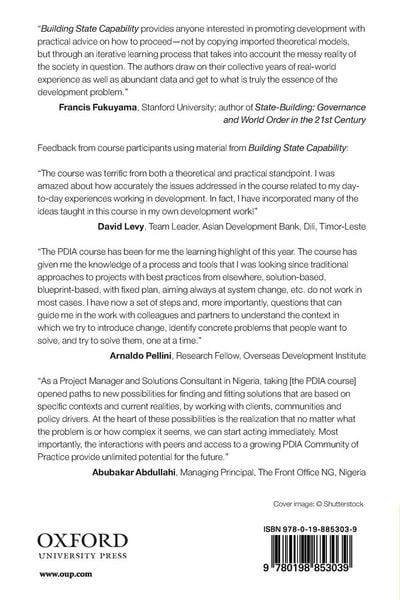
Building State Capability Evidence, Analysis, Action

53,99 €

inkl. gesetzl. MwSt., Versandkostenfrei


Beschreibung

Governments play a major role in the development process, and constantly introduce reforms and policies to achieve developmental objectives. Many of these interventions have limited impact, however; schools get built but children don't learn, IT systems are introduced but not used, plans are written...

Beschreibung

Governments play a major role in the development process, and constantly introduce reforms and policies to achieve developmental objectives. Many of these interventions have limited impact, however; schools get built but children don't learn, IT systems are introduced but not used, plans are written but not implemented. These achievement deficiencies reveal gaps in capabilities, and weaknesses in the process of building state capability. This book addresses these weaknesses and gaps. It starts by providing evidence of the capability shortfalls that currently exist in many countries, showing that many governments lack basic capacities even after decades of reforms and capacity building efforts. The book then analyses this evidence, identifying capability traps that hold many governments back - particularly related to isomorphic mimicry (where governments copy best practice solutions from other countries that make them look more capable even if they are not more capable) and premature load bearing (where governments adopt new mechanisms that they cannot actually make work, given weak extant capacities). The book then describes a process that governments can use to escape these capability traps. Called PDIA (problem driven iterative adaptation), this process empowers people working in governments to find and fit solutions to the problems they face. The discussion about this process is structured in a practical manner so that readers can actually apply tools and ideas to the capability challenges they face in their own contexts. These applications will help readers devise policies and reforms that have more impact than those of the past.

Produktdetails

Einband

Taschenbuch

Erscheinungsdatum

05.02.2020

Abbildungen

27 Figures, 25 Tables, 6 Boxes

Verlag Oxford Academic

Produktdetails

Einband

Taschenbuch

Erscheinungsdatum

05.02.2020

Abbildungen

27 Figures, 25 Tables, 6 Boxes

Verlag Oxford Academic
Seitenzahl

278

Maße (L/B/H)

23,4/15,6/1,5 cm

Gewicht

427 g

Sprache

Englisch

ISBN

978-0-19-885303-9

Herstelleradresse

Libri GmbH
Europaallee 1
36244 Bad Hersfeld
DE

Email: gpsr@libri.de

Noch keine Bewertungen vorhanden

Verfassen Sie die erste Bewertung zu diesem Artikel

Helfen Sie anderen Kundinnen und Kunden durch Ihre Meinung.

Kundinnen und Kunden meinen

Bewertungen (0)

Die Leseprobe wird geladen.
  • Produktbild: Building State Capability
  • Produktbild: Building State Capability
    • Introduction: 'The Long Voyage of Discovery'
    • Part 1. The Problem: The Creation and Consolidation of Capability Traps
    • 1: The Big Stuck in State Capability
    • 2: Looking Like a State: The Seduction of Isomorphic Mimicry
    • 3: Premature Load Bearing: Doing Too Much Too Soon
    • 4: Capability for Policy Implementation
    • 5: What Type of Organization Capability is Needed?
    • Part 2. A Strategy for Action: Problem-Driven Iterative Adaptation (PDIA)
    • 6: The Challenge of Building (Real) State Capability for Implementation
    • 7: Doing Problem-Driven Work
    • 8: The Searchframe: Doing Experimental Iterations
    • 9: Managing Your Authorizing Environment
    • 10: Building State Capability at Scale Through Groups