Gutscheinbedingungen

**Gültig bis 17.08.2026 auf Schreibwaren & Office-Artikel online auf thalia.at, in der Thalia App und in teilnehmenden Thalia Buchhandlungen in Österreich mit Schulsortiment. In den Buchhandlungen nur gültig auf lagernde Ware. Einzelne Artikel können ausgeschlossen sein. Ausgenommen sind preisgebundene Artikel. Pro Einkauf einmal einlösbar. Nur gültig gegen Vorlage oder im Onlineshop hinterlegter Bonuscard. Infos zur Einlösung in der Buchhandlung sind auf der Bonuscard-Vorteilspreisseite zu finden. Click & Collect nur bei Onlinevorabzahlung möglich. Keine Einlösung bei Scan & Go-Bezahlung. Keine Barauszahlung. Nicht kombinierbar mit anderen Aktionen und Gutscheinen. Gutschein wird auf max. 500€ Bestellwert angerechnet. Nicht gültig für Geschenkkarten, Versandkosten und Services.

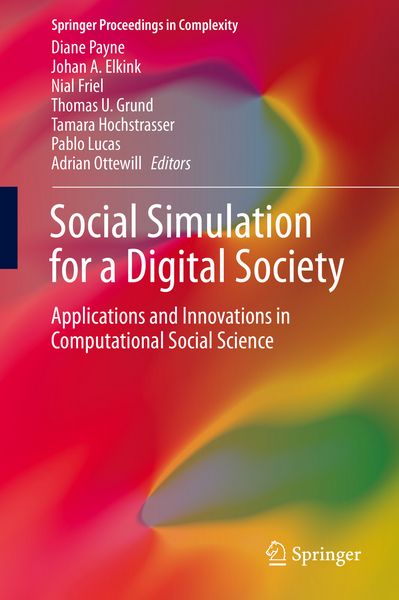
  • Produktbild: Social Simulation for a Digital Society
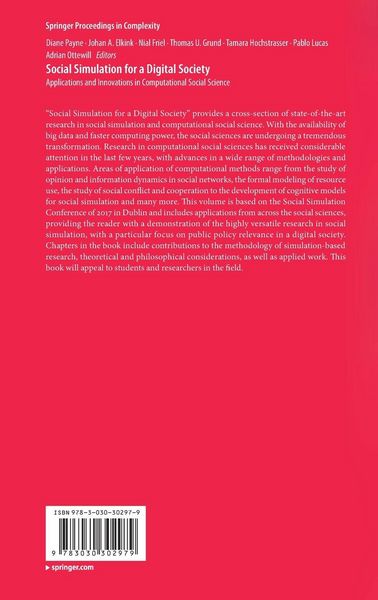
  • Produktbild: Social Simulation for a Digital Society

Social Simulation for a Digital Society Applications and Innovations in Computational Social Science

99,99 €

inkl. gesetzl. MwSt., Versandkostenfrei


Beschreibung

Produktdetails

Einband

Gebundene Ausgabe

Erscheinungsdatum

02.12.2019

Abbildungen

VIII, 218 p. 58 illus., 37 illus. in color.

Herausgeber

Diane Payne + weitere

Verlag

Springer

Seitenzahl

218

Maße (L/B/H)

24,1/16/1,8 cm

Gewicht

512 g

Auflage

19001 Auflage 1st edition 2019

Sprache

Englisch

ISBN

978-3-030-30297-9

Beschreibung

Portrait


Diane Payne
was Associate Professor in Sociology and director of the Dynamics Lab for Computational Social Science at University College Dublin. She obtained her PhD from the University of Groningen and held positions at University of Cambridge and Trinity College Dublin before. Diane passed away in April 2019.

Johan A. Elkink
is Associate Professor in Social Science Research Methods at University College Dublin. He specialises in quantitative methods in political science, in particular simulation-based research and spatial econometrics. Besides applications in voting behaviour in referendums and national elections, he wrote on the international diffusion of democracy and the evolution of personalist regimes. His work appeared, among other outlets, in the Journal of Politics, Comparative Political Studies, European Journal of Political Research and Electoral Studies.


Nial Friel
is Professor of Statistics at University College Dublin. His research is broadly focused on statistical network analysis, Bayesian statistics and Monte Carlo methods. He is especially interested in applications at the interface of these areas. He is currently the joint editor of the Journal of the Royal Statistical Society, Series C.


Thomas U. Grund
is Associate Professor in Sociology at University College Dublin and was Visiting Professor at the Institute of Sociology at University of Zurich and Simon Visiting Professor at the University of Manchester. He studied computer science and sociology at the University of Trier (Diplom), University of Cambridge (MPhil) and the University of Oxford (DPhil) and held postdoctoral positions at ETH Zurich, Universite de Montreal and Linkoping University. His main research interests include social network analysis and analytical sociology.


Tamara Hochstrasser
is an ecologist. For her doctoral research she has developed an individual-based vegetation model. Since joining UniversityCollege Dublin in 2003, she has contributed to research on modelling of greenhouse gas emissions from agricultural land, ecosystem services and biodiversity management in urban areas. Tamara is convinced that a transdisciplinary approach is needed for creating an effective evidence-base for decisions making. Some of her theoretical considerations about transdisciplinary research are captured in an agent-based model and in a course manual on knowledge creation at the science-practice interface that she uses for teaching and intends to publish.


Pablo Lucas
is a Lecturer at the University College Dublin, Ireland, with research focused on computational social science, particularly experimental designs using agent-based models and data analysis. His education include reading for a Bachelor of Science in Computer Science (BSc) focused on evolutionary networks, a Master of Philosophy (MPhil) and a Doctor of Philosophy(PhD) focused on agent-based (social) simulations using models of social behaviour.


Adrian Ottewill
is Full Professor of Mathematical Physics and has been a strong supporter of Computational Social Science research at UCD through his roles as Cluster Leader for Simulation Science of the UCD Complex and Adaptive Systems Laboratory and founding Director of the UCD Institute for Discovery.  Prof Ottewill holds a BA, DPhil and DSc from the University of Oxford and was elected a Member of the Royal Irish Academy in 1997.

Produktdetails

Einband

Gebundene Ausgabe

Erscheinungsdatum

02.12.2019

Abbildungen

VIII, 218 p. 58 illus., 37 illus. in color.

Herausgeber

Verlag

Springer

Seitenzahl

218

Maße (L/B/H)

24,1/16/1,8 cm

Gewicht

512 g

Auflage

19001 Auflage 1st edition 2019

Sprache

Englisch

ISBN

978-3-030-30297-9

Herstelleradresse

Springer-Verlag GmbH
Tiergartenstr. 17
69121 Heidelberg
DE

Email: GPSR Kontakt

Noch keine Bewertungen vorhanden

Verfassen Sie die erste Bewertung zu diesem Artikel

Helfen Sie anderen Kundinnen und Kunden durch Ihre Meinung.

Kundinnen und Kunden meinen

Bewertungen (0)

  • Produktbild: Social Simulation for a Digital Society
  • Produktbild: Social Simulation for a Digital Society

  • Chapter 1: Social Simulation for a Digital Society: Introduction


    Philosophical and technical considerations


    Chapter 2: Ontological Politics in a World of Political Ontologies: More Realistic (Human) Agents for the Anthropocene?


    Chapter 3: The Art of Iterating: Update-Strategies in Agent-Based Simulation


    Chapter 4: Using Parallel Computing to Improve the Scalability of Models with BDI Agents


    Applications to norm diffusion and collective action


    Chapter 5: Information Diffusion as a Mechanism for Natural Evolution of Social Networks


    Chapter 6: Remarks on the Convergence of Opinion Formation in the Presence of Self-interest and Conformity


    Chapter 7: Inequality: Driver or Inhibitor of Collective Action?


    Chapter 8: The Venezuelan System of Potato Production: A Simulation Model to Understand Roots of Deficiencies


    Applications in geographyand urban development


    Chapter 9: Governance of Transitions: A Simulation Experiment on Urban Transportation


    Chapter 10: Evaluating the Impact of an Integrated Urban Design of Transport Infrastructure and Public Space on Human Behavior and Environmental Quality: A Case Study in Beijing


    Chapter 11: Prescription for Urban Sprawl: Street Activeness Changes the City


    Chapter 12: The Greater Dublin Region, Ireland:  Experiences in Applying Urban Modelling in Regional Planning and Engaging between Scientists and Stakeholders


    Chapter 13: Synthesising the Geography of Opportunity in Rural Irish Primary Schools


    Chapter 14: Modelling Collaborative Knowledge Creation Processes: An Empirical Application to the Semiconductor Industry