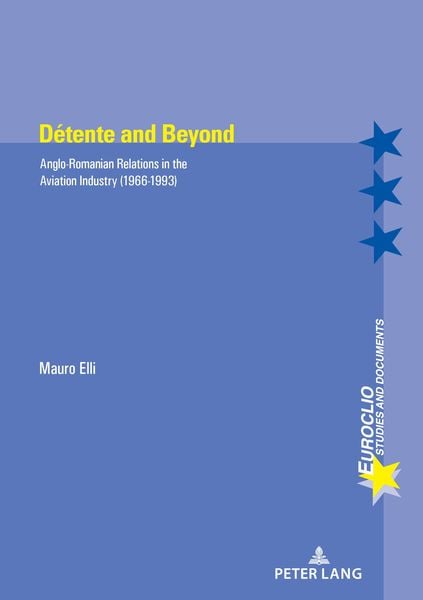
Détente and Beyond Anglo-Romanian Relations in the Aviation Industry (1966-1993)
-
- Taschenbuch
- eBook ausgewählt
-
Form:Einzelkauf Download
-
Sprache:Englisch
-
eBook Format:ePUB
- PDF 71,50 €
- ePUB 71,50 € ausgewählt
71,50 €
inkl. gesetzl. MwSt.Beschreibung
Produktdetails
Format
ePUB
Kopierschutz
Ja
Family Sharing
Nein
Text-to-Speech
Ja
Erscheinungsdatum
26.03.2018
Verlag
P.I.E-Peter Lang S.A., Éditions Scientifiques InternationalesSeitenzahl
274 (Printausgabe)
Dateigröße
361 KB
Auflage
1. Auflage
Sprache
Englisch
EAN
9782807606760
By the mid-1960s, the whole European aviation industry had begun looking at two main solutions in order to survive competition from the USA: European cooperation, and exports to markets still closed to the Americans. Against this background, Anglo-Romanian dealings in the aviation industry over a period of almost thirty years are a case of converging politico-military interests with major interpretative potential. This holds true for the history of East-West relations and infra-Western commercial competition, but also for the transformation of domestic decision-making patterns and the change in economic priorities. While Britain became Romania's first commercial partner in order to offer a new outlet to the aviation industry, Bucharest was looking at the U.K. to pursue a strategy of industrial modernisation and political visibility. The story of their intersection sheds light on the lower-level reality of Détente in Europe. The degree of collaboration across the Iron Curtain was not just the product of a generally improved diplomatic atmosphere, but - at least in the present case - the result of a peculiar mixture of political ambition, economic viability, and technological expertise. Indeed, the change of economic paradigm in the UK (from Neo-Keynesianism to monetarist Neo-Liberalism), along with President Ceausescu's fixation with foreign debt, played a crucial role in the vicissitudes of Anglo-Romanian relations in the aviation industry in the period between the demise of Détente and the end of the Cold War. This points to a reasonably articulated model, which is hinged on the category of 'transfer', rather than on the category of 'cooperation'.
Noch keine Bewertungen vorhanden
Verfassen Sie die erste Bewertung zu diesem Artikel
Helfen Sie anderen Kundinnen und Kunden durch Ihre Meinung.
Kurze Frage zu unserer Seite
Vielen Dank für Ihr Feedback
Wir nutzen Ihr Feedback, um unsere Produktseiten zu verbessern. Bitte haben Sie Verständnis, dass wir Ihnen keine Rückmeldung geben können. Falls Sie Kontakt mit uns aufnehmen möchten, können Sie sich aber gerne an unseren Kund*innenservice wenden.
zum Kundenservice